 Back
BackChapter 29: Relativity – Study Notes for General Physics II
Study Guide - Smart Notes
 Tailored notes based on your materials, expanded with key definitions, examples, and context.
Relativity
Introduction to Relativity
The theory of relativity revolutionized our understanding of space and time, especially at high velocities. It distinguishes between Galilean relativity (valid at low speeds) and Einstein's relativity (necessary at speeds approaching the speed of light). Relativity is divided into two branches: Special Relativity (constant relative speeds, inertial frames) and General Relativity (accelerating frames, gravity).
Galilean Relativity: No observable difference in measurements between two observers at low speeds.
Special Relativity: Applies to inertial reference frames (constant velocity).
General Relativity: Extends to non-inertial reference frames (accelerating).
Applications: GPS systems require relativistic corrections for accurate positioning.
Relativity in Electromagnetism
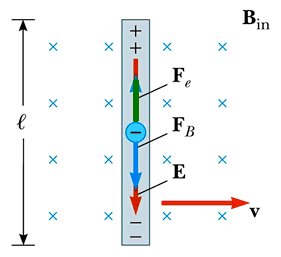
Physical phenomena should be consistent across reference frames. Classical mechanics cannot explain certain electromagnetic effects observed in moving conductors, but special relativity provides the necessary framework.
Reference Frame of Earth: Moving conductor experiences magnetic force, causing charge separation and an internal electric field.
Reference Frame of Conductor: No movement, no magnetic force, no charge separation, and no internal electric field.
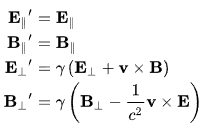
Relativistic Electromagnetism: Electric and magnetic fields transform between reference frames according to the Lorentz transformation.
Michelson-Morley Experiment and the Ether Hypothesis
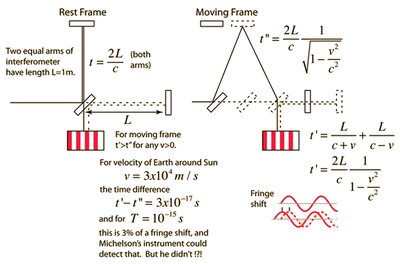
The Michelson-Morley experiment tested the existence of the 'ether' as a medium for light propagation. The experiment found no difference in the speed of light in different directions, disproving the ether hypothesis and supporting the constancy of the speed of light.
Setup: Interference between light rays transverse and longitudinal to Earth's motion.
Result: No phase difference observed; speed of light is independent of observer.
Postulates of Special Relativity
Einstein's Two Postulates
Special relativity is founded on two key postulates:
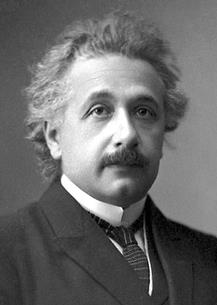
Postulate 1 – Equivalence of Physical Laws: The laws of physics are the same in all inertial frames of reference.
Postulate 2 – Constancy of Speed of Light: The speed of light in vacuum ( m/s) is the same in all inertial frames, regardless of the motion of the source or observer.
Implications: The speed of light is the maximum speed in the universe; absolute rest or motion cannot be detected, only relative motion.
Relativistic Addition of Velocities
Classical mechanics predicts that velocities simply add, but this contradicts the second postulate of relativity. Relativistic velocity addition ensures that the speed of light remains constant.
Classical Example: Arrow shot from a moving train: .
Relativistic Example: Laser shot from a moving train: (speed of light remains ).
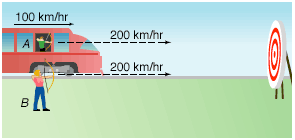
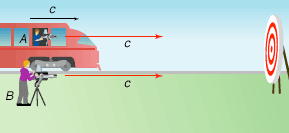
Relativity of Time: Time Dilation
Time Dilation
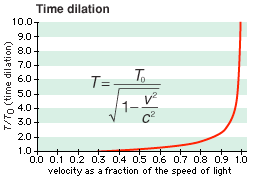
Time intervals between events depend on the observer's frame of reference. Moving clocks run slower compared to stationary ones.
Proper Time (): Time measured by an observer at rest relative to the events.
Observed Time (): Time measured by a moving observer.
Formula:
Remark: The faster the observer, the larger the measured duration.
Examples and Applications
Light Clock: Light bouncing between two mirrors moving at speed demonstrates time dilation.
Twin Paradox: One twin travels at high speed, the other remains on Earth; the traveling twin ages slower.
Simultaneity: Events simultaneous in one frame may not be simultaneous in another.

Relativity of Space: Length Contraction
Length Contraction
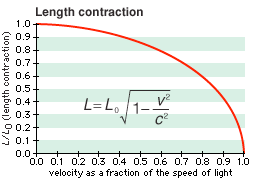
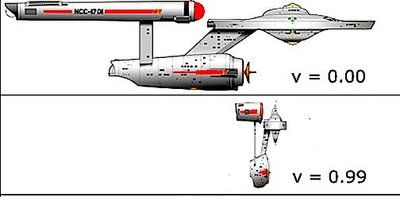
Objects moving at high speeds appear shorter in the direction of motion to a stationary observer. Lengths perpendicular to the direction of motion are unaffected.
Proper Length (): Length measured by an observer at rest relative to the object.
Observed Length (): Length measured by a moving observer.
Formula:
Remark: The larger the speed, the shorter the length.
Examples and Applications
Spaceship Example: A spaceship at rest has its proper length; when moving, its length contracts as observed from Earth.
Relativistic Mass, Momentum, and Energy
Relativistic Mass and Momentum
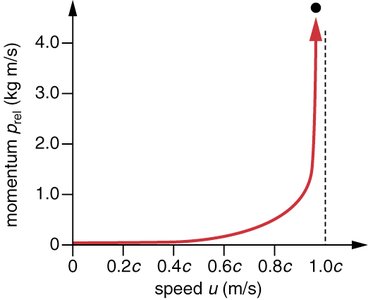
At high speeds, mass and momentum are no longer constant. The relativistic mass increases with velocity, and momentum is calculated using this mass.
Rest Mass (): Mass of an object at rest.
Relativistic Mass ():
Relativistic Momentum:
Conservation of Momentum: Still applies, but uses relativistic mass.
Relativistic Energy
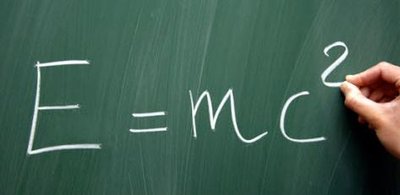
Special relativity introduces new concepts of energy, including total energy and rest energy. Mass and energy are interchangeable.
Total Energy:
Rest Energy:
Relativistic Kinetic Energy:
At low velocities: Classical kinetic energy is recovered.
General Relativity
Principle of Equivalence and Curved Space-Time
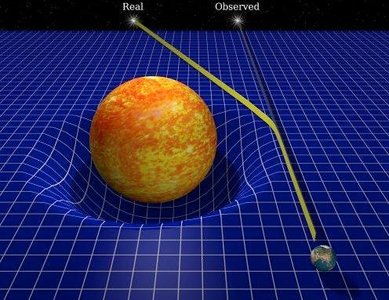
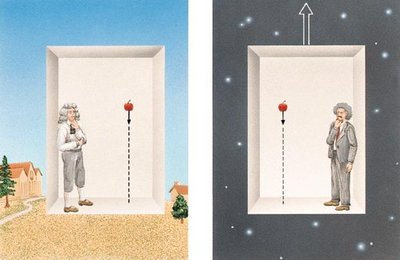
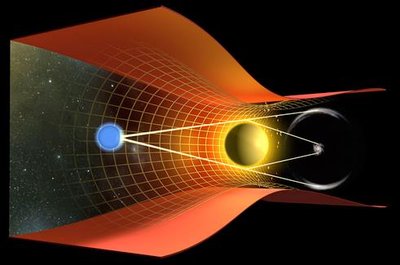
General relativity extends special relativity to accelerated frames and gravity. The principle of equivalence states that experiments in a uniform gravitational field and in an accelerated frame yield identical results. Massive objects curve space-time, affecting the path of light and matter.
Space-Time Curvature: Gravity is interpreted as the curvature of space-time around massive objects.
Schwarzschild Radius: Defines the radius of a black hole.
Predictions: Gravitational lensing, black holes, gravitational waves.
Summary of Key Concepts
Postulate 1: Laws of physics are the same in all inertial frames.
Postulate 2: Speed of light is constant in all inertial frames.
Time Dilation:
Length Contraction:
Relativistic Mass:
Relativistic Energy:
General Relativity: Space-time is curved by mass; principle of equivalence.
