 Back
Chapter 3: Vectors and Coordinate Systems – Study Notes
Study Guide - Smart Notes
 Tailored notes based on your materials, expanded with key definitions, examples, and context.
Vectors and Coordinate Systems
Definition and Properties of Vectors
Vectors are fundamental mathematical objects in physics, representing quantities that possess both magnitude and direction. Unlike scalars, which are fully described by a single number (such as mass or temperature), vectors require both a numerical value and a directional component.
Vector Quantity: A quantity with both magnitude and direction (e.g., displacement, velocity, force).
Scalar Quantity: A quantity described only by magnitude (e.g., mass, temperature).
Geometric Representation: Vectors are depicted as arrows; the length represents magnitude, and the arrow points in the direction.
Notation: Vectors are denoted with an arrow above the letter, such as for position or for velocity.
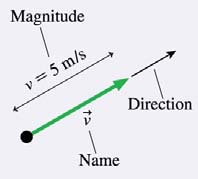
Example: The velocity vector has a magnitude (e.g., 5 m/s) and a direction, as shown in the diagram.
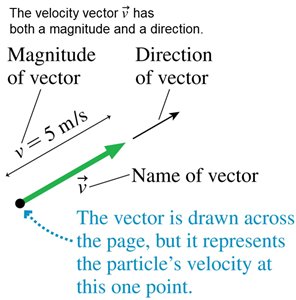
Additional info: Vectors are used to describe physical quantities such as position, displacement, velocity, acceleration, force, and momentum.
Equality and Properties of Vectors
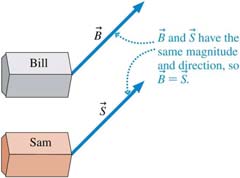
Two vectors are considered equal if they have the same magnitude and direction, regardless of their initial points.
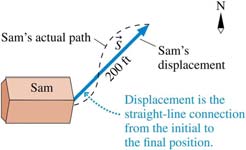
Displacement Example: If Sam and Bill both walk 200 ft northeast from their respective starting points, their displacement vectors are equal.
Magnitude: The length of the vector, representing the size of the quantity.
Direction: The orientation of the vector in space.
Vector Addition and Subtraction
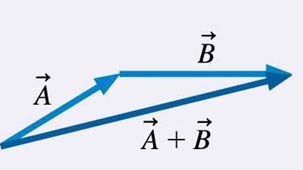
Vector addition is performed using the tip-to-tail method, where the tail of one vector is placed at the tip of another. The resultant vector is drawn from the tail of the first to the tip of the last. Subtraction is achieved by adding the negative of a vector.
Tip-to-Tail Rule: Place the tail of at the tip of ; is the vector from the tail of $\vec{A}$ to the tip of $\vec{B}$.
Order Independence: The order of addition does not affect the result.
Subtraction: ; has the same magnitude as but points in the opposite direction.
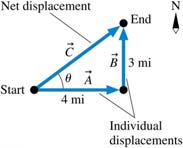
Example: A hiker walks 4 miles east () and 3 miles north (). The net displacement is found using the Pythagorean theorem:
Direction: north of east
Graphical and Algebraic Vector Addition
Vectors can be added graphically or algebraically. Graphical addition is useful for visualizing the result, while algebraic addition is more precise and efficient for calculations.
Law of Cosines: Used when vectors are not at right angles.
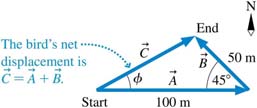
Example: A bird flies 100 m east () and 50 m northwest (, 45° north of west). The net displacement is found using:
Direction can be found using the law of cosines:
Parallelogram Rule for Vector Addition
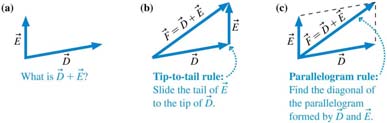
When two vectors are placed with their tails together, the resultant vector can be found as the diagonal of the parallelogram formed by the two vectors.
Tip-to-Tail Rule: Slide the tail of one vector to the tip of the other.
Parallelogram Rule: The diagonal represents the sum of the two vectors.
Addition of More Than Two Vectors
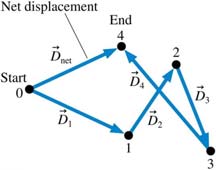
Vector addition can be extended to more than two vectors by successive application of the tip-to-tail method. The net displacement is the vector sum of all individual displacements.
Example: A hiker moves through four segments, each described by a displacement vector. The net displacement is .
Unit Vectors and Coordinate Systems
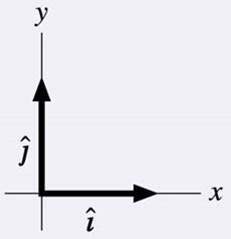
Unit vectors are used to define directions in space. In a Cartesian coordinate system, the unit vectors and point in the positive x- and y-directions, respectively.
Unit Vector: A vector with magnitude 1 and no units, used to specify direction.
Coordinate System: An artificial grid imposed on a problem; the origin and orientation of axes can be chosen freely.
Quadrants: The xy-plane is divided into four quadrants.

Vector Components and Decomposition
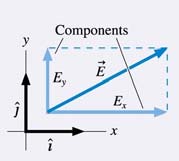
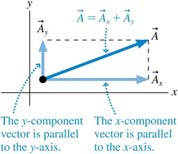
Any vector can be decomposed into components parallel to the coordinate axes. This simplifies calculations and allows vector math to be performed algebraically.
Component Vectors: and are parallel to the x- and y-axes, respectively.
Decomposition:
Magnitude of Components: ,
Signs: Minus signs are used if the vector points left or down.
Algebraic Vector Calculations
Vector calculations are performed component by component. The magnitude and direction of the resultant vector can be found using algebraic methods.
Addition: implies ,
Magnitude:
Direction:
Summary Table: Vector Properties and Operations
Property/Operation | Description | Formula |
|---|---|---|
Magnitude | Length of vector | |
Direction | Angle with respect to axis | |
Addition | Tip-to-tail or parallelogram rule | |
Subtraction | Add negative vector | |
Components | Parallel to axes | , |
Unit Vectors | Direction only | (x-axis), (y-axis) |
Applications of Vectors in Physics
Vectors are used throughout physics and engineering, including in the analysis of motion, forces, electric fields, and fluid flows. Mastery of vector operations is essential for solving problems in these areas.
Additional info: The techniques learned in this chapter are foundational for all subsequent topics in Physics with Calculus.
