 Back
BackChapter 3: Vectors and Coordinate Systems – Structured Study Notes
Study Guide - Smart Notes
 Tailored notes based on your materials, expanded with key definitions, examples, and context.
Vectors and Coordinate Systems
Introduction to Vectors
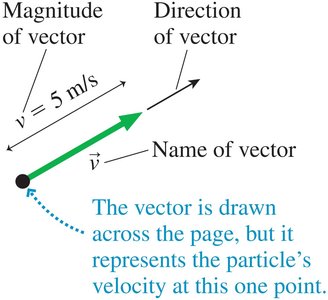
Vectors are fundamental mathematical objects in physics, representing quantities that have both magnitude and direction. They are used to describe physical phenomena such as displacement, velocity, and force.
Definition: A vector is a quantity characterized by both a magnitude (length) and a direction.
Notation: Vectors are typically denoted with an arrow above the symbol, e.g., \( \vec{v} \).
Examples: Displacement, velocity, acceleration, and force are all vector quantities.
Displacement Vectors
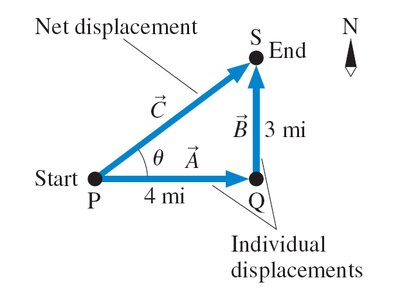
Displacement vectors represent the change in position of an object. The net displacement is the vector sum of individual displacements.
Displacement: The straight-line distance and direction from the initial to the final position.
Vector Addition: Displacement vectors can be added to find the net displacement.
Vector Components and Coordinate Systems
Components of a Vector
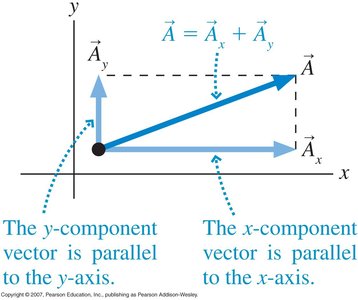
Any vector in a plane can be decomposed into components along the x- and y-axes. This decomposition is essential for calculations in physics.
Component Vectors: The x-component is parallel to the x-axis, and the y-component is parallel to the y-axis.
Vector Decomposition: \( \vec{A} = \vec{A}_x + \vec{A}_y \)
Mathematical Representation: \( \vec{A} = A_x \hat{i} + A_y \hat{j} \)
Determining Vector Components
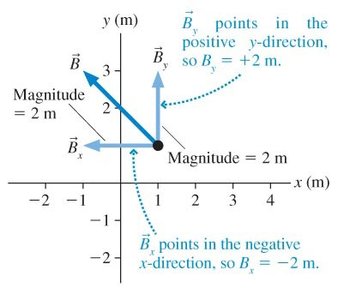
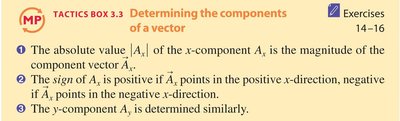
The magnitude and sign of each component depend on the vector's direction relative to the axes.
Magnitude: The absolute value of the component (e.g., \( |A_x| \)).
Sign: Positive if the component points in the positive axis direction, negative otherwise.
Formula:
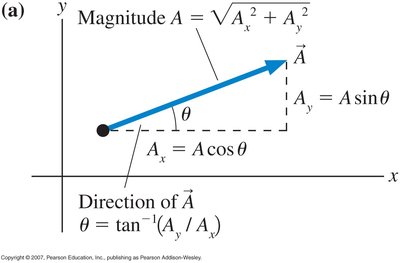
\( A_x = A \cos \theta \)
\( A_y = A \sin \theta \)
\( A = \sqrt{A_x^2 + A_y^2} \)
\( \theta = \tan^{-1}(A_y / A_x) \)
Unit Vectors
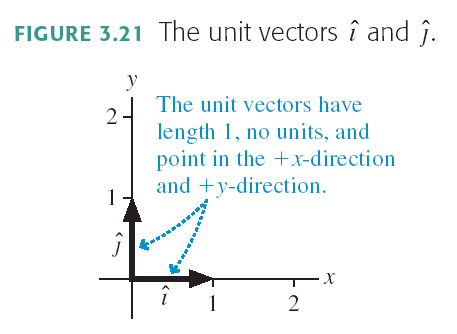
Unit vectors are used to specify direction in a coordinate system. They have a magnitude of 1 and no units.
Definition:
\( \hat{i} \): Unit vector in the +x direction
\( \hat{j} \): Unit vector in the +y direction
Usage: Any vector can be written as \( \vec{A} = A_x \hat{i} + A_y \hat{j} \).
Magnitude and Direction of a Vector
The magnitude and direction of a vector can be calculated from its components using trigonometric relationships.
Magnitude: \( A = \sqrt{A_x^2 + A_y^2} \)
Direction: \( \theta = \tan^{-1}(A_y / A_x) \)
Vector Algebra
Vector Addition
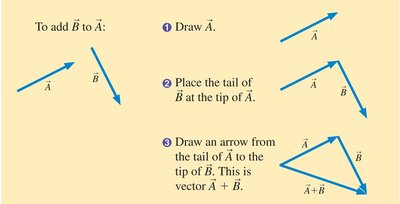
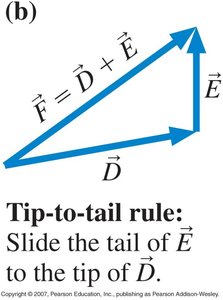
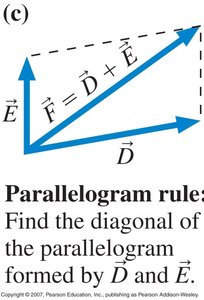
Vectors can be added graphically or algebraically. The two main graphical methods are the tip-to-tail rule and the parallelogram rule.
Tip-to-Tail Rule: Place the tail of the second vector at the tip of the first; the resultant vector is drawn from the tail of the first to the tip of the second.
Parallelogram Rule: The resultant vector is the diagonal of the parallelogram formed by the two vectors.
Algebraic Addition: Add corresponding components: \( \vec{C} = \vec{A} + \vec{B} \) means \( C_x = A_x + B_x \), \( C_y = A_y + B_y \).
Vector Subtraction
Vector subtraction is performed by adding the negative of the vector to be subtracted.
Operation: \( \vec{A} - \vec{B} = \vec{A} + (-\vec{B}) \)
Graphical Representation: Reverse the direction of the vector being subtracted and apply the tip-to-tail rule.
Multiplying Vectors by Scalars
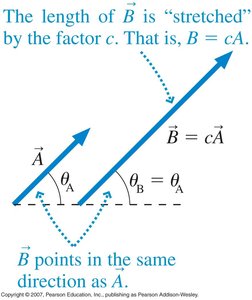
Multiplying a vector by a scalar changes its magnitude but not its direction.
Formula: \( \vec{B} = c \vec{A} \), where \( c \) is a scalar.
Result: The new vector points in the same direction as the original, but its length is scaled by \( c \).
Applications and Examples
Velocity and Displacement Example
Problems involving vectors often require calculation of net displacement or velocity using vector addition.
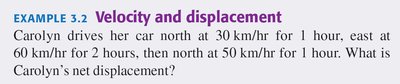
Example: Carolyn drives her car north at 30 km/hr for 1 hour, east at 60 km/hr for 2 hours, then north at 50 km/hr for 1 hour. The net displacement is found by adding the individual displacement vectors.
Finding Components of Acceleration
To find the x- and y-components of an acceleration vector, use trigonometric relationships based on the vector's orientation.
Example: Given an acceleration vector \( \vec{a} \) at an angle \( \theta \), calculate \( a_x \) and \( a_y \) using \( a_x = a \cos \theta \), \( a_y = a \sin \theta \).
Working with Unit Vectors and Tilted Axes
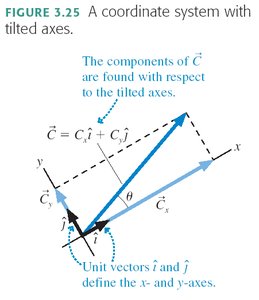
Unit vectors are used to express vector components in any coordinate system, including systems with tilted axes.
Decomposition: \( \vec{C} = C_x \hat{i} + C_y \hat{j} \), where \( \hat{i} \) and \( \hat{j} \) define the axes.
Tilted Axes: Components are found with respect to the new axes defined by the unit vectors.
Summary Table: Vector Properties and Operations
Operation | Formula | Result |
|---|---|---|
Vector Addition | \( \vec{C} = \vec{A} + \vec{B} \) | Sum of two vectors |
Vector Subtraction | \( \vec{A} - \vec{B} \) | Difference of two vectors |
Scalar Multiplication | \( \vec{B} = c \vec{A} \) | Vector with scaled magnitude |
Component Form | \( \vec{A} = A_x \hat{i} + A_y \hat{j} \) | Vector expressed in terms of unit vectors |
Magnitude | \( A = \sqrt{A_x^2 + A_y^2} \) | Length of vector |
Direction | \( \theta = \tan^{-1}(A_y / A_x) \) | Angle with respect to x-axis |
Key Concepts Recap
Vectors represent quantities with magnitude and direction.
Components allow vectors to be analyzed in terms of axes.
Unit vectors define directions in coordinate systems.
Vector algebra includes addition, subtraction, and scalar multiplication.
Applications include displacement, velocity, and acceleration problems.
Additional info: Academic context was added to clarify vector operations, component determination, and applications, ensuring completeness and self-contained explanations for exam preparation.
