 Back
BackChapter 34: Nuclear Fission and Fusion – Study Notes
Study Guide - Smart Notes
 Tailored notes based on your materials, expanded with key definitions, examples, and context.
Chapter 34: Nuclear Fission and Fusion
Introduction
This chapter explores the fundamental processes of nuclear fission and nuclear fusion, their discovery, mechanisms, technological applications, and their significance in energy production and astrophysics. The chapter also discusses mass–energy equivalence and the challenges and prospects of harnessing nuclear energy.
Discovery of Nuclear Fission
Historical Background
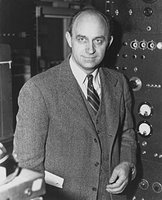
1934, Rome: Enrico Fermi and his team began bombarding uranium with neutrons, aiming to create transuranium elements.
1935, Berlin: Lise Meitner and Otto Hahn started similar experiments, later joined by Otto Frisch for theoretical interpretation.
1938: Discovery that neutron bombardment of uranium-235 produced elements chemically similar to barium, much lighter than uranium, leading to the realization that the uranium nucleus had split.
The process was named nuclear fission.
Meitner and Frisch provided the theoretical explanation, while Hahn published the experimental results.


Key Insights
It was previously believed that nuclear changes occurred only in small steps.
The discovery of fission showed that a heavy nucleus could split into two lighter nuclei, releasing enormous energy.
Nuclear Fission: Mechanism and Energy Release
Forces in the Nucleus
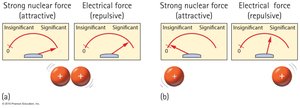
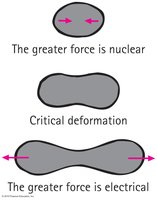
The strong nuclear force holds nucleons (protons and neutrons) together at short distances.
If protons are separated enough, the electrical repulsion can overcome the strong force, causing the nucleus to split (fission).
Fission Reaction Example
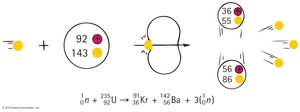
A typical induced fission reaction for uranium-235:
Energy Release in Fission
Fragments are repelled at high speeds, carrying about 200 MeV of kinetic energy.
Some energy is released as kinetic energy of neutrons and gamma radiation.
Fission of uranium-235 releases about 200,000,000 eV per event, compared to 3–4 eV for a TNT molecule.
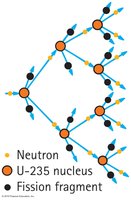
Chain Reaction
A chain reaction occurs when the neutrons produced by one fission event induce further fission events.
Critical Mass
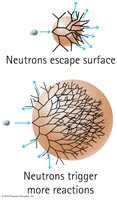
Critical mass: The minimum mass of fissile material needed for a self-sustaining chain reaction.
Subcritical: Reaction fizzles out; Supercritical: Reaction grows explosively.
Isotopes and Fission
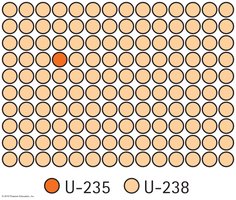
Not all uranium isotopes are fissile; U-235 is, but U-238 is not.
Most neutrons in natural uranium are absorbed by U-238, not causing fission.
Harnessing Nuclear Fission Power
Reactors and Moderators
Reactors use moderators (like graphite) to slow down neutrons, increasing the probability of fission in U-235.
German scientists used heavy water, which was less effective and less available, contributing to the failure of their nuclear program.
Fission Bombs
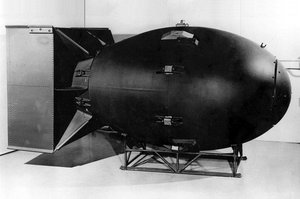
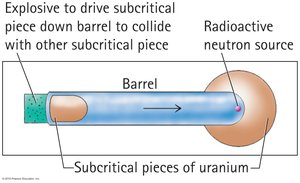
Atomic bombs (e.g., Little Boy and Fat Man) used fission of uranium or plutonium.
Enrichment increases the percentage of U-235 for weapons or reactor fuel.
Nuclear Fission Reactors
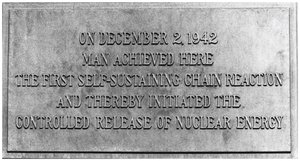
First reactor built under University of Chicago’s Stagg Field, supervised by Enrico Fermi.
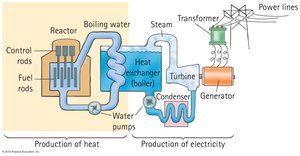
Reactors generate heat to boil water, producing steam to drive turbines and generate electricity.
Key components: nuclear fuel, control rods, moderator, heat-extracting fluid.
Reactor Safety and Accidents
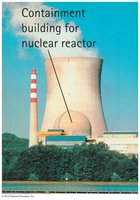
Heat must be removed efficiently to prevent meltdown.
Major accidents: Chernobyl (1986), Fukushima (2011).
Breeder Reactors
Breeder reactors convert U-238 into fissile Pu-239, which can be used as fuel.

Pros and Cons of Fission Power
Benefits: Plentiful electricity, conserves fossil fuels, reduces CO2 emissions.
Drawbacks: Radioactive waste, risk of accidents, potential for weaponization.
Mass–Energy Equivalence
Einstein’s Equation
Mass is a form of potential energy, as described by Einstein’s equation:
During fission, the total mass of the products is less than the original nucleus; the difference is released as energy.
This mass difference is called the mass defect and is equivalent to the binding energy of the nucleus.
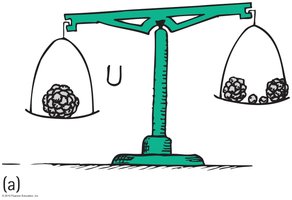
Binding Energy and Mass per Nucleon
The binding energy is the energy required to separate a nucleus into its individual nucleons.
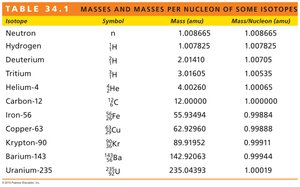
Mass per nucleon decreases as nucleons bind together, releasing energy.
Energy Released in Fission
Fission of uranium-235 releases about 200 MeV per event, 7 million times more than a TNT molecule.
Nuclear Fusion
Fusion Process
Nuclear fusion: Two or more light nuclei combine to form a heavier nucleus, releasing energy.
Fusion converts a higher percentage of mass to energy than fission (up to 0.7%).

Conditions for Fusion
High temperatures are required to overcome the electrical repulsion between nuclei (thermonuclear fusion).
Occurs naturally in stars, including the Sun.
Nucleosynthesis
Big Bang nucleosynthesis: Formation of light elements (H, He, Li) in the early universe.
Stellar nucleosynthesis: Fusion in stars creates heavier elements up to iron.
Supernova nucleosynthesis: Creation of the heaviest elements during supernova explosions.
Cosmic ray spallation: High-energy cosmic rays break nuclei into lighter elements.
Neutron star mergers: Produce very heavy elements like gold and platinum.
Controlling Fusion
Fusion on Earth requires extremely high temperatures, achieved in hydrogen bombs using a fission trigger.
Fusion reactors (magnetic and inertial confinement) are under development but have not yet achieved net energy gain.
Fusion fuel (hydrogen) is abundant, and the main byproduct is nonradioactive helium.
Summary Table: Masses and Masses per Nucleon of Some Isotopes
Isotope | Symbol | Mass (amu) | Mass/Nucleon (amu) |
|---|---|---|---|
Neutron | n | 1.008665 | 1.008665 |
Hydrogen | ^1H | 1.007825 | 1.007825 |
Deuterium | ^2H | 2.01410 | 1.00705 |
Tritium | ^3H | 3.01605 | 1.00535 |
Helium-4 | ^4He | 4.00260 | 1.00065 |
Carbon-12 | ^12C | 12.00000 | 1.00000 |
Iron-56 | ^56Fe | 55.93494 | 0.99884 |
Copper-63 | ^63Cu | 62.92960 | 0.99888 |
Krypton-90 | ^90Kr | 89.91951 | 0.99911 |
Barium-143 | ^143Ba | 142.92065 | 0.99945 |
Uranium-235 | ^235U | 235.04393 | 1.00109 |
Conclusion
Nuclear fission and fusion are powerful processes that release vast amounts of energy by converting mass into energy, as described by Einstein’s equation. Fission is currently used in nuclear reactors and weapons, while fusion powers stars and holds promise for future energy production. Understanding these processes is crucial for both technological advancement and addressing global energy needs.
