 Back
Chapter 4: Forces and Newton’s Laws of Motion – Structured Study Notes
Study Guide - Smart Notes
 Tailored notes based on your materials, expanded with key definitions, examples, and context.
Forces and Newton’s Laws of Motion
What Is a Force?
A force is a push or pull that can cause an object to accelerate, change direction, or alter its state of motion. Forces are classified as either contact forces (requiring physical interaction) or long-range forces (acting at a distance, such as gravity, electric, and magnetic forces). Forces are vector quantities, possessing both magnitude and direction. The SI unit of force is the newton (N), defined as 1 N = 1 kg·m/s2.
Contact Forces: Examples include pushing a chair or kicking a ball.
Long-Range Forces: Examples include gravitational, electric, and magnetic forces.
Vector Nature: Forces are represented by arrows indicating direction and magnitude.
Unit: 1 N causes a 1 kg mass to accelerate at 1 m/s2.
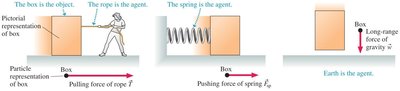
Drawing Force Vectors
To analyze forces acting on an object, represent the object as a particle and draw force vectors with their tails at the particle. The length of each arrow is proportional to the force’s magnitude, and the direction shows the force’s action.
Label each force vector with a unique name.
Use arrows to indicate direction and magnitude.
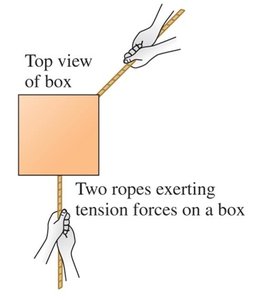
Combining Forces: Net Force
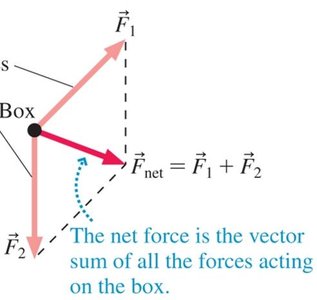
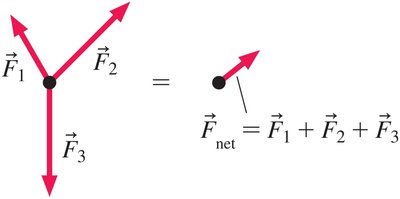
When multiple forces act on an object, the net force is the vector sum of all individual forces. The net force determines the object's acceleration according to Newton’s Second Law.
Vector Addition: Forces are added using vector rules.
Net Force Formula:
Resultant Force: The net force is a single equivalent force.
Newton’s First Law (Law of Inertia)
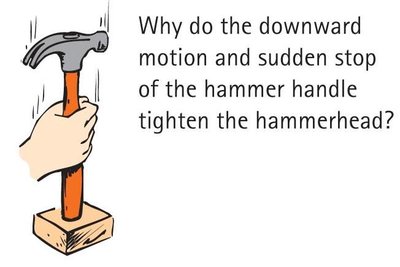
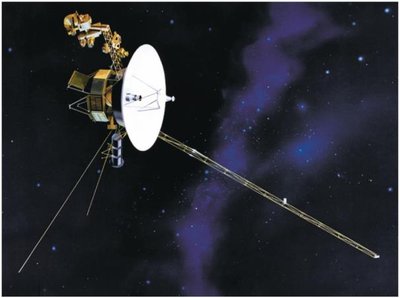
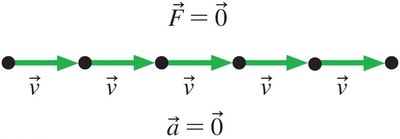
Newton’s First Law states that an object remains at rest or in uniform motion unless acted upon by a net external force. This principle is known as inertia.
If no net force acts, velocity remains constant.
Objects resist changes in their state of motion.
Mathematically:
Types of Forces
Several common forces act on objects in everyday situations:
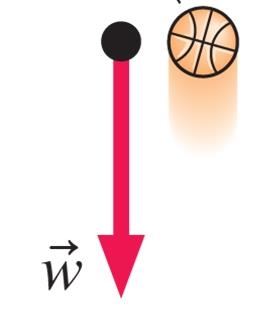
Weight: The gravitational force exerted by Earth, always directed downward.
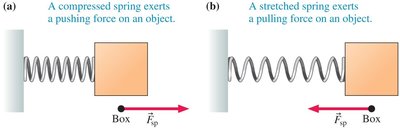
Spring Force: Exerted by a compressed or stretched spring, can push or pull.
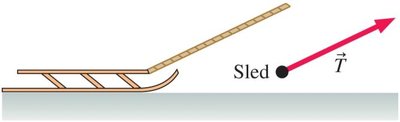
Tension: Force exerted by a rope or cable, always directed along the rope.
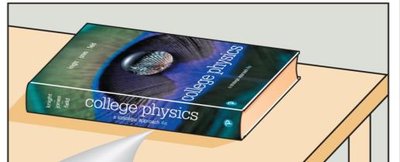
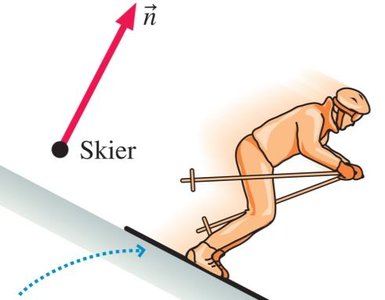
Normal Force: Perpendicular force exerted by a surface.
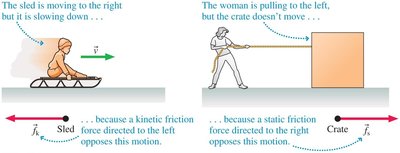
Friction: Force parallel to the surface, opposes motion (kinetic or static).
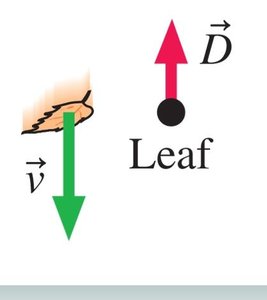
Drag: Resistive force from a fluid, opposes motion.
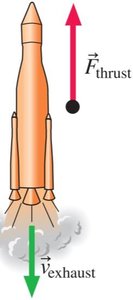
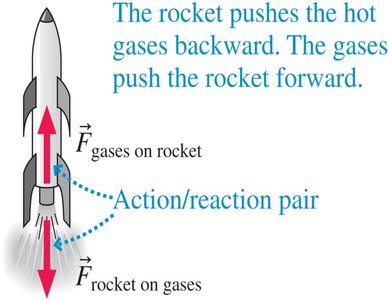
Thrust: Force from expelling mass, as in rockets.
Electric and Magnetic Forces: Long-range forces acting on charged or magnetized particles.
Identifying Forces
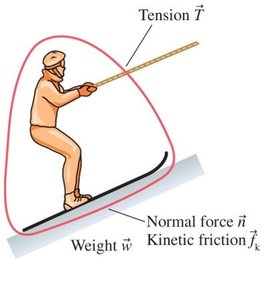
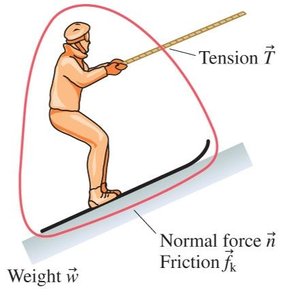
To solve problems, identify all forces acting on the object. Draw a closed curve around the object, label contact and long-range forces, and represent each force vector.
Draw a picture of the situation.
Draw a closed curve around the object.
Label each contact and long-range force.
Newton’s Second Law (Law of Acceleration)
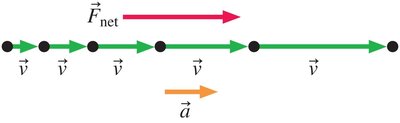
Newton’s Second Law states that the net force on an object causes it to accelerate. The acceleration is in the direction of the net force and is proportional to the force and inversely proportional to the mass.
Formula:
Acceleration points in the direction of the net force.
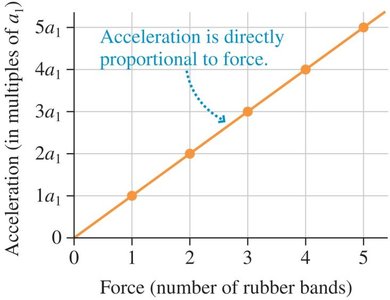
Direct proportionality:
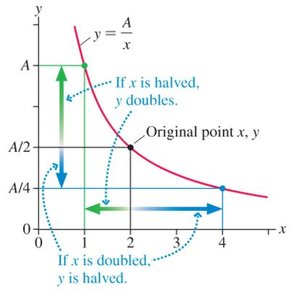
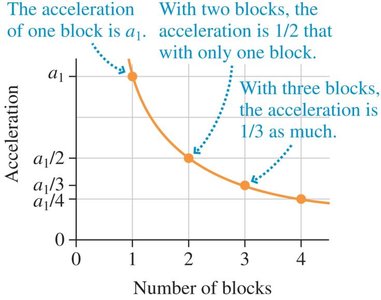
Inverse proportionality:
Free-Body Diagrams
A free-body diagram is a visual tool used to analyze all forces acting on an object. It helps in solving dynamics problems by clearly representing each force and the net force.
Identify all forces acting on the object.
Draw a coordinate system.
Draw vectors for each force.
Draw the net force vector.
Newton’s Third Law (Action and Reaction)
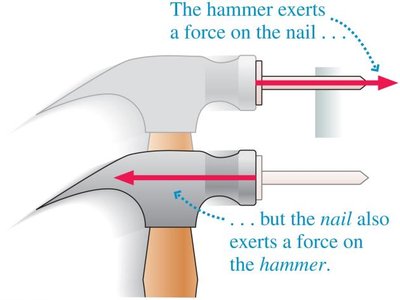
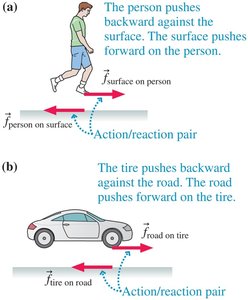
Newton’s Third Law states that for every action, there is an equal and opposite reaction. When two objects interact, each exerts a force on the other of equal magnitude and opposite direction.
Formula:
Action and reaction forces act on different objects.
Examples: Hammer and nail, walking, rocket propulsion.
Summary Table: Common Forces and Notation
The following table summarizes common forces and their notation:
Force | Notation |
|---|---|
General force | |
Weight | |
Spring force | |
Tension | |
Normal force | |
Static friction | |
Kinetic friction | |
Drag | |
Thrust |
Example Applications
Physics problems often require identifying and combining forces, drawing free-body diagrams, and applying Newton’s Laws to solve for unknowns such as acceleration or net force.
Example: A skier being towed up a hill experiences tension, normal force, weight, and friction.
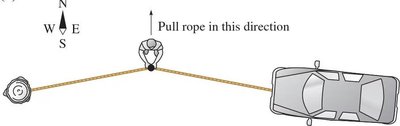
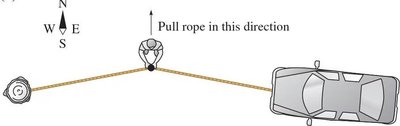
Example: A car stuck in mud can be pulled out using a rope and a tree, applying tension forces.
Additional info: These notes expand on brief points from the original slides, providing definitions, formulas, and examples for clarity and completeness. All images included are directly relevant to the adjacent explanations, visually reinforcing the concepts discussed.
