 Back
Chapter 4: Forces and Newton’s Laws of Motion – Structured Study Notes
Study Guide - Smart Notes
 Tailored notes based on your materials, expanded with key definitions, examples, and context.
Forces and Newton’s Laws of Motion
Introduction to Forces
Forces are fundamental to understanding motion in physics. A force is defined as a push or a pull resulting from the interaction between two objects: the agent (the source of the force) and the object (the recipient of the force). Forces are responsible for changes in the motion of objects, and their study is central to Newtonian mechanics.
Force: A vector quantity with both magnitude and direction.
Agent: The entity exerting the force.
Object: The entity receiving the force.
Contact Forces: Forces that require physical contact (e.g., friction, tension).
Long-Range Forces: Forces that act without contact (e.g., gravity, electromagnetic forces).

Force and Motion
Forces cause objects to accelerate. The relationship between force and acceleration is described by Newton’s Second Law. The direction of acceleration is always the same as the direction of the net force acting on the object.
Acceleration: A vector quantity representing the rate of change of velocity.
Net Force: The vector sum of all forces acting on an object.
Newton’s Second Law:

Newton’s Laws of Motion
Newton’s First Law (Law of Inertia)
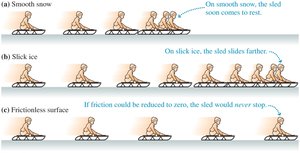
An object at rest remains at rest, and an object in motion continues in a straight line at constant speed unless acted upon by a net external force. This law explains why objects require a force to change their state of motion.
Inertia: The tendency of an object to resist changes in its motion.
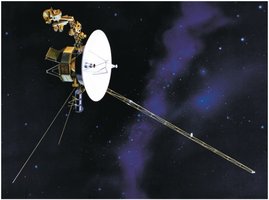
Example: A space probe in deep space continues moving indefinitely unless acted upon by another force.

Newton’s Second Law
Newton’s Second Law quantifies the relationship between force, mass, and acceleration. The net force acting on an object is equal to the product of its mass and acceleration.
Formula:
Units: The SI unit of force is the newton (N), where .
Example: If two people push a car, the net force is the sum of their forces minus friction.
Newton’s Third Law
For every action, there is an equal and opposite reaction. Forces always occur in pairs, called action/reaction pairs, acting on two different objects.
Action/Reaction Pair: Two forces equal in magnitude and opposite in direction.
Example: A hammer striking a nail; the nail exerts an equal force back on the hammer.

Types of Forces
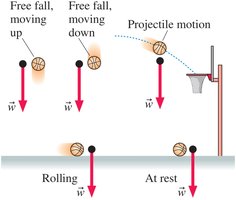
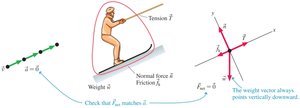
Weight: The gravitational force exerted by the Earth on an object. Always points downward. Formula:
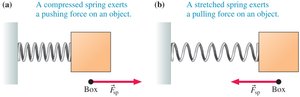
Spring Force: The force exerted by a spring when compressed or stretched.
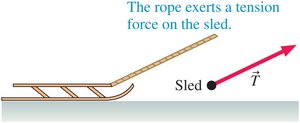
Tension Force: The force exerted by a string, rope, or wire.
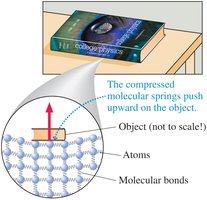
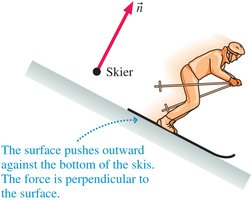
Normal Force: The force exerted by a surface perpendicular to the object.
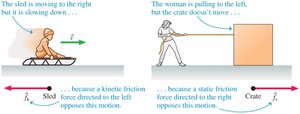
Friction: The force that opposes motion between two surfaces.
Kinetic Friction: Acts when objects slide past each other.
Static Friction: Prevents motion between surfaces.
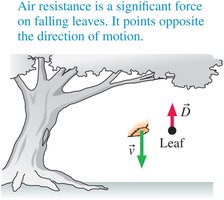
Drag: The resistive force of a fluid (air or water) on a moving object.
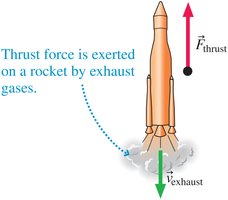
Thrust: The force produced by expelling gas molecules at high speed (e.g., rockets).
Identifying Forces
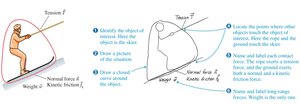
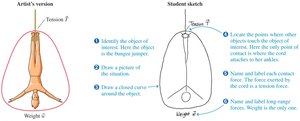
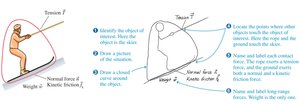
To analyze the motion of an object, it is essential to identify all forces acting on it. This involves drawing a picture, marking points of contact, and labeling each force.
Contact Forces: Occur at points where objects touch.
Long-Range Forces: Weight is the primary long-range force considered in introductory dynamics.
Combining Forces and Net Force
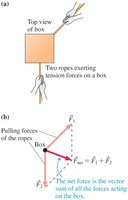
When multiple forces act on an object, they combine to form a net force, which determines the object's acceleration. The net force is the vector sum of all individual forces.
Vector Addition: Forces are added using vector addition rules.
Resultant Force: The net force replacing all individual forces.
Proportional Relationships: Force, Mass, and Acceleration
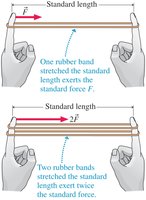
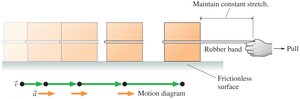
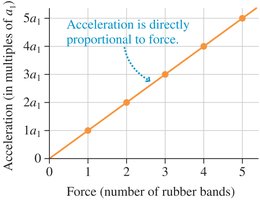
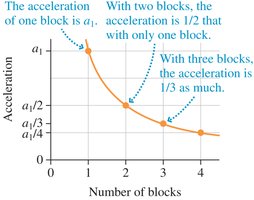
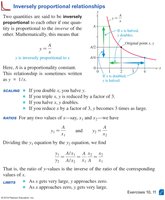
Experiments show that acceleration is directly proportional to force and inversely proportional to mass. This relationship is foundational to Newton’s Second Law.
Direct Proportionality:
Inverse Proportionality:
Scaling: Doubling the force doubles the acceleration; doubling the mass halves the acceleration.
Free-Body Diagrams
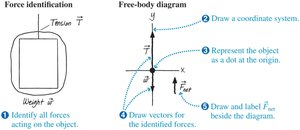
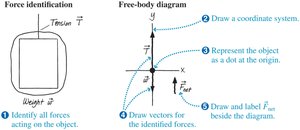
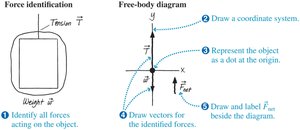
Free-body diagrams are essential tools for visualizing and solving dynamics problems. They represent the object as a particle and show all forces acting on it, including the net force.
Steps:
Identify all forces acting on the object.
Draw a coordinate system.
Represent the object as a dot at the origin.
Draw vectors for each force, labeling them appropriately.
Draw and label the net force vector beside the diagram.
Newton’s Third Law: Action/Reaction Pairs
Newton’s Third Law states that every force occurs as one member of an action/reaction pair. These pairs act on two different objects, are equal in magnitude, and point in opposite directions.
Examples: Hammer and nail, bat and ball, foot and ground.
Implications: Forces always come in pairs; you cannot have a single force without its counterpart.
Summary Table: Common Forces and Their Notation
Force Type | Symbol | Description |
|---|---|---|
Weight | Gravitational force, always downward | |
Normal Force | Perpendicular to surface | |
Tension | Along string, rope, or wire | |
Spring Force | Push or pull by a spring | |
Friction (kinetic) | Opposes sliding motion | |
Friction (static) | Prevents motion | |
Drag | Opposes motion in fluid | |
Thrust | Produced by expelling mass |
Summary of Key Concepts
Force: Push or pull, vector quantity, requires an agent.
Net Force: Vector sum of all forces.
Mass: Resistance to acceleration.
Newton’s Laws: Foundation for understanding motion and forces.
Free-Body Diagrams: Essential for solving dynamics problems.
Action/Reaction Pairs: Forces always occur in pairs.
