 Back
BackChapter 4: Momentum – Friction, Inertia, Systems, and Conservation
Study Guide - Smart Notes
 Tailored notes based on your materials, expanded with key definitions, examples, and context.
Momentum
Introduction to Momentum
Momentum is a fundamental concept in physics describing the quantity of motion an object possesses. It is defined as the product of an object's inertia (mass) and its velocity. Momentum is a vector quantity, meaning it has both magnitude and direction. The study of momentum is essential for understanding collisions, motion, and conservation laws in physics.
Momentum (p):
Vector form:
Units: kilogram meter per second (kg·m/s)
Conservation of Momentum: In an isolated system, the total momentum remains constant.

4.1 Friction
Nature of Friction
Friction is the resistance to motion that occurs when two surfaces slide against each other. It arises from microscopic interactions between the surfaces and depends on their material properties and roughness.
Definition: Friction is a force that opposes the relative motion of two surfaces in contact.
Dependence: The amount of friction depends on the types of surfaces and the materials involved.
Effect: Higher friction causes objects to stop more quickly when sliding.
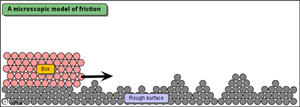
Friction and Surface Types
The stopping time of a sliding object varies with the surface. For example, a block slides longer on ice than on concrete due to lower friction.
Ice: Low friction, slow deceleration.
Polished wood: Moderate friction, moderate deceleration.
Concrete: High friction, fast deceleration.
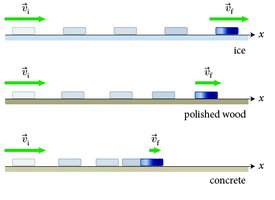
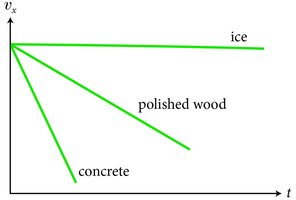
Acceleration Due to Friction
When friction acts, the acceleration is opposite to the velocity, causing the object to slow down. Thus, the acceleration is negative relative to the direction of motion.
Sign of acceleration: Negative when object slows down due to friction.
Minimizing Friction
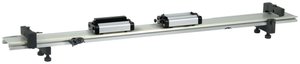
Friction can be minimized using special tracks or air cushions, allowing objects to move with negligible resistance. This is useful for isolating other physical effects, such as inertia.
Low friction tracks: Objects float on air, reducing friction.
4.2 Inertia
Definition and Experimentation
Inertia is the property of an object to resist changes in its velocity. It is directly related to the object's mass. Experiments with colliding carts help illustrate inertia and its effects.
Definition: Inertia is the tendency of an object to resist any change in its velocity.
Standard carts: Used to compare inertia in collision experiments.
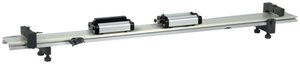
Collisions and Inertia
When two identical carts collide, their velocities swap, demonstrating equal inertia. If the carts have different masses, the velocity changes are inversely proportional to their inertia.
Velocity exchange: In collisions, identical carts swap velocities.
Inertia comparison: Larger mass changes velocity less; smaller mass changes velocity more.
Quantitative Analysis
Change in velocity:
Inertia ratio:
4.3 What Determines Inertia?
Material and Quantity
The inertia of an object depends on both the type of material and the amount of material present. Experiments show that objects of different materials but equal volume can have different inertias.
Material dependence: Inertia varies with material type.
Quantity dependence: Inertia increases with the amount of material.
4.4 Systems
Defining a System
A system is a boundary drawn around one or more objects to analyze their physical properties and interactions. The environment is everything outside the system.
System: Any object or group of objects separated from the environment.
Purpose: Simplifies analysis and allows tracking of physical quantities.
Extensive and Intensive Properties
Physical properties of systems are classified as extensive or intensive.
Extensive: Depend on system size (e.g., mass, inertia).
Intensive: Independent of system size (e.g., temperature).
Property | Extensive | Intensive |
|---|---|---|
Inertia | Yes | No |
Velocity | No | Yes |
Inertia × Velocity | Yes | No |
Changing Extensive Quantities
Extensive quantities change through input, output, creation, or destruction.
Change formula:
Isolated Systems and Conservation
An isolated system has no input or output, simplifying the accounting of extensive quantities. If a quantity cannot be created or destroyed, it is conserved.
Isolated system: No input/output; only creation/destruction.
Conserved quantity:
Noether's Theorem
Noether's Theorem links symmetries in physical laws to conserved quantities, a foundational result in theoretical physics.
Symmetry: Physical laws unchanged under certain transformations.
Conservation: Associated with symmetry (e.g., momentum conservation from spatial symmetry).
4.5 Inertial Standard
Mass as a Measure of Inertia
The symbol m is used for inertia, commonly referred to as mass. The SI unit of mass is the kilogram (kg), defined by a standard object.
Standard mass: Platinum-iridium cylinder defines 1 kg.
Comparison: Inertia of unknown objects determined by collision experiments.
4.6 Momentum
Definition and Properties
Momentum is the product of inertia (mass) and velocity. It is an extensive quantity and is conserved in isolated systems.
Formula:
Conservation: in isolated systems
4.7 Isolated Systems
Accounting for Momentum
In an isolated system, the total momentum is the sum of the momenta of all objects. Momentum can be transferred between objects but not created or destroyed.
System selection: Choose objects so all interactions are internal.
Conservation law:
4.8 Conservation of Momentum and Impulse
Impulse and Force
Impulse is the change in momentum resulting from a force applied over time. The relationship between force and impulse is given by:
Impulse:
Force:
Examples and Applications
Collisions: Momentum is transferred but conserved.
Rocket propulsion: Forward motion is a consequence of momentum conservation.
Bouncing ball: Impulse delivered by the floor equals the change in momentum.
Summary Table: Key Concepts
Concept | Definition | Formula | Conservation? |
|---|---|---|---|
Friction | Resistance to motion between surfaces | N/A | No |
Inertia | Resistance to change in velocity | N/A | No |
Momentum | Inertia × velocity | Yes | |
Impulse | Change in momentum | N/A |
