 Back
BackChapter 42: Nuclear Physics – Structure, Stability, and Radioactivity
Study Guide - Smart Notes
 Tailored notes based on your materials, expanded with key definitions, examples, and context.
Nuclear Structure and Properties
The Atomic Nucleus
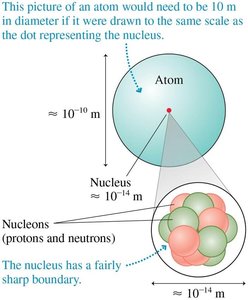
The nucleus is the dense central core of an atom, containing protons and neutrons (collectively called nucleons). It is much smaller than the atom itself, with a typical nuclear radius on the order of m, compared to the atomic radius of about m.
Protons have a positive charge (+e), while neutrons are neutral.
The atomic number (Z) is the number of protons, defining the element.
The mass number (A) is the total number of nucleons: (N = number of neutrons).
Atomic Mass and Isotopes
Atomic masses are measured in atomic mass units (u), where . Isotopes are atoms of the same element (same Z) with different mass numbers (A). Isobars are nuclei with the same A but different Z and N.
Most isotopes are radioactive; only 266 are stable in nature.
The chemical atomic mass is a weighted average of all naturally occurring isotopes.
Nuclear Size and Density
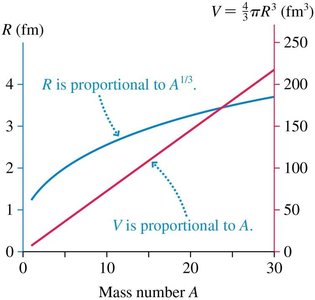
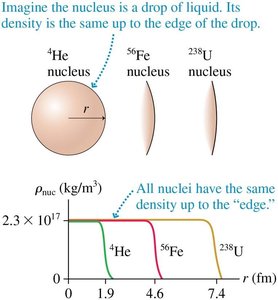
The radius of a nucleus is given by , where m. The volume is proportional to the number of nucleons, implying a nearly constant nuclear density for all nuclei.
Nuclear matter density: .
Nucleons are tightly packed and incompressible.
Nuclear Stability and Binding Energy
Stability of Nuclei
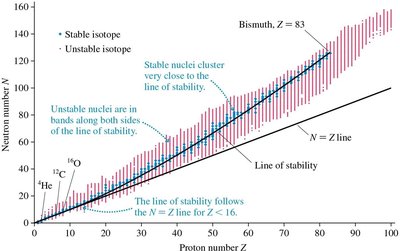
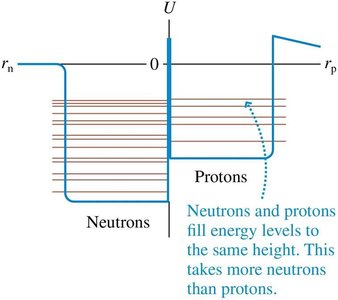
Stable nuclei cluster along the line of stability in a plot of neutron number (N) vs. proton number (Z). For light elements (Z < 16), stability occurs when N ≈ Z. For heavier elements, more neutrons are needed for stability. No nuclei with Z > 83 are stable.
Nuclear Binding Energy
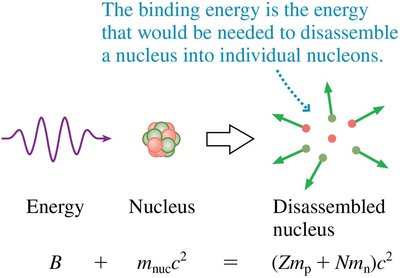
The binding energy is the energy required to disassemble a nucleus into its constituent protons and neutrons. It is calculated from the mass defect (the difference between the mass of the nucleus and the sum of the masses of its nucleons):
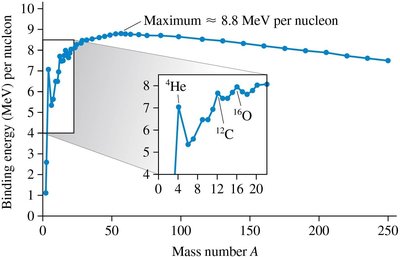
The binding energy per nucleon peaks at about 8.8 MeV for nuclei near iron (Fe), indicating maximum stability.
The Strong Nuclear Force
Nature of the Strong Force
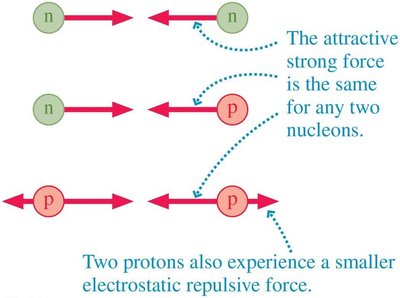
The strong nuclear force is the fundamental force that binds nucleons together. It is:
Attractive between any two nucleons (proton-proton, neutron-neutron, or proton-neutron).
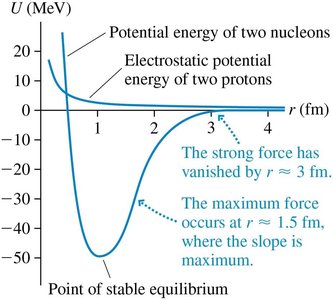
Short-ranged (acts over distances ~1-3 femtometers).
Much stronger than the electrostatic repulsion between protons at short distances.
Nuclear Models
The Shell Model
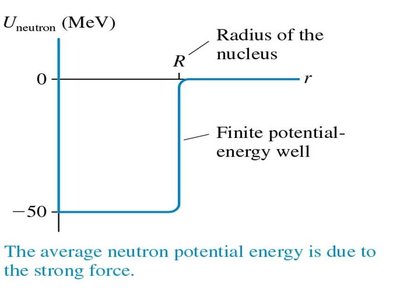
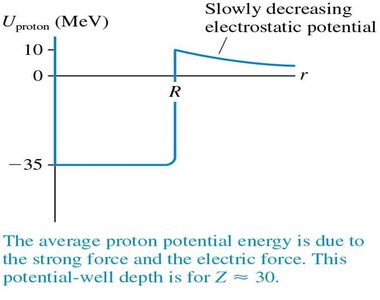
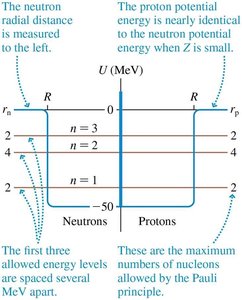
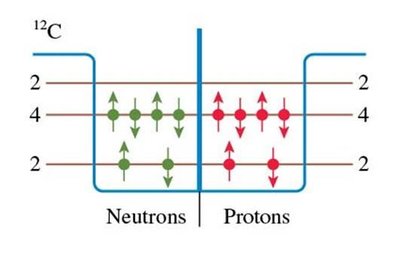
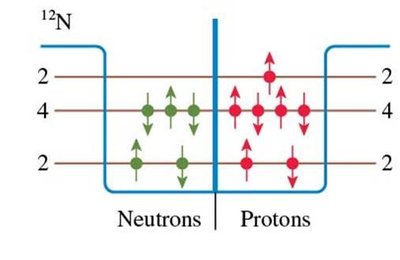
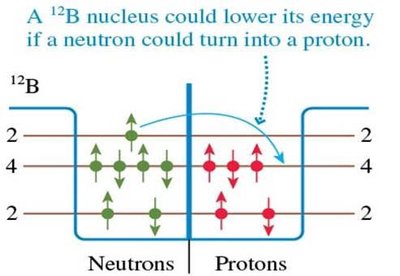
The shell model treats nucleons as moving independently in an average potential well created by the strong force. Energy levels are quantized, similar to electrons in atoms. Closed shells correspond to particularly stable nuclei.
Proposed by Maria Goeppert-Mayer (Nobel Prize, 1963).
Neutrons and protons fill separate shells.

Radioactivity and Nuclear Decay
Types of Radiation
Radioactive decay emits three main types of radiation:
Radiation | Identification | Charge | Stopped by |
|---|---|---|---|
Alpha (α) | He nucleus | +2e | Sheet of paper |
Beta (β) | Electron | −e | Few mm of aluminum |
Gamma (γ) | High-energy photon | 0 | Many cm of lead |
Ionizing Radiation and Detection
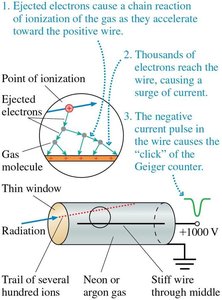
Ionizing radiation can break molecular bonds and ionize atoms, which is the principle behind radiation detectors like the Geiger counter.
Nuclear Decay and Half-Life
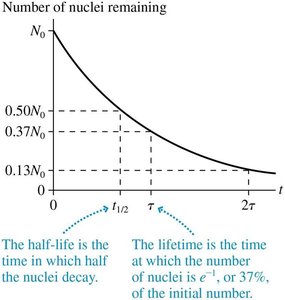
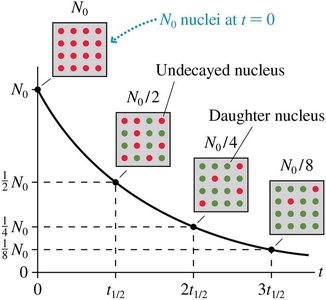
The probability that a nucleus will decay in a given time is characterized by its decay rate (r) and lifetime (). The half-life () is the time for half the nuclei in a sample to decay. The number of nuclei remaining at time t is:
Or, in terms of half-life:
Radioactive Dating
Carbon-14 dating uses the known half-life of C (5730 years) to date organic materials by comparing the C/C ratio in a sample to that in living organisms.

Types of Nuclear Decay
Alpha Decay
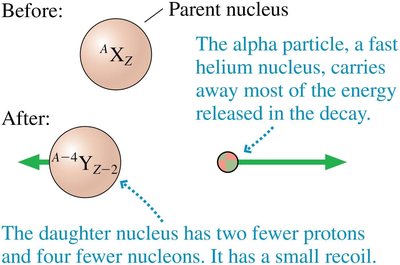
In alpha decay, a nucleus emits an alpha particle (He nucleus), reducing its atomic number by 2 and mass number by 4:
The energy released is primarily carried by the alpha particle.
Beta Decay
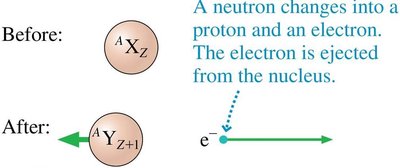
There are two types of beta decay:
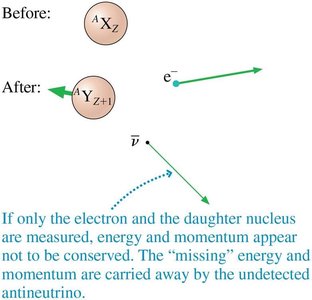
Beta-minus decay: A neutron converts to a proton, emitting an electron () and an antineutrino ():
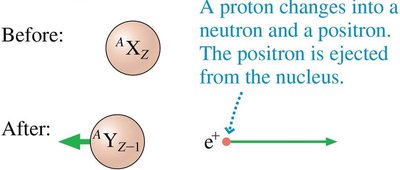
Beta-plus decay: A proton converts to a neutron, emitting a positron () and a neutrino ():
Gamma Decay
In gamma decay, an excited nucleus releases energy by emitting a high-energy photon (gamma ray), without changing its atomic or mass number.
Decay Series
Some radioactive nuclei decay through a series of steps, producing a sequence of daughter nuclei until a stable isotope is reached. This is called a decay series.
Radiation Dose and Applications
Radiation Dose and Biological Effects
The absorbed dose is the energy deposited per kilogram of tissue (measured in grays, Gy). The dose equivalent (in sieverts, Sv) accounts for the type of radiation using the relative biological effectiveness (RBE):
Alpha particles have a much higher RBE than x-rays or gamma rays.
Medical and Industrial Applications
Radiation therapy uses focused gamma rays to kill cancer cells while minimizing damage to healthy tissue.
Magnetic Resonance Imaging (MRI) uses the magnetic properties of protons in a magnetic field to produce detailed images of internal organs.
Summary Table: Properties of Protons and Neutrons
Property | Proton | Neutron |
|---|---|---|
Number | Z | N |
Charge (q) | +e | 0 |
Spin (s) | 1/2 | 1/2 |
Mass (u) | 1.00728 | 1.00866 |
Additional info: This guide covers the essential concepts of nuclear structure, stability, radioactivity, and applications, as outlined in a typical college-level physics curriculum.
