 Back
Chapter 5: Applying Newton’s Laws – Equilibrium, Friction, and Dynamics
Study Guide - Smart Notes
 Tailored notes based on your materials, expanded with key definitions, examples, and context.
Applying Newton’s Laws
Equilibrium
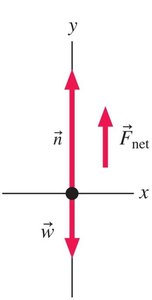
Equilibrium describes the state of an object when the net force acting on it is zero. This can occur when the object is at rest (static equilibrium) or moving at constant velocity (dynamic equilibrium).
Static Equilibrium: The object is at rest; all forces balance so that acceleration is zero.
Dynamic Equilibrium: The object moves in a straight line at constant speed; acceleration remains zero.
Mathematical Condition: In one dimension, . In two dimensions, .
Equilibrium Problem-Solving Approach
Solving equilibrium problems involves systematic steps to identify and analyze forces.
Draw a diagram of the situation.
Identify all forces acting on the object.
Draw a free-body diagram.
Determine known and unknown quantities.
Write equations based on Newton’s second law.
Solve for the unknowns.
Dynamics Problem-Solving Approach
Dynamics problems connect forces to motion using Newton’s second law.
Draw a diagram.
Identify all forces acting on the object.
Draw a free-body diagram.
Determine known and unknown quantities.
Write equations from Newton’s second law: .
Use kinematics equations to find acceleration.
Solve for the unknowns.
Mass and Weight
Definitions
Mass and weight are fundamental concepts in mechanics, but they are distinct.
Mass (m): The amount of matter in an object, measured in kilograms (kg). Mass is invariant regardless of location.
Weight (W): The force of gravity acting on an object, measured in Newtons (N). Weight depends on the local gravitational acceleration.
Formula:
Example: On the Moon, , so .
Apparent Weight
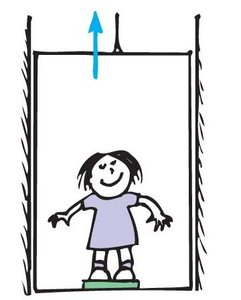
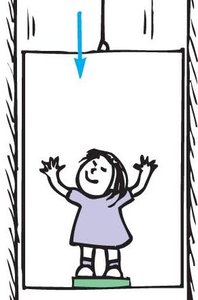
Apparent weight is the normal force exerted by a supporting surface, which can differ from true weight during acceleration.
Accelerating Upward: (heavier than normal)
Accelerating Downward: (lighter than normal)
Constant Speed:
Weightlessness
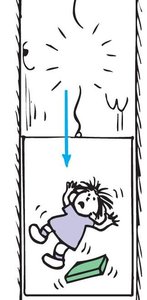
Weightlessness occurs when there is no supporting force, such as during free fall.
Condition:
Example: Astronauts in orbit experience weightlessness because they are in continuous free fall.
Normal Force
Definition and Inclined Surfaces
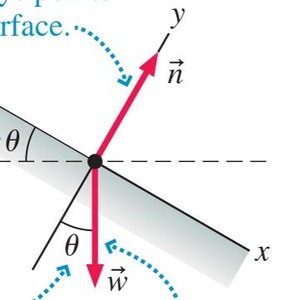
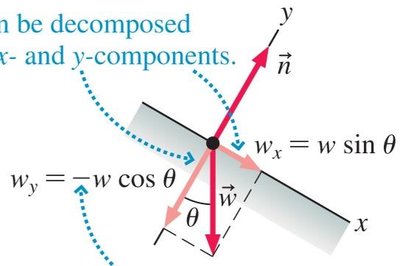
The normal force is the perpendicular supporting force exerted by a surface.
On a flat surface:
On an inclined surface:
Friction
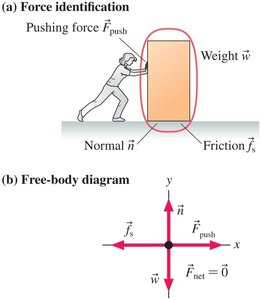
Static Friction
Static friction prevents motion between surfaces in contact. It acts opposite to the direction of attempted motion.
Maximum Static Friction:
Coefficient of Static Friction (): Depends on materials in contact.
Kinetic Friction
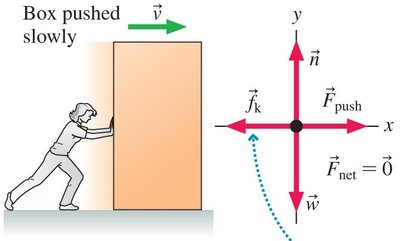
Kinetic friction opposes the motion of sliding objects.
Formula:
Coefficient of Kinetic Friction (): Usually less than .
Rolling Friction
Rolling friction occurs when a wheel or sphere rolls over a surface, and is typically much smaller than kinetic friction.
Formula:
Coefficient of Rolling Friction (): Significantly less than .
Coefficients of Friction Table
The table below compares static, kinetic, and rolling friction coefficients for various material pairs.
Material | Static () | Kinetic () | Rolling () |
|---|---|---|---|
Rubber on concrete | 1.00 | 0.80 | 0.02 |
Steel on steel (dry) | 0.80 | 0.60 | 0.002 |
Steel on steel (lubricated) | 0.10 | 0.05 | — |
Wood on wood | 0.50 | 0.20 | — |
Wood on snow | 0.12 | 0.06 | — |
Ice on ice | 0.10 | 0.03 | — |
Objects in Contact
Action-Reaction Pairs
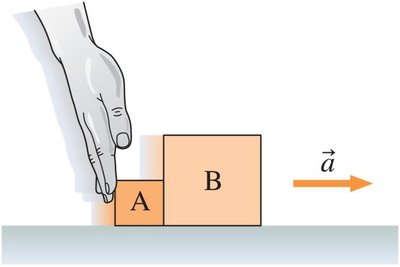
When objects are in contact, Newton’s third law applies: forces between them are equal in magnitude and opposite in direction.
Draw separate free-body diagrams for each object.
Write Newton’s second law for each object.
Equate the magnitudes of action/reaction pairs.
Objects in contact share the same acceleration.
Ropes and Tension
Tension in Strings
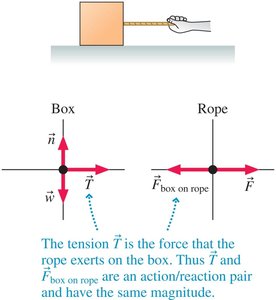
When a rope or string pulls an object, the tension force is transmitted through the rope.
Assume massless rope: .
Tension is the same throughout a massless rope.
Action/reaction pairs: The box pulls on the rope, and the rope pulls on the box with equal magnitude.
Pulleys
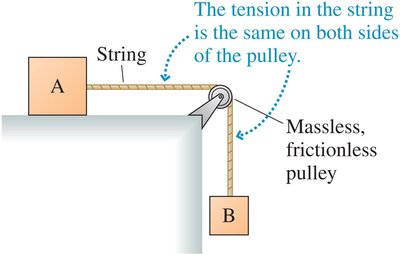
For massless, frictionless pulleys, the tension in the string remains constant on both sides.
Drag Forces
Drag and Reynolds Number
Drag is a resistive force experienced by objects moving through fluids. The Reynolds number determines the nature of drag.
Drag Force: Opposes velocity; increases with speed.
Reynolds Number: , where is fluid density, is velocity, is characteristic length, is viscosity.
High Reynolds Number: Inertial forces dominate (e.g., cars, planes).
Low Reynolds Number: Viscous forces dominate (e.g., bacteria in water).
Drag Coefficients and Cross-Sectional Area
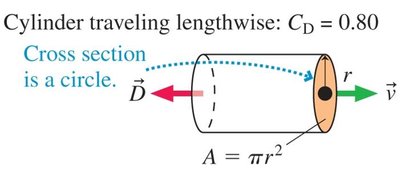
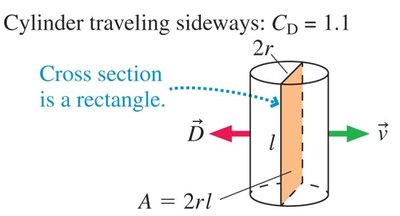
Drag depends on the shape and orientation of the object.
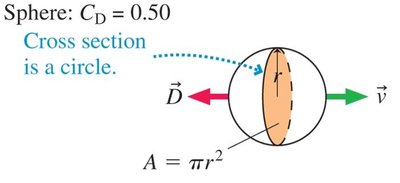
Drag Force Formula:
Drag Coefficient (): Varies by object shape.
Cross-Sectional Area (): Area facing the flow.
Terminal Speed
Definition and Conditions
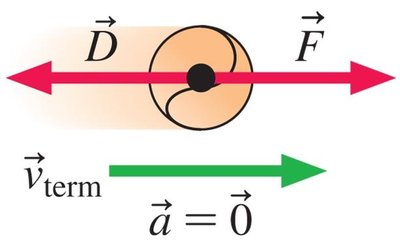
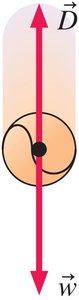
Terminal speed is reached when the drag force equals the weight force, resulting in zero acceleration.
Condition:
At terminal speed:
Example: A falling object eventually stops accelerating and moves at constant speed.
Sample Problems and Applications
Curling Stone Example
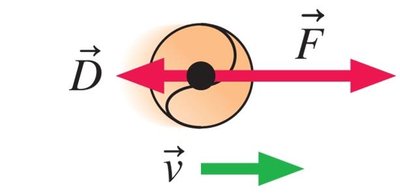
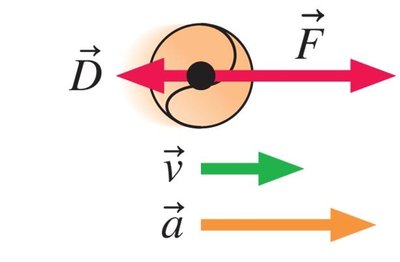
In curling, friction and applied force determine the stone’s motion. Sweeping the ice can alter the coefficient of friction, affecting speed and trajectory.
Key Point: Decreasing the coefficient of friction increases the distance traveled by the stone.
Application: Players sweep the ice to reduce friction and control the stone’s path.
Summary Table: Friction Coefficients
Material | Static () | Kinetic () | Rolling () |
|---|---|---|---|
Rubber on concrete | 1.00 | 0.80 | 0.02 |
Steel on steel (dry) | 0.80 | 0.60 | 0.002 |
Steel on steel (lubricated) | 0.10 | 0.05 | — |
Wood on wood | 0.50 | 0.20 | — |
Wood on snow | 0.12 | 0.06 | — |
Ice on ice | 0.10 | 0.03 | — |
Additional info: Academic context and expanded explanations were added to ensure completeness and clarity for exam preparation.
