 Back
BackChapter 5: Circular Motion and Gravitation – Study Notes
Study Guide - Smart Notes
 Tailored notes based on your materials, expanded with key definitions, examples, and context.
Circular Motion and Gravitation
Kinematics of Uniform Circular Motion
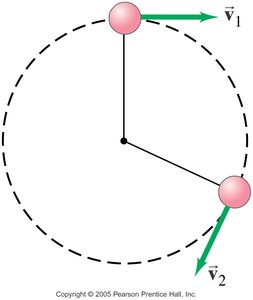
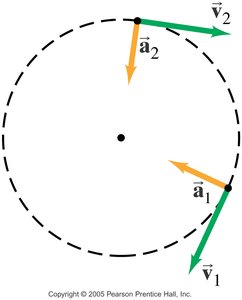
Uniform circular motion describes the motion of an object traveling at constant speed along a circular path. The velocity vector is always tangent to the circle, and its direction changes continuously, even though its magnitude remains constant.
Instantaneous Velocity: Always tangent to the circle at any point.
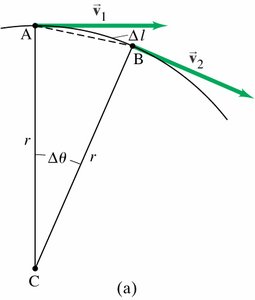
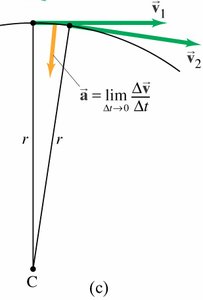
Acceleration: Points toward the center of the circle (centripetal acceleration).
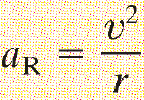
Centripetal Acceleration Formula:
Direction of Acceleration: Determined by the change in velocity vector as the object moves along the circle.
Key Terms: Centripetal means "center-seeking."
Example: A ball moving in a circle has its velocity vector tangent to the path, and its acceleration vector points inward.
Dynamics of Uniform Circular Motion
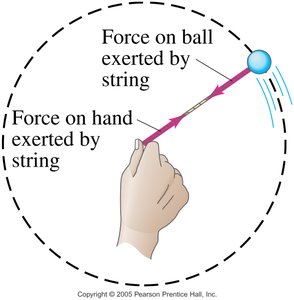
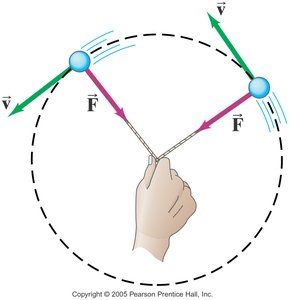
For an object to maintain uniform circular motion, a net force must act toward the center of the circle. This force is called the centripetal force.
Centripetal Force Formula:
Source of Centripetal Force: Can be friction, tension, gravity, or the normal force, depending on the situation.
No Centrifugal Force: The so-called "centrifugal force" is not a real force; it is a result of inertia.
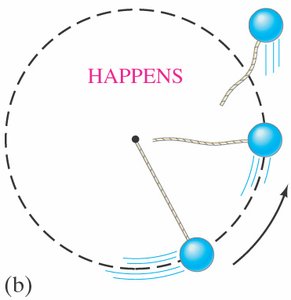
If Centripetal Force Vanishes: The object moves tangent to the circle.
Example: A ball on a string is swung in a circle; the string provides the centripetal force.
Highway Curves: Banked and Unbanked
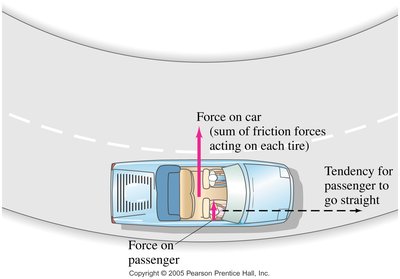
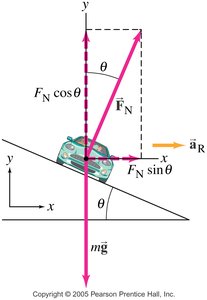
When a car goes around a curve, the required centripetal force is provided by friction if the road is flat. If the road is banked, the normal force can provide part or all of the centripetal force, reducing reliance on friction.
Static Friction: Provides centripetal force as long as tires do not slip.
Kinetic Friction: Occurs if tires slip; it is weaker and opposes motion, making control difficult.
Banked Curves: At a certain speed, the horizontal component of the normal force supplies the entire centripetal force.
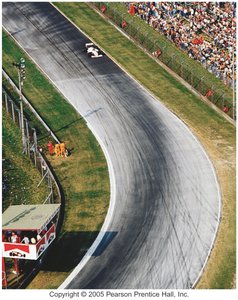
Example: Skid marks on a racetrack show where friction was insufficient to keep cars on the curve.
Nonuniform Circular Motion
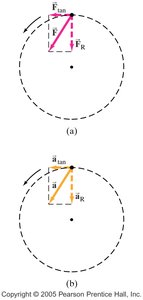
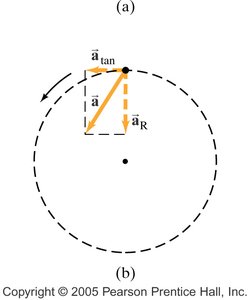
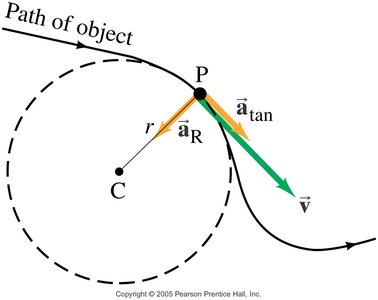
If an object moves in a circle but its speed changes, it has both radial (centripetal) and tangential acceleration components. The total acceleration is the vector sum of these two.
Tangential Acceleration: Changes the speed of the object.
Radial Acceleration: Changes the direction of the velocity.
Total Acceleration:
Example: A race car accelerating on a circular track experiences both tangential and radial acceleration.
Centrifugation
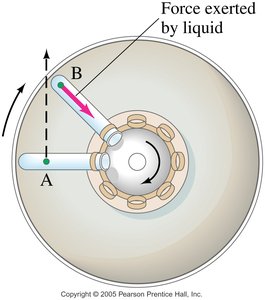
A centrifuge spins objects at high speeds, creating a large centripetal force that separates substances based on their mass.
Principle: The greater the speed, the greater the centripetal force.
Application: Used in laboratories to separate blood components or other mixtures.
Newton’s Law of Universal Gravitation
Newton proposed that every mass attracts every other mass with a force proportional to the product of their masses and inversely proportional to the square of the distance between them.
Law of Universal Gravitation:
Gravitational Constant:
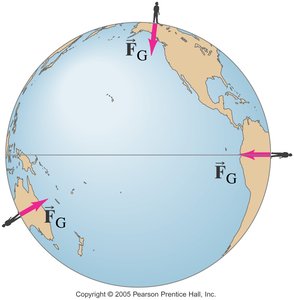
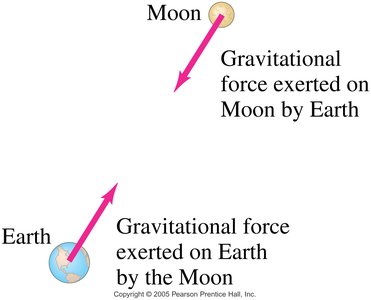
Third Law Pair: The force Earth exerts on you is equal and opposite to the force you exert on Earth.
Origin of Force: The force comes from the Earth and keeps the Moon in orbit.
Example: Cavendish experiment measures the gravitational constant.

Gravity Near the Earth’s Surface; Geophysical Applications
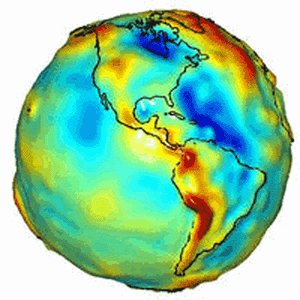
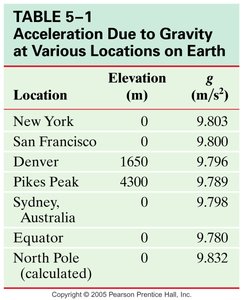
The acceleration due to gravity varies slightly across the Earth's surface due to altitude, local geology, and the Earth's shape.
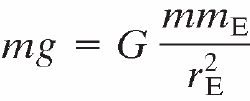
Local Gravity:
Variation: Gravity is stronger at the poles and weaker at the equator.
Application: Used to calculate the mass of the Earth.
Location | Elevation (m) | g (m/s2) |
|---|---|---|
New York | 0 | 9.803 |
San Francisco | 0 | 9.800 |
Denver | 1650 | 9.796 |
Pikes Peak | 4300 | 9.789 |
Sydney, Australia | 0 | 9.798 |
Equator | 0 | 9.780 |
North Pole (calculated) | 0 | 9.832 |
Satellites and "Weightlessness"
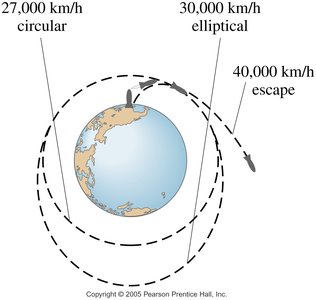
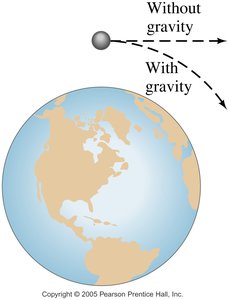
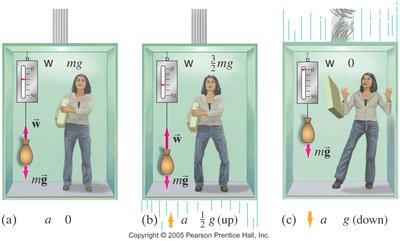
Satellites in orbit around the Earth are in continuous free fall, experiencing apparent weightlessness because there is no normal force acting on them.
Orbital Speed: Must be high enough to avoid falling back to Earth, but not so high as to escape Earth's gravity.
Apparent Weightlessness: Occurs because both the satellite and its contents are in free fall.
True Weightlessness: Only occurs if no gravitational force acts, which is not the case in orbit.
Example: Astronauts in the International Space Station experience apparent weightlessness.

Kepler’s Laws and Newton's Synthesis
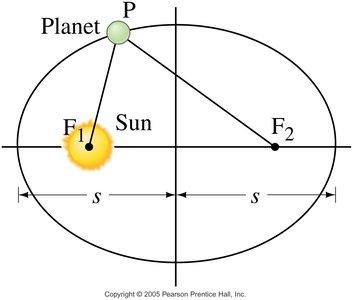
Kepler's laws describe planetary motion and were later explained by Newton's law of gravitation.
First Law: Planets move in ellipses with the Sun at one focus.
Second Law: A line from the planet to the Sun sweeps out equal areas in equal times.
Third Law: The square of the orbital period is proportional to the cube of the mean distance from the Sun:
Newton's Synthesis: Kepler's laws can be derived from Newton's laws.
Example: Irregularities in planetary motion led to the discovery of Neptune.
Types of Forces in Nature
Modern physics recognizes four fundamental forces: gravity, electromagnetism, weak nuclear force, and strong nuclear force. Most everyday forces (except gravity) are manifestations of electromagnetic forces at the atomic level.
Gravity: Responsible for planetary motion and weight.
Electromagnetism: Responsible for friction, normal force, tension, etc.
Weak Nuclear Force: Responsible for certain types of radioactive decay.
Strong Nuclear Force: Binds protons and neutrons in the nucleus.
Example: Friction and tension are electromagnetic in origin.
Summary of Chapter 5
An object moving in a circle at constant speed is in uniform circular motion.
It has a centripetal acceleration given by .
There is a centripetal force given by .
The centripetal force may be provided by friction, gravity, tension, the normal force, or others.
Newton’s law of universal gravitation: .
Satellites stay in Earth orbit because of their large tangential speed.
