 Back
BackChapter 5: Energy – Collisions, Kinetic Energy, Internal Energy, and Closed Systems
Study Guide - Smart Notes
 Tailored notes based on your materials, expanded with key definitions, examples, and context.
Chapter 5: Energy
Overview
This chapter explores the concept of energy in physics, focusing on its role in analyzing motion, especially during collisions. The chapter covers the classification of collisions, kinetic energy, internal energy, and the concept of closed systems. These topics are foundational for understanding energy conservation and transformation in physical systems.
Section 5.1: Classification of Collisions
Types of Collisions
Collisions are classified based on the behavior of the relative velocity and the energy transformations that occur during the event.
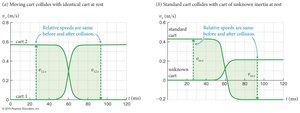
Elastic Collision: The relative speed between two objects before and after the collision remains the same. Both kinetic energy and momentum are conserved.
Inelastic Collision: The relative speed after the collision is less than before. Kinetic energy is not conserved, but momentum is.
Totally Inelastic Collision: A special case of inelastic collision where the objects stick together after the collision, resulting in zero relative speed.
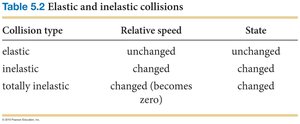
Collision type | Relative speed | State |
|---|---|---|
elastic | unchanged | unchanged |
inelastic | changed | changed |
totally inelastic | changed (becomes zero) | changed |
Section 5.2: Kinetic Energy
Definition and Calculation
Kinetic energy is the energy associated with the motion of an object. It is a scalar quantity and is given by:
m = mass of the object (kg)
v = speed of the object (m/s)
Kinetic energy is an extensive quantity, meaning it depends on the amount of matter present.
Kinetic Energy in Collisions
In elastic collisions, the total kinetic energy before and after the collision is the same.
In inelastic collisions, the total kinetic energy after the collision is less than before; some energy is transformed into other forms.
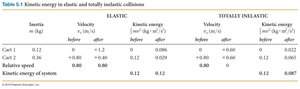
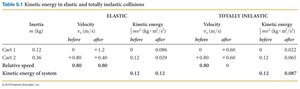
ELASTIC | TOTALLY INELASTIC | |||||
|---|---|---|---|---|---|---|
Inertia (kg) | Velocity (m/s) | Kinetic energy (J) | Inertia (kg) | Velocity (m/s) | Kinetic energy (J) | |
Cart 1 | 0.12 | 0 | 0 | 0.12 | 0 | 0 |
Cart 2 | 0.12 | +1.2 | 0.086 | 0.12 | +0.60 | 0.022 |
Relative speed | 0.80 | 0 | ||||
Kinetic energy of system | 0.12 | 0.022 | ||||
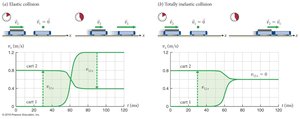
Graphical Representation
Bar diagrams are useful for visualizing energy changes during collisions.
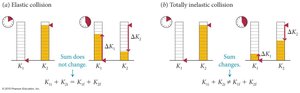
Section 5.3: Internal Energy
Definition and Physical Meaning
Internal energy is the energy associated with the microscopic state of an object, including its shape, temperature, and molecular structure. A process is a transformation from one state to another, often involving changes in internal energy.
In inelastic collisions, some kinetic energy is converted into internal energy, resulting in permanent changes in the objects (e.g., deformation, heating).
In elastic collisions, there are no permanent changes in the state; the process is reversible.


Energy Conservation in Collisions
In any collision, the total energy (kinetic + internal) of a closed system remains constant (law of conservation of energy).
In inelastic collisions, the decrease in kinetic energy equals the increase in internal energy.

Examples and Applications
When a ball bounces and regains its shape, the process is nearly elastic.
When cars collide and deform, the process is inelastic and irreversible.
Section 5.4: Closed Systems
Definition and Identification
A closed system is one in which no energy is transferred to or from the system. The only energy changes possible are transformations from one type to another within the system.
To analyze energy changes, choose a system that includes all objects undergoing changes in state or motion.
Draw a boundary around the system and ensure no energy crosses this boundary.
Procedure for Choosing a Closed System
Sketch the initial and final conditions of the objects.
Identify all changes in state or motion during the process.
Include all relevant objects within the system boundary.
Verify that nothing outside the system undergoes related changes.
Once a closed system is selected, its total energy remains constant.
Examples of Energy Transformations in Closed Systems
Heating water on a burner: Chemical energy of propane is converted to thermal energy of water.
Cyclist accelerating: Chemical energy in muscles is converted to kinetic energy of the cyclist and bicycle.
Spring-loaded gun: Elastic energy in the spring is converted to kinetic energy of the putty.
Key Equations and Concepts
Kinetic Energy:
Law of Conservation of Energy: Energy can be transferred or transformed but cannot be created or destroyed.
Relative Velocity: The velocity of one object as observed from another, crucial for classifying collisions.
Summary Table: Collision Types
Collision Type | Kinetic Energy | Internal Energy | Reversibility |
|---|---|---|---|
Elastic | Conserved | Unchanged | Reversible |
Inelastic | Not conserved | Increases | Irreversible |
Totally Inelastic | Not conserved | Increases (max) | Irreversible |
Practice and Application
Analyze collisions by comparing kinetic energy and relative velocity before and after the event.
Identify energy transformations in real-world systems (e.g., vehicles, sports, machinery).
Apply the concept of closed systems to ensure proper energy accounting in physical problems.
