 Back
BackChapter 5: Using Newton’s Laws – Friction, Circular Motion, and Drag Forces
Study Guide - Smart Notes
 Tailored notes based on your materials, expanded with key definitions, examples, and context.
Chapter 5: Using Newton’s Laws – Friction, Circular Motion, and Drag Forces
5-1 Applications of Newton’s Laws Involving Friction
Friction is a fundamental force that arises when two surfaces interact, opposing relative motion. It is essential in understanding many real-world phenomena, from walking to driving.
Microscopic Origin: Even the smoothest surfaces are rough at the microscopic level, leading to frictional forces. Attractive forces between atoms may cause tiny welds at contact points.
Kinetic Friction: Occurs when surfaces slide past each other. The force of kinetic friction is given by , where is the coefficient of kinetic friction and is the normal force. Kinetic friction acts opposite to the velocity of the object and is independent of the contact area.
Static Friction: Prevents motion when surfaces are at rest relative to each other. The static frictional force can vary up to a maximum value: , where is the coefficient of static friction. Usually, , meaning it is easier to keep an object moving than to start it.
Force Diagrams: Free-body diagrams help visualize forces acting on objects, including friction, normal force, applied force, and gravity.
Example: A 10.0-kg box on a floor with and demonstrates how frictional force changes with applied force.
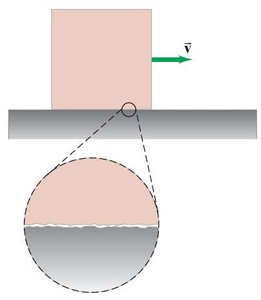
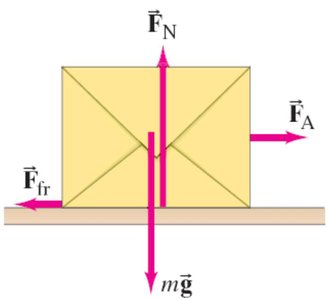
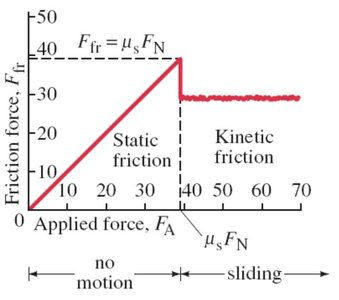
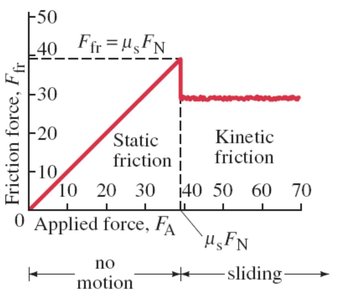
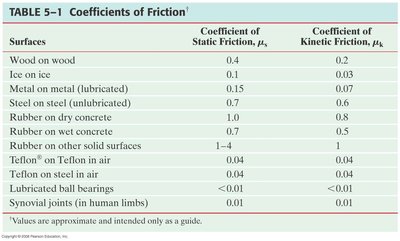
Table: Coefficients of Friction
The coefficients of static and kinetic friction vary depending on the materials in contact. These values are crucial for solving friction-related problems.
Surfaces | Coefficient of Static Friction, | Coefficient of Kinetic Friction, |
|---|---|---|
Wood on wood | 0.4 | 0.2 |
Ice on ice | 0.1 | 0.03 |
Metal on metal (lubricated) | 0.15 | 0.07 |
Steel on steel (unlubricated) | 0.7 | 0.6 |
Rubber on dry concrete | 1.0 | 0.8 |
Rubber on wet concrete | 0.7 | 0.5 |
Rubber on other solid surfaces | 1–4 | 1.0 |
Teflon on Teflon in air | 0.04 | 0.04 |
Teflon on steel in air | 0.04 | 0.04 |
Lubricated ball bearings | <0.01 | <0.01 |
Synovial joints (in human limbs) | 0.01 | 0.01 |
5-2 Uniform Circular Motion—Kinematics
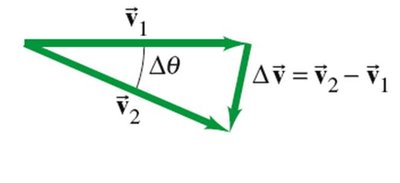
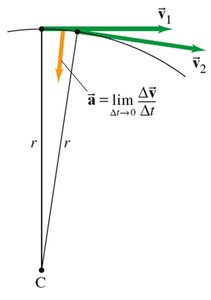
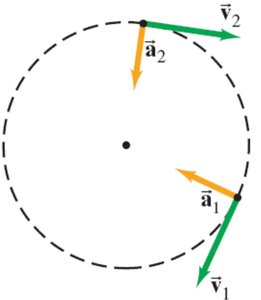
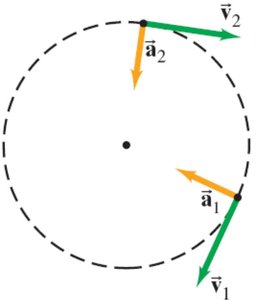
Uniform circular motion describes the movement of an object in a circle at constant speed. The velocity is always tangent to the circle, and the object experiences a centripetal acceleration directed toward the center.
Centripetal Acceleration: The magnitude is , where is speed and is radius.
Period and Frequency: The period is the time for one revolution, and frequency is the number of revolutions per second. , .
Example: A ball revolving in a circle demonstrates how to calculate centripetal acceleration.
5-3 Dynamics of Uniform Circular Motion
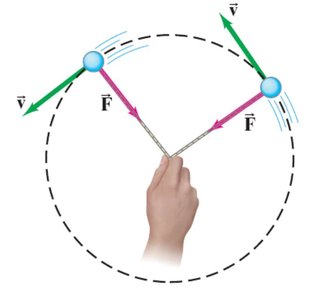
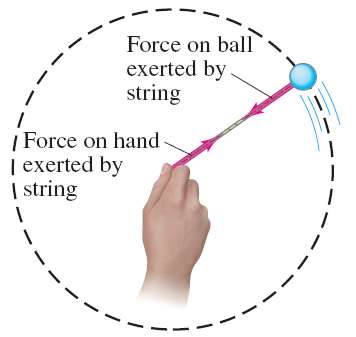
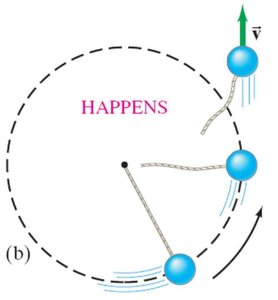
For uniform circular motion, a net force must act toward the center of the circle. This force is called the centripetal force and is responsible for maintaining the circular path.
Centripetal Force:
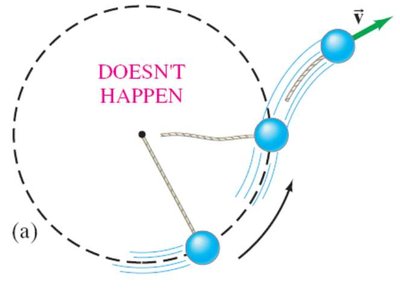
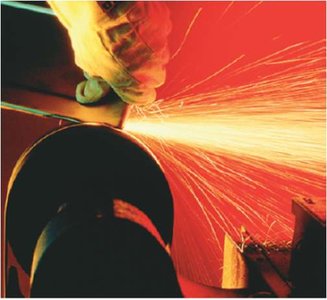
Direction: The force is always directed inward, toward the center. There is no outward 'centrifugal' force; the tendency to move straight is due to inertia.
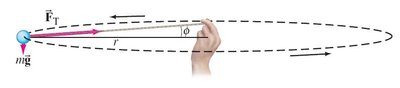
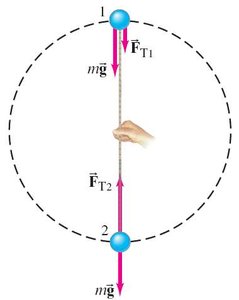
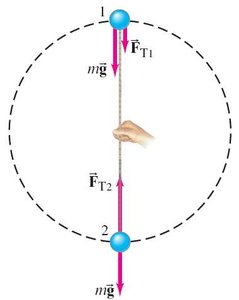
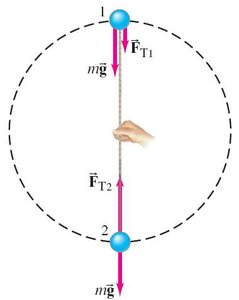
Examples: Calculating the force required to keep a ball moving in a circle, both horizontally and vertically.
5-4 Highway Curves: Banked and Unbanked
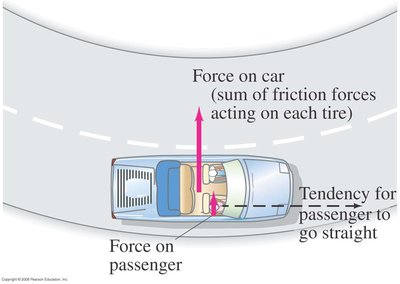
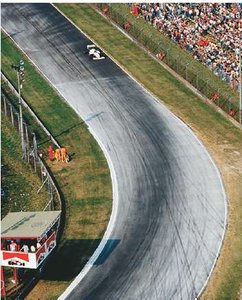
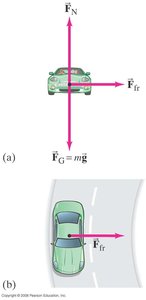
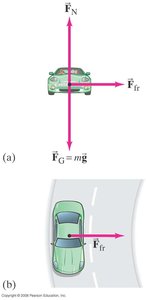
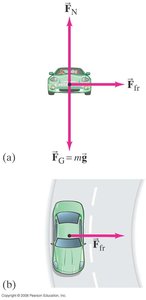
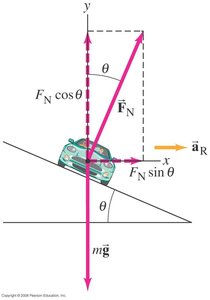
When a car rounds a curve, a net force toward the center is required. On flat roads, this force is supplied by friction. On banked curves, the normal force can provide the necessary centripetal force.
Static vs Kinetic Friction: Static friction keeps tires from slipping; kinetic friction is less effective and can lead to loss of control.
Banked Curves: For a banked curve, the ideal banking angle is given by , where is speed, is radius, and is acceleration due to gravity.
Example: Calculating whether a car will skid on a curve based on friction coefficients.
5-5 Nonuniform Circular Motion
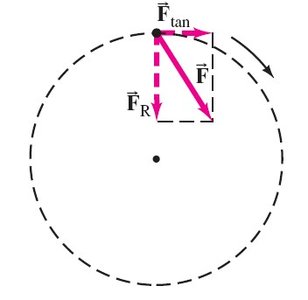
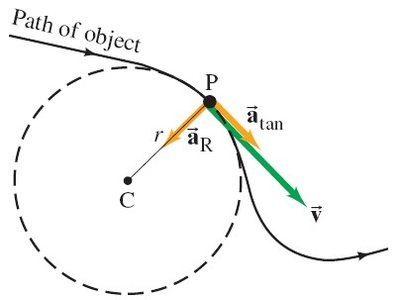
Nonuniform circular motion occurs when an object moves in a circle but its speed changes. The acceleration has both radial (centripetal) and tangential components.
Radial Acceleration:
Tangential Acceleration:
Total Acceleration:
5-6 Velocity-Dependent Forces: Drag and Terminal Velocity
When objects move through fluids, they experience drag forces that depend on their velocity. At low speeds, drag is proportional to velocity; at higher speeds, it is proportional to the square of velocity. Terminal velocity is reached when drag balances gravity.
Drag Force: (for small velocities), (for higher velocities)
Terminal Velocity: , where is mass, is gravity, and is the drag coefficient.
Example: Calculating terminal velocity for a falling object with known drag and acceleration.
Summary of Chapter 5
Kinetic friction:
Static friction:
Uniform circular motion: Centripetal acceleration , centripetal force
