 Back
BackChapter 6: Circular Motion, Orbits, and Gravity – Study Notes
Study Guide - Smart Notes
 Tailored notes based on your materials, expanded with key definitions, examples, and context.
Chapter 6: Circular Motion, Orbits, and Gravity
Introduction
This chapter explores the physics of objects moving in circles, the forces that govern such motion, and the universal law of gravitation. Applications include planetary orbits, apparent forces in rotating frames, and the concept of weightlessness.
Uniform Circular Motion
Velocity and Acceleration in Circular Motion
When an object moves in a circle at constant speed, its velocity vector is always tangent to the circle, but its direction changes continuously. This change in direction means the object is accelerating, even if its speed remains constant. The acceleration is always directed toward the center of the circle and is called centripetal acceleration.
Centripetal Acceleration: , where is the speed and is the radius of the circle.
Direction: Always points toward the center of the circle.
Velocity: Tangent to the circle at every point.
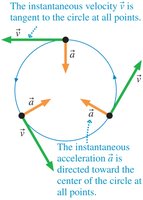
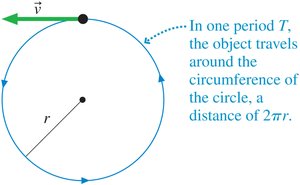
Period, Frequency, and Speed
The period () is the time for one complete revolution. The frequency () is the number of revolutions per second. The speed of an object in uniform circular motion is related to these quantities:
Example: Spinning Table Saw Blade
A table saw blade of diameter 25 cm spins at 3600 rpm. To find the period, speed, and acceleration of a tooth at the edge:
Convert rpm to Hz: Hz
Period:
Speed:
Acceleration:
Dynamics of Uniform Circular Motion
Forces in Circular Motion
According to Newton’s second law, a net force must act toward the center of the circle to maintain circular motion. This force is called the centripetal force and can be provided by tension, friction, gravity, or the normal force, depending on the situation.
Centripetal Force:
Direction: Always toward the center of the circle.
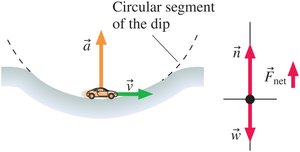
Examples: Forces on a Car
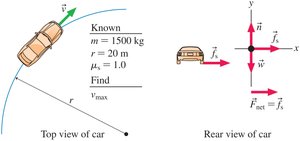
When a car rounds a corner or goes through a dip, the forces acting on it include the normal force, weight, and friction. At the bottom of a dip, the normal force exceeds the car’s weight, making passengers feel heavier.
When turning a corner, static friction between the tires and the road provides the necessary centripetal force. If friction is insufficient, the car will skid.
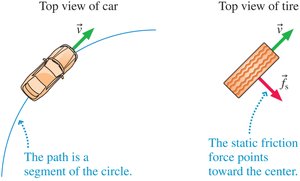
Maximum Speed on a Curve
The maximum speed a car can take a turn without sliding is determined by the maximum static friction force:
Maximum speed:
Banked Curves
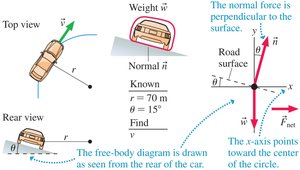
On a banked curve, the normal force provides a component toward the center, allowing a car to turn even without friction. The ideal speed for a banked curve of angle and radius is:
Apparent Forces in Circular Motion
Centrifugal Force and Apparent Weight
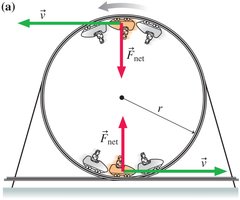
In a rotating frame, passengers may feel an outward "force" (centrifugal force), but this is not a real force. The sensation is due to inertia as the body resists the change in direction. Apparent weight changes in circular motion, such as on roller coasters, where the normal force (apparent weight) can be greater or less than true weight depending on position in the loop.
Circular Orbits and Weightlessness
Orbital Motion
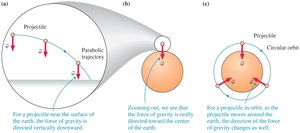
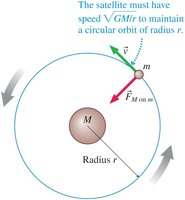
Satellites and projectiles in orbit are in free fall, continuously falling toward Earth but moving forward fast enough that the ground curves away beneath them. The force of gravity provides the necessary centripetal force for orbital motion.
Orbital speed near Earth's surface:
Period of orbit:
Weightlessness
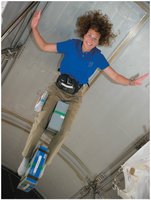
Astronauts in orbit experience weightlessness because they are in continuous free fall, not because there is no gravity. Both the spacecraft and its occupants accelerate toward Earth at the same rate.
Newton’s Law of Gravity
Universal Gravitation
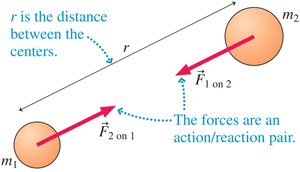
Newton’s law of universal gravitation states that every pair of masses attracts each other with a force proportional to the product of their masses and inversely proportional to the square of the distance between them:
(gravitational constant)
Gravity on Other Worlds
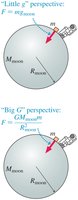
The weight of an object on another planet depends on the planet’s mass and radius:
Gravity and Orbits
Orbital Speed and Period
For a satellite of mass orbiting a planet of mass at radius :
Orbital speed:
Orbital period:
Geostationary Orbits
A geostationary satellite orbits Earth with a period of 24 hours, remaining above the same point on the equator. The required orbital radius can be found by setting hours in the period formula above.
Summary Tables
Key Equations and Concepts
Quantity | Equation | Description |
|---|---|---|
Centripetal Acceleration | Acceleration toward center in circular motion | |
Centripetal Force | Net force required for circular motion | |
Orbital Speed | Speed for stable circular orbit | |
Orbital Period | Time for one complete orbit | |
Newton’s Law of Gravity | Gravitational force between two masses |
Applications
Apparent Weight: Changes in circular motion, such as on roller coasters or in elevators.
Weightlessness: Experienced in orbit due to free fall.
Planetary Orbits: Governed by gravity and centripetal force.
Additional info: These notes synthesize textbook explanations, example problems, and conceptual questions to provide a comprehensive overview of circular motion, orbits, and gravity for college-level physics with calculus.
