Back
BackChapter 7: Energy – Conceptual Physics Study Notes
Study Guide - Smart Notes
 Tailored notes based on your materials, expanded with key definitions, examples, and context.
Energy
Definition and Properties
Energy is a fundamental concept in physics, quantifying a system’s ability to do work. It is observed when transferred or transformed and is a conserved quantity in the universe.
Energy: The property of a system that enables it to do work or produce heat.
Occurs in various forms (mechanical, thermal, chemical, etc.).
Can be transferred, but the total amount in the universe remains constant.
Matter: Substance with mass that occupies space.
Work
Definition and Calculation
Work is the process of energy transfer that occurs when a force acts upon an object causing displacement.
Work involves both force and distance.
Mathematically:
Unit: Joule (J), where
Work is done when a force moves an object over a distance.
Examples:
Lifting two loads one story high requires twice the work as lifting one load the same distance.
Lifting a load two stories high requires twice the work as lifting it one story.
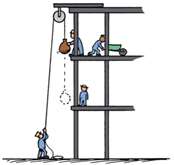
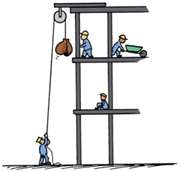
Example: A weightlifter raising a barbell from the floor does work on the barbell.

Power
Definition and Calculation
Power measures the rate at which work is done or energy is transferred.
Power:
Unit: Watt (W), where
1 kilowatt (kW) = 1000 watts (W)
Examples:
A worker uses more power running up stairs than climbing slowly.
Doubling the power of an engine doubles the work done in a given time interval.
Mechanical Energy
Types of Mechanical Energy
Mechanical energy is the energy due to the position or motion of an object. It is classified into two main types:
Potential Energy: Energy stored due to position.
Kinetic Energy: Energy of motion.
Potential Energy
Potential energy is stored energy held in readiness, with the potential to do work.
Examples: A stretched bow or rubber band stores energy.
Gravitational Potential Energy
Potential energy due to elevated position is called gravitational potential energy.
Examples: Water in an elevated reservoir, raised ram of a pile driver.
Calculated as the work required to lift an object against gravity.
Formula: (where = mass, = gravitational acceleration, = height)
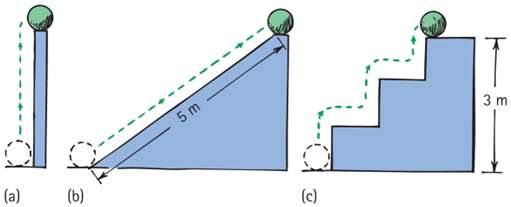
Example: The potential energy of a 10-N ball is the same regardless of the path taken to elevate it, as long as the height is the same.
Kinetic Energy
Kinetic energy is the energy of motion, given by one half the mass times the square of the speed.
Formula:
If speed is doubled, kinetic energy quadruples.
Kinetic energy is equal to the work required to bring an object from rest to its speed.
Work-Energy Theorem
Relationship Between Work and Energy
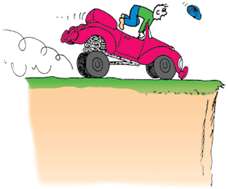
The work-energy theorem states that any change in kinetic energy is the result of work done on an object.
Formula:
Applies to both increasing and decreasing speed (e.g., applying brakes to slow a car).
Conservation of Energy
Law of Conservation of Energy
Energy cannot be created or destroyed; it can only be transformed from one form to another. The total energy in the universe remains constant.
Example: In a pile driver, energy transforms without net loss or gain.
In a bow and arrow system, work done in drawing the bow is stored as potential energy, which is transferred to the arrow as kinetic energy and some as heat.
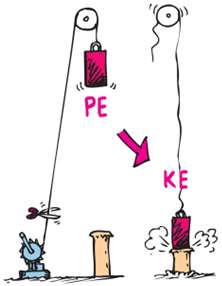

Kinetic Energy and Momentum Compared
Comparison Table
Both kinetic energy and momentum are properties of moving objects, but they differ in important ways.
Property | Kinetic Energy | Momentum |
|---|---|---|
Type | Scalar | Vector |
Dependence on Velocity | Proportional to | Proportional to |
Can be Canceled? | No | Yes (directional) |
Example: An object moving with twice the velocity of another (same mass) has twice the momentum but four times the kinetic energy.
Machines
Definition and Principles
A machine is a device for multiplying forces or changing the direction of forces. Machines cannot create energy but can transfer or transform it.
Principle: Conservation of energy applies to machines.
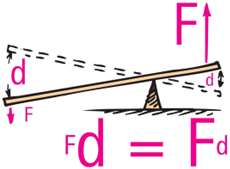
Work input equals work output:

Types of Simple Machines
Lever: Rotates on a fulcrum, allows a small force over a large distance to induce a large force over a short distance.
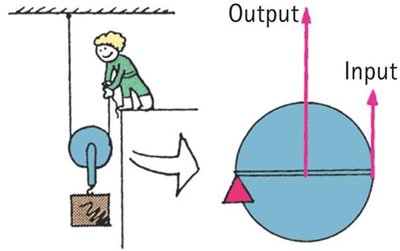
Pulley: Changes the direction of the input force, operates like a lever with equal arms.
Block and Tackle: System of pulleys that multiplies force.

Efficiency
Definition and Calculation
Efficiency is the percentage of work put into a machine that is converted into useful work output.
Formula:
Recycled Energy
Re-employment of Energy
Recycled energy refers to the use of energy that would otherwise be wasted. For example, heat from power plants can be used to heat buildings.
Typical power plants waste about 30% of their energy as heat.
Energy for Life
Biological Energy
The human body requires energy to function, obtained from food. Cells metabolize hydrocarbons, releasing energy when reacting with oxygen.
More energy is stored in food than in the products after metabolism.
Sources of Energy
Solar Energy
The Sun is a primary source of energy for Earth. Sunlight can be used to evaporate water, generate electricity via photovoltaic cells, and power wind turbines.
Photovoltaic cells convert solar energy to electricity.
More energy from the Sun hits Earth in one hour than all human consumption in a year.

Fuel Cells
Fuel cells produce electricity by compressing hydrogen and oxygen at electrodes, generating electric current.

Nuclear and Geothermal Energy
Concentrated energy sources include nuclear power (stored in uranium and plutonium) and geothermal energy (from underground reservoirs of hot water).
Dry-rock geothermal power produces electricity by injecting water into hot rock, generating steam to drive turbines.