 Back
BackChapter 7: Energy, Work, and Power – Study Notes
Study Guide - Smart Notes
 Tailored notes based on your materials, expanded with key definitions, examples, and context.
Energy
Definition and Concept
Energy is a fundamental concept in physics, defined as the ability to do work. It can be considered both as a process (the act of doing work) and as a thing (a measurable quantity stored in objects or systems).
Ability to do work: Energy enables physical systems to cause changes or perform actions.
Process vs. Thing: Energy can be transferred or transformed, and it exists in various forms.
Work
Definition and Calculation
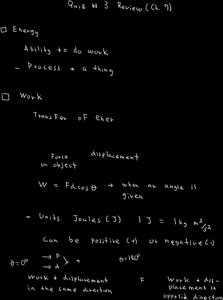
Work is the transfer of energy that occurs when a force acts upon an object causing displacement. The amount of work done depends on the magnitude of the force, the displacement, and the angle between them.
Formula: (when an angle is given between force and displacement)
Units: Joules (J), where
Work can be positive or negative: Positive when force and displacement are in the same direction; negative when they are in opposite directions.
Example: If a box is pushed across the floor, work is done by the force applied in the direction of movement.
Work-Energy Theorem
Relationship Between Work and Kinetic Energy
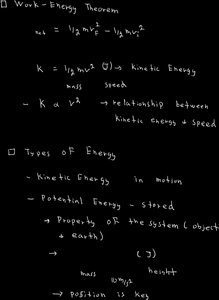
The work-energy theorem states that the net work done on an object is equal to the change in its kinetic energy.
Formula:
Kinetic Energy (K):
Relationship: Kinetic energy increases with the square of speed; doubling speed quadruples kinetic energy.
Example: A moving car has kinetic energy proportional to its mass and the square of its velocity.
Types of Energy
Kinetic and Potential Energy
Energy exists in several forms, but two primary types in mechanics are kinetic energy and potential energy.
Kinetic Energy: Energy of motion; depends on mass and speed.
Potential Energy: Stored energy due to position or configuration; for example, gravitational potential energy depends on height and mass.
Properties: Potential energy is a property of the system (object and Earth); position is key.
Formula for Gravitational Potential Energy:
Example: A ball held at a height has potential energy; when released, it converts to kinetic energy as it falls.
Power
Definition and Calculation
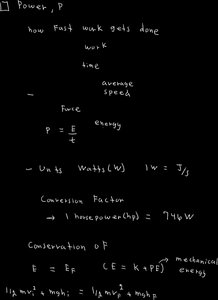
Power measures how fast work gets done, or the rate at which energy is transferred or transformed.
Formula:
Units: Watts (W), where
Conversion Factor:
Example: A motor lifting a weight quickly does more work per second, thus has higher power.
Conservation of Energy
Principle and Application
The conservation of energy principle states that the total energy in a closed system remains constant, though it may change forms (e.g., from kinetic to potential energy).
Formula: (initial energy equals final energy)
Mechanical Energy: (sum of kinetic and potential energy)
Expanded Formula:
Example: A pendulum at its highest point has maximum potential energy; as it swings down, energy converts to kinetic.
