 Back
BackChapter 7: Interactions – Energy, Forces, and Fundamental Processes
Study Guide - Smart Notes
 Tailored notes based on your materials, expanded with key definitions, examples, and context.
Chapter 7: Interactions
Introduction
This chapter explores how interactions between objects convert energy from one form to another, the nature of potential energy, energy dissipation, and the fundamental forces that govern all physical processes in the universe.
Section 7.1: The Effects of Interactions
Definition of Interaction
Interaction: A mutual influence between two objects that produces a change, such as motion or state.
Interactions are responsible for causing acceleration and changes in energy.
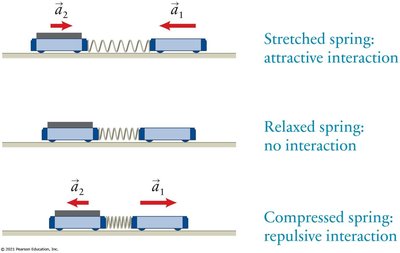
Examples include attractive and repulsive forces, such as those seen in springs or collisions.
Section 7.2: Potential Energy
Nature of Potential Energy
Potential Energy (U): A form of internal energy associated with the configuration or state of a system, particularly in reversible processes.
Potential energy can be spontaneously undone, meaning the system can return to its original state without external input.
Examples: Gravitational potential energy, elastic potential energy in springs.
Section 7.3: Energy Dissipation
Coherent vs. Incoherent Energy
Coherent energy: Ordered forms of energy, such as kinetic or potential energy, associated with organized motion or configuration.
Incoherent energy: Disordered forms, such as thermal energy, resulting from dissipative processes.
Energy dissipation converts coherent energy into incoherent energy, often as heat.
Example: When a piece of paper is crumpled, the ordered motion (coherent) is converted into random molecular motion (incoherent/thermal).
Section 7.4: Source Energy
Energy Transformations
Energy can change between coherent forms (reversible processes) or from coherent to incoherent forms (irreversible, dissipative processes).
Some energy is always dissipated as thermal energy in real processes.
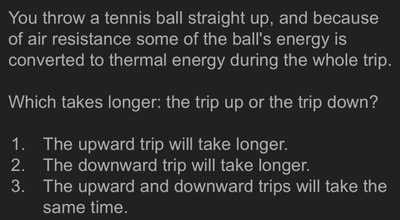
Non-dissipative process: All kinetic energy is conserved.
Dissipative process: Some kinetic energy is lost as heat, causing objects to slow down.
Section 7.5: Interaction Range
Classification of Interactions
Matter can be classified by how its particles interact: gravitationally, electromagnetically, etc.
The strength and range of interactions depend on the type of force and the distance between objects.
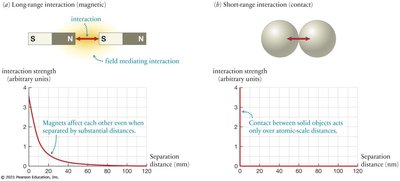
Long-range interactions: e.g., magnetic forces, act over large distances.
Short-range interactions: e.g., contact forces, act only at atomic scales.
Section 7.6: Fundamental Interactions
The Four Fundamental Forces
All interactions in nature can be classified into four fundamental forces, each with unique properties:
Type | Required Attribute | Relative Strength | Range | Gauge Particle | Propagation Speed |
|---|---|---|---|---|---|
Gravitational | Mass | 1 | Infinity | Graviton? | c? |
Weak | Weak charge | 1025 | 10-18 m | Vector bosons | Varies |
Electromagnetic | Electric charge | 1036 | Infinity | Photon | c |
Strong | Color charge | 1038 | 10-15 m | Gluon | c |
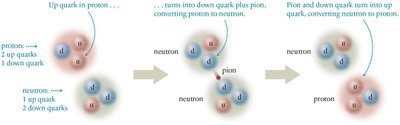
Example: The strong force binds quarks together in protons and neutrons, and mediates interactions via pion exchange.
Section 7.7: Interactions and Accelerations
Momentum and Acceleration in Interactions
During interactions, the change in momentum () of two objects is equal and opposite, consistent with Newton's Third Law.
Acceleration is caused by the interaction force and can be analyzed using conservation laws.
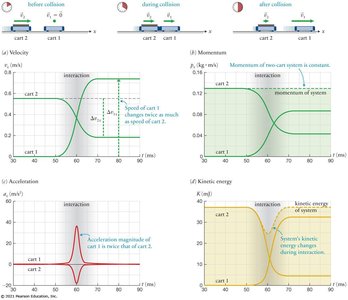
In collisions, kinetic energy may not be conserved if the process is dissipative, but momentum is always conserved in isolated systems.
Section 7.8: Nondissipative Interactions
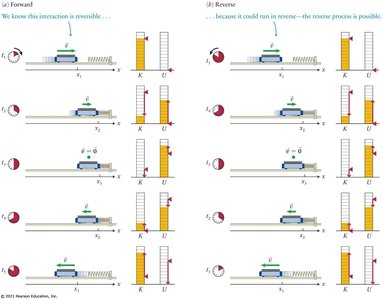
Conservation of Mechanical Energy
For a closed system with only nondissipative (reversible) interactions:
If and , then
The system will accelerate in a direction that reduces its potential energy.
Section 7.9: Potential Energy Near Earth’s Surface
Gravitational Potential Energy
For an object of mass near Earth's surface, the change in gravitational potential energy is:
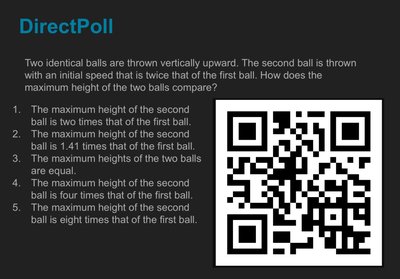
When a ball is dropped from a height, its loss in potential energy equals its gain in kinetic energy (if air resistance is negligible).
Example: Dropping a ball from height :
In non-dissipative processes, mechanical energy is conserved.
Section 7.10: Dissipative Interactions
Energy Loss in Real Processes
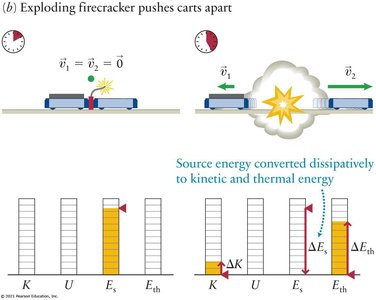
In dissipative interactions, some mechanical energy is converted to thermal energy or other incoherent forms.
These processes are irreversible.
Example 7.6: Fender Bender
Two cars collide and stick together (totally inelastic collision).
Initial kinetic energy:
Final kinetic energy:
Energy dissipated:
In such collisions, some energy is always lost as heat, sound, or deformation.
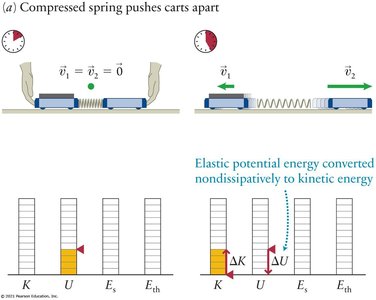
Reversible vs. Irreversible Explosive Separation
Reversible: The process can run backward, restoring the original state.
Irreversible: The process cannot spontaneously reverse; energy is dissipated.
Summary Table: Fundamental Interactions
Force | Relative Strength | Range | Carrier Particle |
|---|---|---|---|
Gravitational | 1 | Infinite | Graviton (hypothetical) |
Weak | 1025 | 10-18 m | W and Z bosons |
Electromagnetic | 1036 | Infinite | Photon |
Strong | 1038 | 10-15 m | Gluon |
Key Equations
Conservation of Energy (closed system):
Gravitational Potential Energy (near Earth):
Kinetic Energy:
Momentum Conservation (isolated system):
Additional info: The chapter also introduces the concept of reversibility in physical processes, emphasizing that only nondissipative interactions are reversible, while dissipative interactions increase the system's entropy and are irreversible.
