 Back
BackChapter 7: Interactions – Principles and Practice of Physics
Study Guide - Smart Notes
 Tailored notes based on your materials, expanded with key definitions, examples, and context.
Chapter 7: Interactions
Introduction to Interactions
Interactions are fundamental events in physics that involve mutual influences between two objects, resulting in either a physical change or a change in motion. Understanding interactions is crucial for analyzing how energy is transferred and transformed in physical systems.
Section 7.1: The Effects of Interactions
Definition and Classification of Interactions
Interaction: A mutual influence between two objects that produces a change in motion or a physical change.
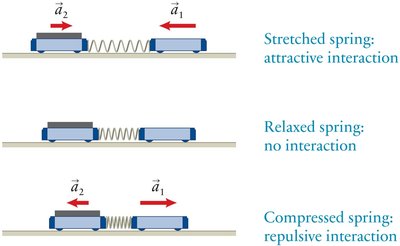
Interactions can be attractive (objects accelerate toward each other) or repulsive (objects accelerate away from each other).
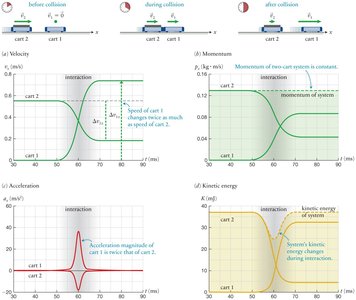
Interactions are classified by their effects, such as changes in velocity, momentum, acceleration, and kinetic energy.
Conservation Laws in Interactions
Momentum Conservation: In an isolated system, the total momentum remains constant before, during, and after an interaction.
Kinetic Energy: In elastic collisions, the system's kinetic energy is conserved before and after the interaction, but not necessarily during the interaction.
The ratio of the x-components of the accelerations of two interacting objects is the negative inverse of the ratio of their inertias:
Example: Car and Truck Collision
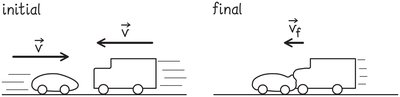
In a totally inelastic collision between a small car and a heavy truck moving at equal speeds in opposite directions, both experience equal changes in momentum, but the car undergoes a larger change in velocity and acceleration due to its smaller inertia.
Energy During Interactions
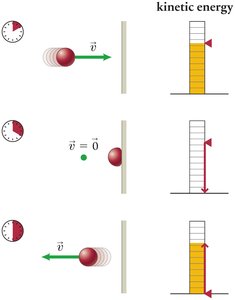
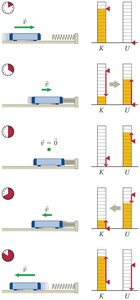
During interactions, the system's kinetic energy may temporarily decrease as it is converted to internal energy (e.g., deformation), but is restored after the interaction in elastic collisions.
Section 7.2: Potential Energy
Definition and Types of Potential Energy
Potential Energy (U): The part of converted kinetic energy that is temporarily stored as internal energy and can be recovered as kinetic energy in reversible processes.
Potential energy is associated with reversible changes in the configuration of a system, such as the compression of a spring (elastic potential energy) or the elevation of a mass (gravitational potential energy).
Section 7.3: Energy Dissipation
Coherent vs. Incoherent Energy
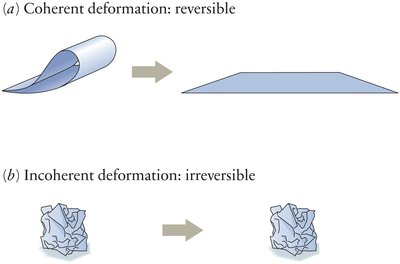
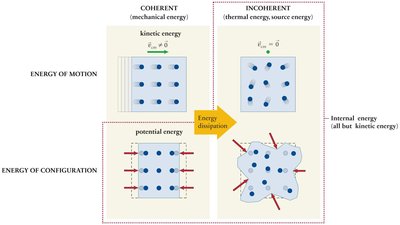
Coherent Energy: Ordered energy, such as kinetic and potential energy, associated with the motion and configuration of objects.
Incoherent Energy: Disordered energy, such as thermal energy, associated with random atomic motion.
Energy dissipation occurs when coherent energy is irreversibly converted to incoherent energy (e.g., friction converting kinetic energy to heat).
Section 7.4: Source Energy
Classification of Energy Types
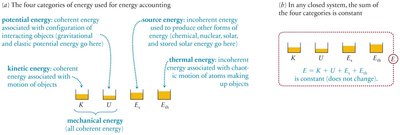
All energy can be categorized as:
Kinetic Energy (K): Energy of motion (coherent).
Potential Energy (U): Energy of configuration (coherent).
Source Energy (E_s): Incoherent energy from chemical, nuclear, solar, or stored solar sources.
Thermal Energy (E_{th}): Incoherent energy due to random atomic motion.
Energy conservation in a closed system is expressed as:
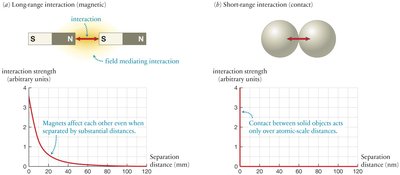
Section 7.5: Interaction Range
Long-Range vs. Short-Range Interactions
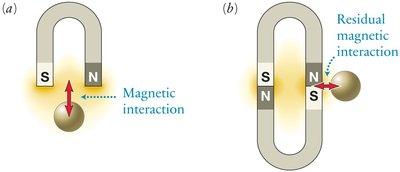
Long-range interactions: Influence is appreciable over large distances (e.g., gravitational, electromagnetic).
Short-range interactions: Influence is significant only when objects are in close contact (e.g., contact forces between billiard balls).
Fields are used to model long-range interactions, while exchange of gauge particles can model both types.
Section 7.6: Fundamental Interactions
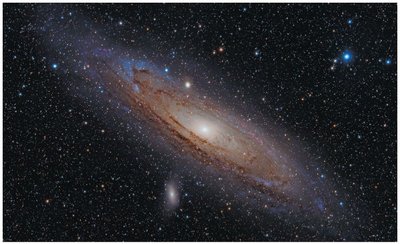
The Four Fundamental Interactions
Type | Required Attribute | Relative Strength | Range | Gauge Particle |
|---|---|---|---|---|
Gravitational | Mass | 1 | Infinity | Graviton (hypothetical) |
Electromagnetic | Electric charge | 1036 | Infinity | Photon |
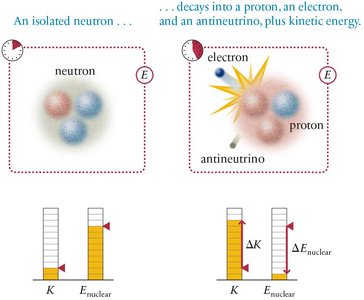
Weak | Weak charge | 1025 | 10-18 m | Vector bosons |
Strong | Color charge | 1038 | 10-15 m | Gluon |
Section 7.7: Interactions and Accelerations
Mathematical Relationship Between Acceleration and Inertia
For two interacting objects of constant inertia in an isolated system:
This relationship holds for all interactions in an isolated two-object system.
Section 7.8: Nondissipative Interactions
Energy Conservation in Nondissipative Systems
For a closed system with only nondissipative interactions:
Mechanical energy (kinetic + potential) is conserved.
Potential energy is a unique function of position, and changes in potential energy are independent of the path taken.
Section 7.9: Potential Energy Near Earth's Surface
Gravitational Potential Energy
For an object of mass m near Earth's surface, the gravitational potential energy is:
The change in gravitational potential energy between two points is independent of the path taken.
Section 7.10: Dissipative Interactions
Irreversible Processes and Energy Dissipation
Dissipative interactions are irreversible and involve the conversion of mechanical energy to thermal energy.
For a closed system undergoing a dissipative process:
In inelastic collisions, some kinetic energy is irreversibly converted to thermal energy.
can
Summary Table: Types of Energy and Interactions
Energy Type | Coherent (Ordered) | Incoherent (Disordered) |
|---|---|---|
Kinetic | Motion of objects | Thermal motion of atoms |
Potential | Elastic, gravitational | Chemical, nuclear |
Key Equations
Momentum conservation:
Mechanical energy conservation (nondissipative):
Gravitational potential energy near Earth's surface:
Energy conservation (general):
Conclusion
Understanding interactions and the associated energy transformations is fundamental to physics. By classifying interactions as dissipative or nondissipative, and by tracking energy in its various forms, we can analyze and predict the outcomes of physical processes in both simple and complex systems.
