 Back
BackChapter 7: Rotational Motion – Structured Study Notes
Study Guide - Smart Notes
 Tailored notes based on your materials, expanded with key definitions, examples, and context.
Rotational Motion
Introduction to Rotational Motion
Rotational motion refers to the movement of a rigid body turning about an axis. This chapter explores the fundamental concepts and equations governing rotational dynamics, drawing analogies to linear motion.
Rotational motion: Motion of an object (rigid body) that turns on an axis.
Rigid body: An object whose parts remain fixed relative to each other during motion.
Revolution: One complete cycle in the motion of an object about a point.

Example: Balanced Rock in Arches National Park is an example of stable equilibrium, illustrating the concept of center of gravity in rotational motion.
Describing Circular and Rotational Motion
Angular Position
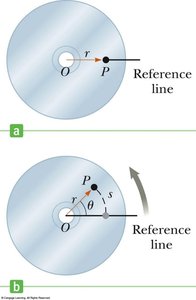
The angular position of a rigid object is the angle θ between a reference line on the object and a fixed reference line in space, often chosen as the x-axis.
Reference line: Used to measure angular position.
Axis of rotation: The center about which the object rotates.
Angular Displacement
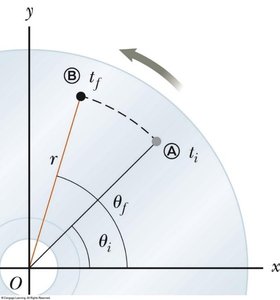
Angular displacement (Δθ) is the angle through which an object rotates during a given time interval. Each point on the object undergoes the same angular displacement.
Formula:
SI unit: radian (rad)
Angular Velocity and Acceleration
Angular velocity (ω) and angular acceleration (α) describe how quickly an object rotates and how its rotational speed changes.
Average angular velocity:
Instantaneous angular velocity:
Average angular acceleration:
Instantaneous angular acceleration:
SI units: rad/s (velocity), rad/s² (acceleration)
Analogies Between Linear and Rotational Motion
Rotational motion equations mirror those of linear motion, with angular variables replacing linear ones.
Linear displacement:
Angular displacement:
Linear velocity:
Angular velocity:
Linear acceleration:
Angular acceleration:
Forces in Circular Motion
Centripetal Force
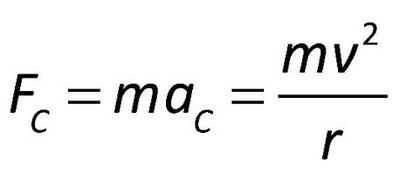
Circular motion requires a net force directed toward the center, called centripetal force. It is not a separate force but must be supplied by actual physical forces.
Formula:
Direction: Toward the center of the circle.
Torque
Definition and Calculation
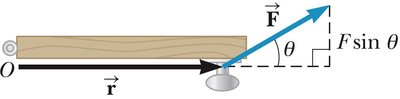
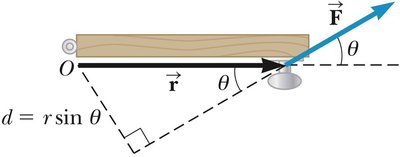
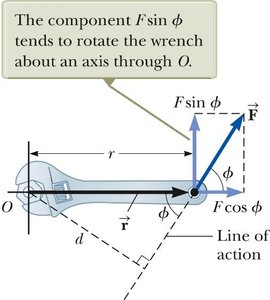
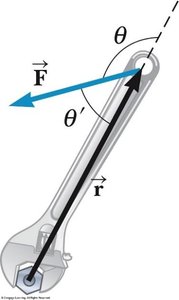
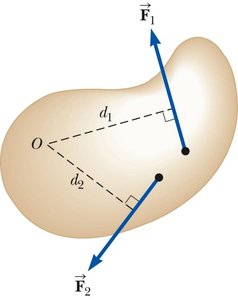
Torque (τ) is the rotational equivalent of force, causing angular acceleration. It depends on the force, the distance from the axis, and the angle between them.
Formula:
SI unit: Newton-meter (N·m)
Lever arm: The perpendicular distance from the axis to the line of action of the force.

Direction of Torque
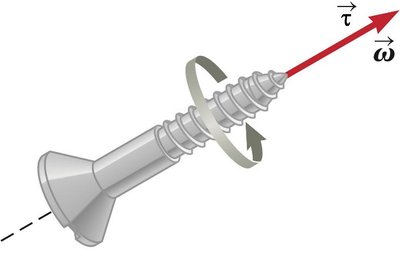
Torque is a vector quantity, perpendicular to the plane formed by the position and force vectors. The right-hand rule determines its direction.
Counterclockwise: Positive torque
Clockwise: Negative torque
Net torque: Sum of all individual torques
Gravitational Torque and Center of Gravity
Center of Mass (Gravity)
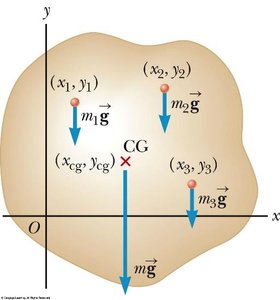
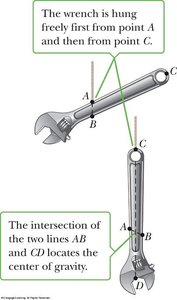
The center of mass is the point where the object's mass is considered to be concentrated for rotational calculations. The center of gravity is where the weight exerts no net torque.
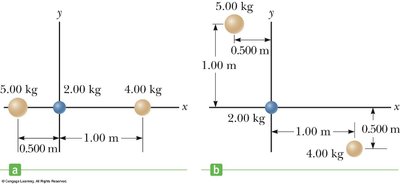
Calculation: ,
Homogeneous objects: Center of mass lies on the axis of symmetry.
Rotational Dynamics and Moment of Inertia
Moment of Inertia
Moment of inertia (I) quantifies an object's resistance to changes in rotational motion. It depends on mass distribution and axis location.
Formula:
SI unit: kg·m²
Extended objects: Different shapes have characteristic moments of inertia.
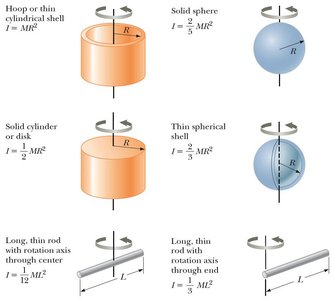
Newton's Second Law for Rotation
Newton's second law for rotation relates net torque to angular acceleration and moment of inertia.
Formula:
Angular acceleration: Directly proportional to net torque, inversely proportional to moment of inertia.
Rotational Kinetic Energy
Energy in Rotational Motion
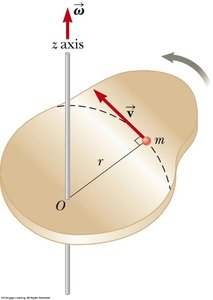
Objects rotating about an axis possess rotational kinetic energy, analogous to translational kinetic energy.
Formula:
Each particle:
Rolling Motion
Rolling Without Slipping
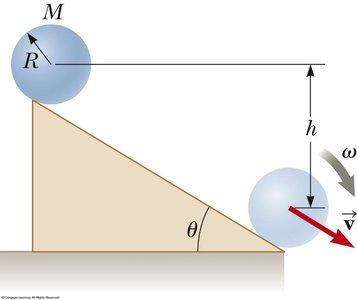
When an object rolls without slipping, its rotational and translational motions are linked. The total energy includes both forms.
Condition:
Energy conservation:
Rotational Systems with Pulleys
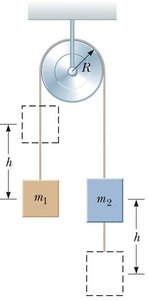
Systems involving pulleys and masses combine rotational and translational dynamics. The speed of the masses and angular speed of the pulley are found using energy conservation and moment of inertia.
Energy conservation:
Moment of inertia for pulley: (for a hollow cylinder)
Physics Glossary (Chapter 7)
Rotational motion: Motion about an axis
Angular position: Angle relative to a reference line
Angular displacement: Change in angular position
Angular velocity: Rate of change of angular position
Angular acceleration: Rate of change of angular velocity
Center of gravity: Point where weight exerts no net torque
Moment of inertia: Resistance to rotational acceleration
Rolling motion: Combination of rotational and translational motion
