 Back
Chapter 8: Equilibrium and Elasticity – Physics with Calculus Study Notes
Study Guide - Smart Notes
 Tailored notes based on your materials, expanded with key definitions, examples, and context.
Equilibrium and Elasticity
Conditions for Equilibrium
For an object or structure to be in equilibrium, certain physical conditions must be satisfied. These conditions ensure that the object remains at rest or moves with constant velocity, and does not rotate or tip over.
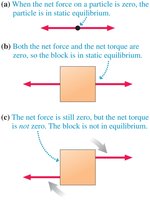
Static Equilibrium: An object at rest is said to be in static equilibrium.
Net Force Condition: The net force acting on the object must be zero.
Net Torque Condition: The net torque acting on the object must also be zero.
Example: A balanced arrangement of rocks on a beam illustrates equilibrium, where both net force and net torque are zero.

Torque and Static Equilibrium
Torque is a measure of the tendency of a force to rotate an object about a pivot point. For extended objects, both force and torque must be considered to determine equilibrium.
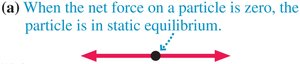
Particle Model: If the object can be modeled as a particle, static equilibrium is achieved when the net force is zero.
Extended Object: For objects that can rotate, both net force and net torque must be zero.
Key Equations:
Net force:
Net torque:
Identifying Static Equilibrium
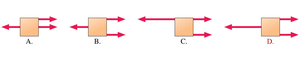
To determine if an object is in static equilibrium, analyze the forces and torques acting on it. Only when both are zero is the object truly in equilibrium.
Example: Lifting a Load
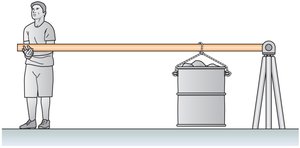
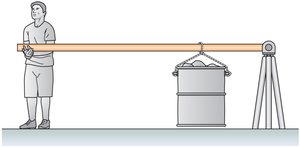
Consider a strongman lifting a beam with a heavy bucket attached. The beam is supported at a pivot and lifted at its end. To solve for the forces, apply the conditions for static equilibrium.
Object of Interest: The beam is analyzed, not the man or the bucket.
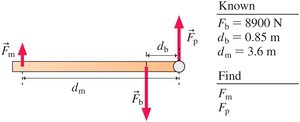
Forces: Downward force from the bucket, upward force from the man, and upward force from the pivot.
Distances: Forces act at different distances from the pivot, which is the natural axis for torque calculations.
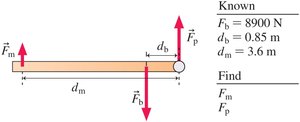
Equilibrium Equations:
Net force:
Net torque:
Choosing the Pivot Point
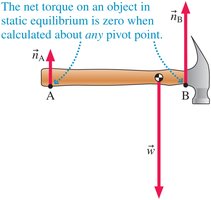
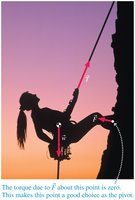
For static equilibrium, the net torque about every point must be zero. Choosing the right pivot point can simplify calculations, especially when some forces are poorly specified.
Natural Axis: The axis about which rotation would occur if not in equilibrium.
Strategic Choice: Choose the pivot where unknown forces act to eliminate their torque contributions.
Stability and Balance
Base of Support and Center of Gravity
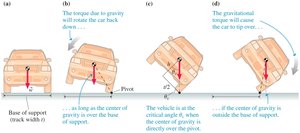
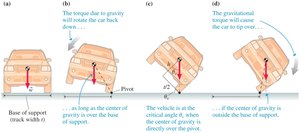
An extended object rests on a base of support. Stability is improved by a wider base and a lower center of gravity. The center of gravity must remain over the base for stability.
Stable Equilibrium: If the center of gravity is over the base, gravity rotates the object back to stability.
Unstable Equilibrium: If the center of gravity moves outside the base, the object tips over.
Ladder Safety and Stability
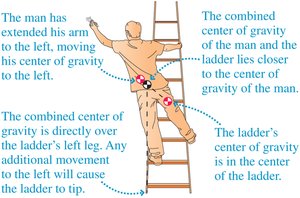
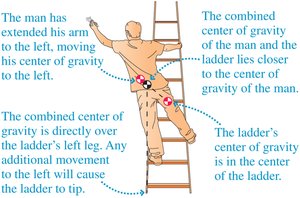
When a person leans out from a ladder, the combined center of gravity shifts. If it moves outside the ladder's base, the ladder tips.
Combined Center of Gravity: The center of gravity of the man and ladder is closer to the man's center.
Safe Lean Angle: There is a narrow range for safe use; a wider base increases safety.
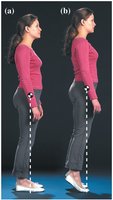
Stability and Balance of the Human Body
Humans constantly adjust their body position to keep their center of gravity over their base of support, especially when moving or standing on tiptoes.
Forces and Torques in the Body
Mechanical Advantage
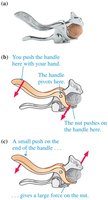
Mechanical advantage allows large forces to be applied with a smaller force, using leverage. The ratio of output force to input force is the mechanical advantage.
Example: A nutcracker applies three times the force to the nut as the force applied by the hand.
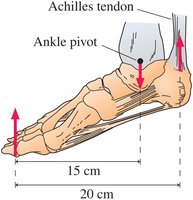
Example: Forces in the Ankle Joint
The foot pivots about the ankle, with forces applied at different points. The tension in the Achilles tendon and the force from the floor are analyzed for static equilibrium.
Forces: Upward force from the floor, upward force from the tendon, downward force at the ankle joint.
Moment Arms: Distances from the pivot are used to calculate torques.
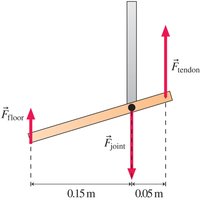
Equilibrium Equations:
Net force:
Net torque:
Springs and Hooke’s Law
Elasticity and Restoring Force
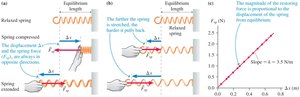
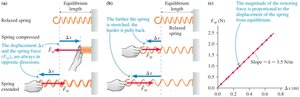
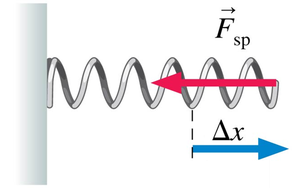
Elastic systems, such as springs and rubber bands, exhibit restoring forces that return the system to equilibrium. The spring force is proportional to the displacement.
Hooke’s Law
Hooke’s law describes the relationship between the restoring force and the displacement of a spring:
Equation:
Spring Constant: is the spring constant, measured in N/m.
Negative Sign: Indicates that the restoring force and displacement are in opposite directions.

Comparing Spring Constants
The spring with the steepest slope in a force vs. displacement graph has the largest spring constant. It takes more force to stretch the spring a given distance.
Stretching and Compressing Materials
Elasticity of Materials
Solid materials can be modeled as atoms connected by spring-like bonds. The elasticity of a material determines how much it stretches or compresses under force.
Rigid Materials: Experience small changes in dimension under normal forces (e.g., steel).
Pliant Materials: Can be stretched easily or show large deformations (e.g., rubber bands).
Young’s Modulus
The spring constant for a rod depends on its cross-sectional area, length, and material. Young’s modulus () is a property of the material and quantifies its elasticity.
Equation:
Stress: Force per unit area ()
Strain: Relative change in length ()
Beyond the Elastic Limit
When the stretch stays within the linear region, a rod obeys Hooke’s law and returns to its original length when the force is removed. The elastic limit is the maximum stretch before permanent deformation occurs.
Ultimate Stress: The largest stress a material can sustain before breaking.
Example: A steel cable stretches when a heavy ball is suspended from it. The amount of stretch depends on Young’s modulus and the cable’s dimensions.
Additional info: These notes cover the main concepts of equilibrium, torque, stability, elasticity, and Hooke’s law, as relevant to a college-level Physics with Calculus course.
