 Back
Chapter 8: Equilibrium and Elasticity – Physics with Calculus Study Notes
Study Guide - Smart Notes
 Tailored notes based on your materials, expanded with key definitions, examples, and context.
Equilibrium and Elasticity
Introduction
This chapter explores the principles of static equilibrium for extended objects, the role of torque, stability, and the properties of elastic materials such as springs and rods. Understanding these concepts is essential for analyzing real-world systems ranging from bridges and ladders to biological structures.
Torque and Static Equilibrium
Static Equilibrium of Particles and Extended Objects
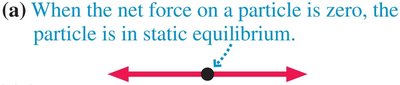
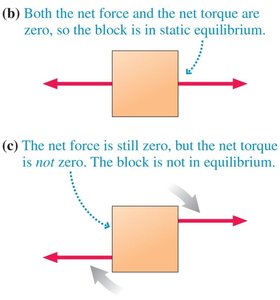
Static equilibrium occurs when an object is at rest and remains at rest under the action of forces and torques. For a particle, equilibrium is achieved when the net force is zero. For extended objects, both net force and net torque must be zero.
Net Force Condition:
Net Torque Condition:
Static Equilibrium: Both conditions must be satisfied for an object to be in static equilibrium.
Torque (): The rotational effect of a force, calculated as where is the distance from the pivot and is the perpendicular component of the force.
Example: A block with equal and opposite forces is in static equilibrium. If the net force is zero but the net torque is not, the object is not in equilibrium.
Conditions for Static Equilibrium
First Condition: (no net force)
Second Condition: (no net torque)
Both conditions must be met for extended objects.
Identifying Static Equilibrium
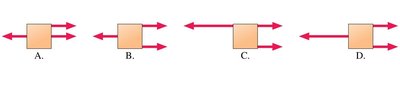
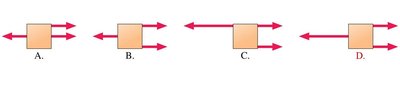
To determine if an object is in static equilibrium, analyze the forces and torques acting on it.
Example: Lifting a Load
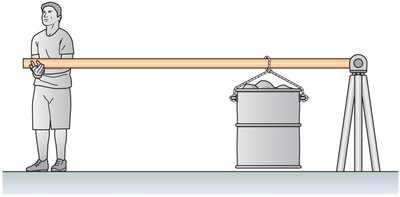
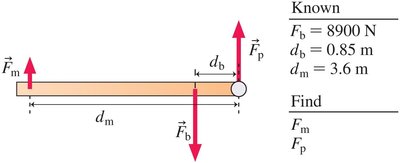
Consider a beam pivoted at one end, with a heavy load suspended and a person lifting the other end. The forces and torques must be balanced to keep the beam in static equilibrium.
Force of the bucket:
Distances from pivot: (bucket), (man)
Torque equation:
Force equation:
Example Calculation: If N, m, m, solve for and .
Choosing the Pivot Point
Pivot Point Selection
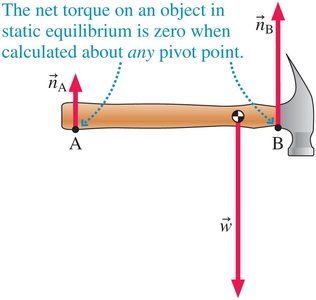
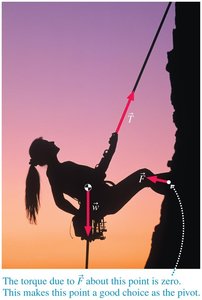
The net torque must be zero about every point for static equilibrium. Choosing a convenient pivot point can simplify calculations, especially where forces are poorly specified.
Natural axis: The axis about which rotation would occur if not in equilibrium.
Strategic choice: Select the pivot where unknown forces act, as their torque will be zero.
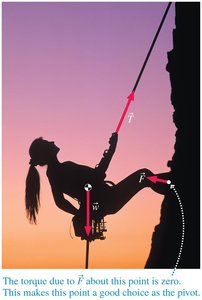
Problem-Solving Approach: Static Equilibrium
Steps for Solving Static Equilibrium Problems
Strategize: Identify the object of interest and choose a pivot point.
Prepare: Draw a diagram, label forces, and measure distances from the pivot.
Solve: Write equations for net force and net torque, solve for unknowns.
Assess: Check if the solution is reasonable and answers the question.
Stability and Balance
Stable vs. Unstable Equilibrium
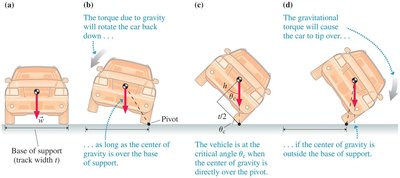
An object is in stable equilibrium if forces tend to return it to its equilibrium position. If forces move it away, it is in unstable equilibrium.
Stable equilibrium: Center of gravity over base of support.
Unstable equilibrium: Center of gravity outside base of support.
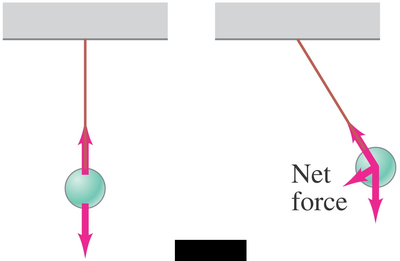
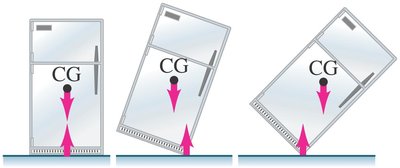
Stability and Center of Gravity
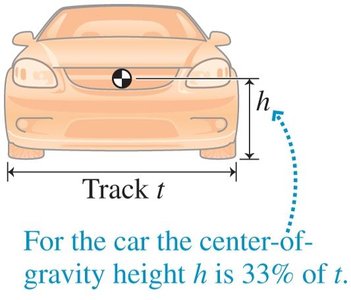
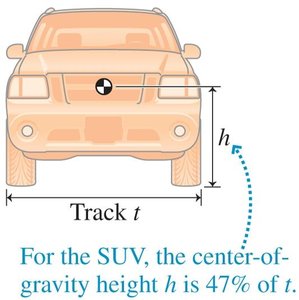
Wider base/lower center of gravity: Improves stability.
Critical angle (): The angle at which the center of gravity is over the edge of the base.
Formula: where is track width and is height of center of gravity.
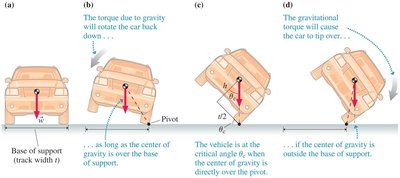
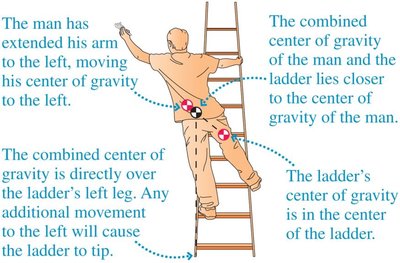
Ladder Safety Example
When a person leans out from a ladder, the combined center of gravity may move outside the base, causing the ladder to tip.
Springs and Hooke’s Law
Elasticity and Restoring Force
Elastic materials return to their original shape after deformation. The restoring force is proportional to the displacement.
Hooke’s Law:
Spring constant (): Measures stiffness, units N/m.
Stretching and Compressing Materials
Young’s Modulus and Material Properties
Solid materials can be modeled as atoms connected by spring-like bonds. The spring constant for a rod depends on its cross-sectional area, length, and material.
Young’s modulus ():
Restoring force:
Stress:
Strain:
Table: Young’s modulus for common materials
Material | Young’s modulus (1010 N/m2) |
|---|---|
Cast iron | 20 |
Steel | 20 |
Silicon | 13 |
Copper | 11 |
Aluminum | 7 |
Glass | 7 |
Concrete | 3 |
Wood (Douglas Fir) | 1 |
Beyond the Elastic Limit
Ultimate Stress and Tensile Strength
If a material is stretched beyond its elastic limit, it will not return to its original shape and may break. The maximum stress a material can withstand is its tensile strength.
Forces and Torques in the Body
Biomechanics and Mechanical Advantage
Muscles and tendons apply forces and torques to maintain equilibrium. The arrangement of bones and tendons can provide mechanical advantage, allowing large forces to be applied with smaller input forces.
Mechanical advantage: Ratio of output force to input force.
Example: Nutcracker applies 3 times the force to the nut as the hand applies.
Summary of Key Concepts
Static equilibrium: ,
Stability: Center of gravity over base of support
Hooke’s law:
Young’s modulus:
Mechanical advantage: Leverage increases force output
