 Back
BackChapter 8: Force – Foundations of Dynamics
Study Guide - Smart Notes
 Tailored notes based on your materials, expanded with key definitions, examples, and context.
Chapter 8: Force
8.1 Momentum and Force
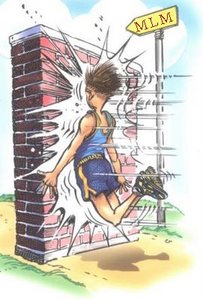
Force is the capacity to move objects or cause physical change. In physics, force is quantitatively defined as the rate of change of momentum. The force of impact during a collision depends on both the speed and inertia (mass) of the object, as well as the duration of the interaction. The longer the impact time, the smaller the force of impact for the same change in momentum.
Momentum (\(\vec{p}\)): The product of an object's mass and velocity, \(\vec{p} = m\vec{v}\).
Force (\(\vec{F}\)): The time rate of change of momentum, \(\vec{F} = \frac{d\vec{p}}{dt}\).
Key Relationships:
\(\vec{F} \propto \Delta \vec{p}\)
\(\vec{F} \propto \frac{1}{\Delta t}\)
\(\vec{F} \propto \frac{\Delta \vec{p}}{\Delta t}\)
Constant Velocity: If an object moves at constant velocity, the net force on it is zero.
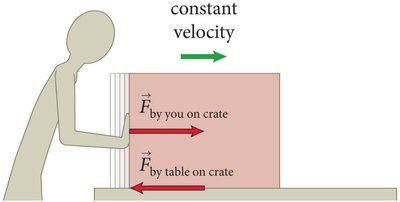
Example: Pushing a 10 kg crate at a steady speed of 2 m/s results in zero net force, as the forces exerted by the person and the surface balance each other.
8.2 Reciprocity of Forces (Newton's Third Law)
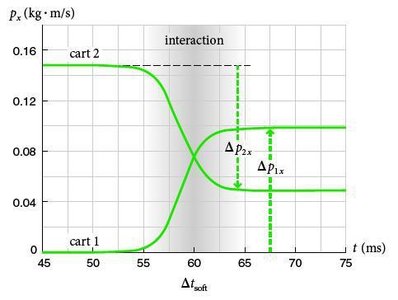
Forces always occur in pairs, known as interaction pairs. When two objects interact, each exerts a force on the other that is equal in magnitude and opposite in direction. This is a direct consequence of the conservation of momentum.
Soft vs. Hard Collisions: The force during a collision depends on the duration of the interaction. Shorter interaction times (hard collisions) result in larger forces.
Mathematical Expression:
\(\vec{F}_{\text{by 2 on 1}} = \frac{\Delta \vec{p}_1}{\Delta t}\)
\(\vec{F}_{\text{by 1 on 2}} = \frac{\Delta \vec{p}_2}{\Delta t}\)
\(\vec{F}_{\text{by 2 on 1}} = -\vec{F}_{\text{by 1 on 2}}\)
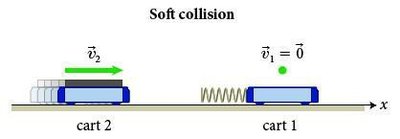
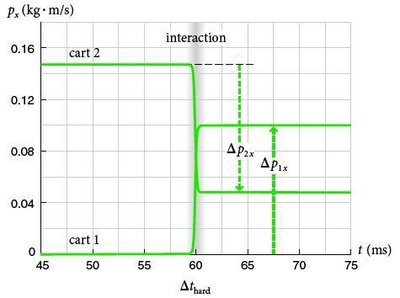
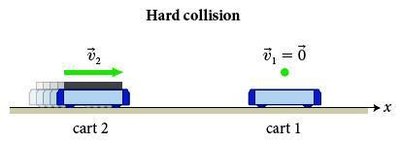
Example: When a book falls, the force exerted by the book on Earth is equal in magnitude to the force exerted by Earth on the book.
8.3 Identifying Forces
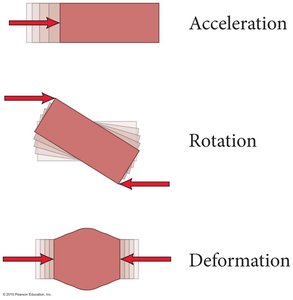
Forces can be classified as contact forces (arising from physical contact) or field forces (action at a distance, such as gravity or electromagnetism). Identifying all forces acting on an object is essential for analyzing its motion.
Contact Forces: Pushing, pulling, friction, normal force.
Field Forces: Gravitational, electric, and magnetic forces.
Example: A book on a table experiences a contact force from the table and a gravitational force from Earth.
8.4 Translational Equilibrium
An object is in translational equilibrium if it is at rest or moving with constant velocity. This occurs when the vector sum of all forces acting on the object is zero. Equilibrium does not mean the absence of forces, but rather that all forces balance.
Condition for Equilibrium: \(\sum \vec{F} = 0\)
8.5 Free-Body Diagrams
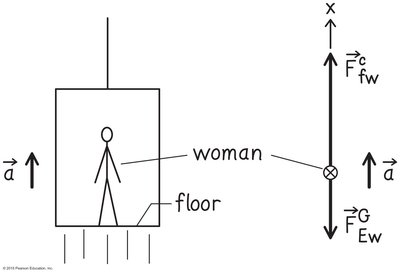
Free-body diagrams (FBDs) are essential tools for visualizing and analyzing the forces acting on a single object. Each force is represented by an arrow pointing in the direction of the force, with the tail at the object's center of mass.
Draw the object as a dot or simple shape.
Identify all forces acting on the object (not by the object).
Draw and label each force vector appropriately.
Include a reference axis and, if relevant, the acceleration vector.
8.6 Springs and Tension
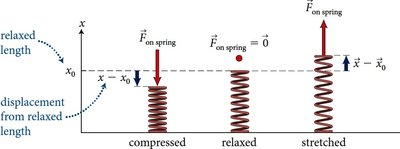
Springs exert forces that tend to return them to their relaxed length. The force exerted by a spring is called a restoring force and is described by Hooke's law within the elastic range. Tension is the force transmitted through a rope, string, or spring when it is pulled tight by forces acting from opposite ends.
Restoring Force: Acts to return the spring to its original length.
Tension: The magnitude of the force transmitted through a rope or spring.
Elastic Range: The range within which deformation is reversible.
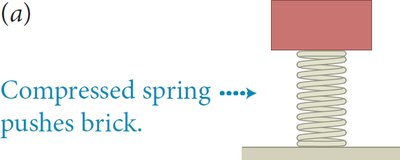
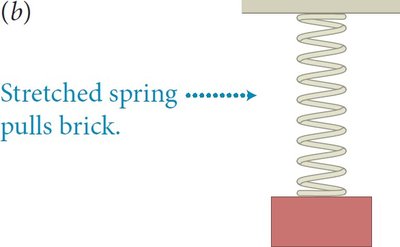
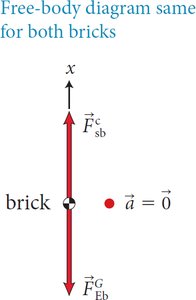
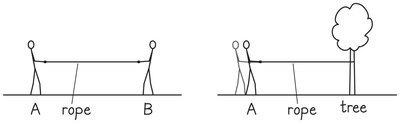
Example: In a tug-of-war, the tension in the rope is equal to the force exerted by each participant if the rope's mass is negligible.
8.7 Equations of Motion (Newton's Second Law)
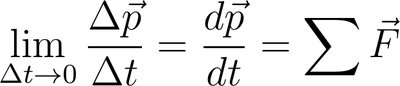
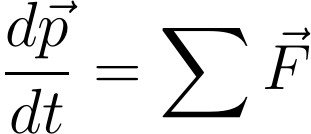
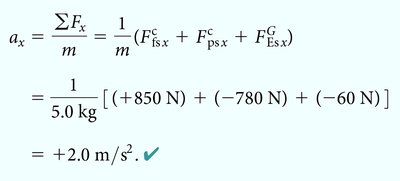
The equation of motion relates the net force acting on an object to the rate of change of its momentum. For constant mass, this reduces to Newton's second law: the net force equals mass times acceleration.
General Form:
For Constant Mass:
Component Form:



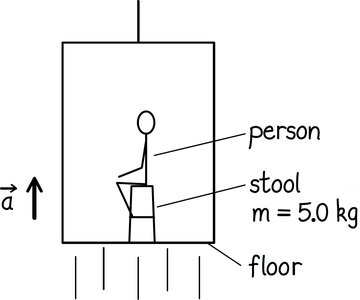
Example: A stool in a lift experiences forces from the person, the Earth, and the lift floor. The acceleration of the lift can be calculated using the net force and the mass of the stool.
8.8 Force of Gravity
Gravity is a field force that acts on all objects with mass. Near Earth's surface, the gravitational force on an object of mass \(m\) is \(F = mg\), where \(g\) is the acceleration due to gravity. All objects, regardless of mass, fall with the same acceleration in the absence of air resistance.
Gravitational Force:
Interaction Pair: The force Earth exerts on an object is equal in magnitude and opposite in direction to the force the object exerts on Earth.
8.9 Hooke’s Law
Hooke’s law describes the behavior of springs within the elastic range. The force exerted by a spring is proportional to its displacement from the relaxed position and acts in the opposite direction.
Hooke’s Law:
Spring Constant (k): A measure of the stiffness of the spring. Larger \(k\) means a stiffer spring.
8.10 Impulse
Impulse is the change in momentum of a system during a time interval. The impulse delivered by a force is equal to the area under the force vs. time curve. For a constant force, impulse is simply the product of force and time.
Impulse (J): (for constant force)
For Variable Force:
Application: Increasing the time over which a force acts reduces the magnitude of the force required to achieve the same change in momentum (e.g., landing on a mattress vs. concrete).
Summary Table: Types of Forces
Type of Force | Origin | Example |
|---|---|---|
Contact Force | Physical contact | Normal force, friction |
Field Force | Action at a distance | Gravity, electromagnetism |
Summary Table: Newton’s Laws of Motion
Law | Statement |
|---|---|
First Law (Inertia) | An object at rest remains at rest, and an object in motion remains in motion at constant velocity unless acted upon by a net force. |
Second Law | The net force on an object is equal to the rate of change of its momentum: |
Third Law | For every action, there is an equal and opposite reaction. |
Additional info: The notes also reference the historical development of Newton’s laws and their connection to conservation laws, but do not go into detail as this is not a history course.
