 Back
BackChapter 8: Force – Principles and Practice of Physics (Mazur, 2nd Edition)
Study Guide - Smart Notes
 Tailored notes based on your materials, expanded with key definitions, examples, and context.
Chapter 8: Force
Introduction to Force
Force is a central concept in physics, describing the interaction that causes changes in an object's motion. This chapter explores the characteristics, effects, and mathematical representation of forces, including their role in systems of interacting objects.
Characteristics of Forces
Momentum and Force
Force is defined as the time rate of change of an object's momentum.
For a single interaction:
The vector sum of all forces on an object equals the time rate of change of its momentum.
For constant mass:
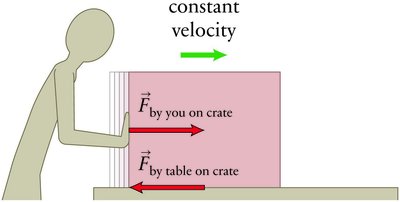
Example: Pushing a crate at constant velocity means the net force is zero, as the applied force and friction balance each other.
Interaction Pairs (Newton's Third Law)
Forces always come in pairs: when object A exerts a force on object B, B exerts an equal and opposite force on A.
Mathematically:
These are called interaction pairs or action-reaction pairs.
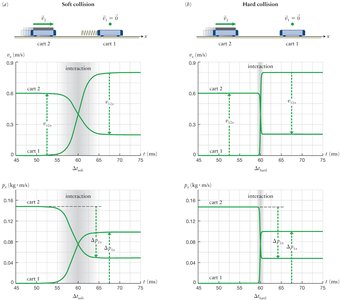
Example: In a collision, the forces two carts exert on each other are equal in magnitude and opposite in direction.
Types of Forces: Contact and Field Forces
Contact forces arise from physical contact (e.g., friction, tension, normal force).
Field forces (action at a distance) do not require contact (e.g., gravity, electromagnetic force).
Gravitational and electromagnetic forces are the main field forces for macroscopic objects.
Translational Equilibrium
Definition and Conditions
An object is in translational equilibrium if it is at rest or moving with constant velocity.
Condition: The vector sum of all forces on the object is zero:
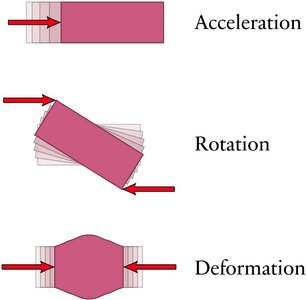
Forces can also cause rotation or deformation, but here only translational motion is considered.
Free-Body Diagrams
Purpose and Construction
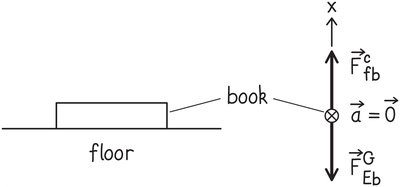
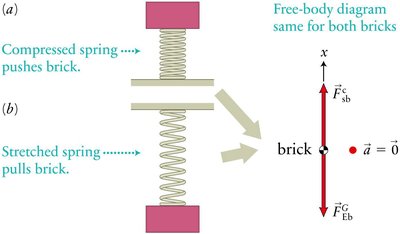
Free-body diagrams are essential tools for analyzing forces acting on an object. They help visualize all forces and predict motion.
Represent the object as a dot or simple shape (center of mass symbol).
Draw arrows for all forces acting on the object, with tails at the center of mass.
Label each force clearly (e.g., for gravity by Earth on book).
Include a reference axis and, if relevant, the acceleration vector.
Springs, Tension, and Hooke's Law
Elastic Forces and Tension
Springs exert forces that tend to return them to their relaxed length.
Within the elastic range, deformation is reversible and the force is called an elastic force.
Tension is the force transmitted through a rope, string, or spring when pulled tight by forces acting from opposite ends.
Hooke's Law
For small displacements, the force exerted by a spring is proportional to its displacement from equilibrium:
is the spring constant, a measure of stiffness (higher means a stiffer spring).
Equations of Motion
Newton's Laws of Motion
First Law (Law of Inertia): An object at rest remains at rest, and an object in motion remains in motion at constant velocity unless acted upon by a net external force.
Second Law: The net force on an object is equal to the time rate of change of its momentum: , or for constant mass,
Third Law: For every action, there is an equal and opposite reaction:
Superposition of Forces
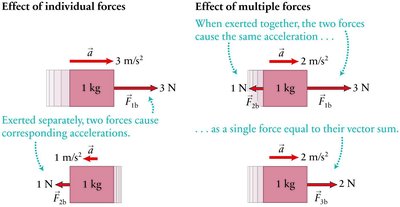
Forces add vectorially: the net force is the vector sum of all individual forces acting on an object.
Impulse and Momentum
Impulse Equation
Impulse is the product of the average force and the time interval over which it acts:
Impulse equals the change in momentum:
For time-varying forces:
Systems of Interacting Objects
Center of Mass and External Forces
The center of mass of a system accelerates as if all mass were concentrated there and all external forces acted at that point.
For a system of mass and total external force :
Summary Table: Key Equations and Concepts
Concept | Equation | Description |
|---|---|---|
Force and Momentum | Force is the time rate of change of momentum | |
Newton's Second Law | Net force equals mass times acceleration | |
Hooke's Law | Spring force proportional to displacement | |
Impulse | Impulse equals change in momentum | |
Center of Mass Acceleration | External forces determine center of mass acceleration |
Key Terms and Definitions
Force: An interaction that changes the motion of an object.
Momentum (): Product of mass and velocity, .
Impulse (): Change in momentum due to a force acting over time.
Contact Force: Force arising from physical contact between objects.
Field Force: Force exerted without physical contact (e.g., gravity).
Equilibrium: State where the net force on an object is zero.
Spring Constant (): Measure of a spring's stiffness.
Tension: Force transmitted through a string, rope, or spring.
Examples and Applications
Book on a Table: The gravitational force by Earth and the normal force by the table are equal and opposite when the book is at rest.
Elevator Problem: The normal force exceeds gravity when accelerating upward, resulting in a net upward force and acceleration.
Tug of War: The tension in a rope is equal to the force applied at either end if the rope is massless and at rest.
Conclusion
Understanding forces and their effects is fundamental to analyzing physical systems. By applying Newton's laws, constructing free-body diagrams, and using the equations of motion, one can predict and explain the behavior of objects under various interactions.
