 Back
BackChapter 8: Momentum, Impulse, and Center of Mass
Study Guide - Smart Notes
 Tailored notes based on your materials, expanded with key definitions, examples, and context.
Momentum and Conservation of Momentum
Definition and Properties
Momentum is a fundamental concept in physics describing the quantity of motion an object possesses. It is defined as the product of an object's mass and velocity, and is a vector quantity.
Momentum (\( \vec{p} \)): \( \vec{p} = m \vec{v} \)
Total Momentum of a System: The sum of the momenta of all objects in a system: \( \vec{p}_{\text{total}} = \vec{p}_1 + \vec{p}_2 + \vec{p}_3 + \ldots \)
Conservation of Momentum: In the absence of net external forces, the total momentum of a system remains constant.
Collisions
Collisions are classified based on whether kinetic energy is conserved:
Inelastic Collisions: Momentum is conserved, but kinetic energy is not.
Elastic Collisions: Both momentum and kinetic energy are conserved.
Completely Inelastic Collision: Maximum kinetic energy loss; objects stick together after collision.
Key Equations:
Momentum Conservation: \( p_{A,i} + p_{B,i} = p_{A,f} + p_{B,f} \)
Kinetic Energy Conservation (Elastic):
Relative Velocity Reversal:
Example: Car Crash
In a car crash, the total momentum before and after the collision is conserved if external forces are negligible.

Impulse
Definition and Calculation
Impulse is the effect of a force acting over a time interval, resulting in a change in momentum. It is a vector quantity and has the same units as momentum (kg·m/s).
Impulse (\( \vec{J} \)):
Impulse-Momentum Theorem:
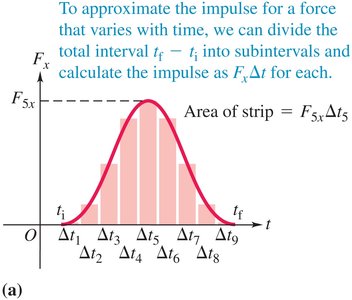
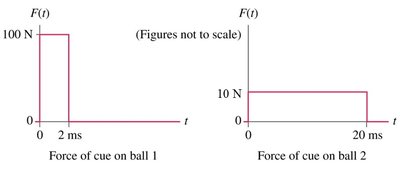
For variable force: Impulse is the area under the force vs. time graph.
Example: Kicking a Soccer Ball
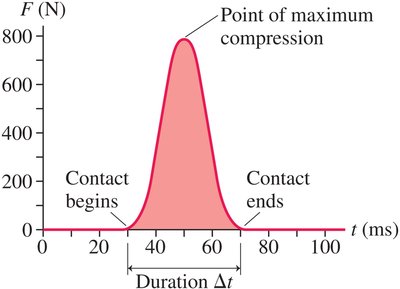
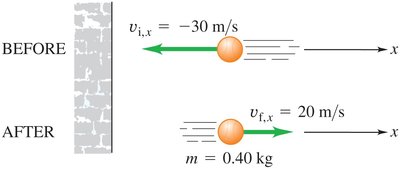
When a soccer ball is kicked, the force applied over a short time interval changes its momentum.
Impulse in Two Dimensions
Impulse can be calculated separately for each component:

Impulse and Force Graphs
Variable Force and Average Force
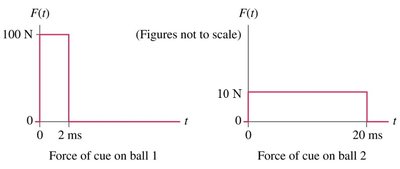
When force varies with time, impulse is calculated as the area under the force-time curve. The average force can be estimated by dividing the impulse by the duration.
Average Force:
Center of Mass
Definition and Calculation
The center of mass is the point representing the average position of all mass in a system, weighted by mass. It is useful for analyzing the motion of systems of particles.
Center of Mass Coordinates:

Velocity of Center of Mass
The velocity of the center of mass is the mass-weighted average of the velocities of all particles in the system.

Total Momentum in Terms of Center of Mass
The total momentum of a system can be expressed as the total mass times the velocity of the center of mass:
Newton's Law of Center of Mass Motion
Newton's laws applied to each particle in a system combine to give the law for the center of mass:
Internal forces cancel due to action-reaction pairs.
Example: Exploding Shell
After an explosion, the center of mass continues to follow the original trajectory.
Rocket Propulsion
Principle and Conservation of Momentum
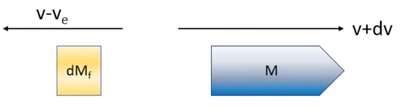
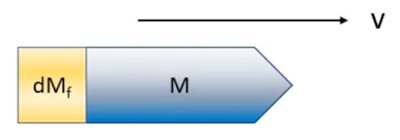
Rocket propulsion is an application of momentum conservation where the mass of the system changes as fuel is ejected.
Momentum Conservation: The momentum of the rocket and ejected fuel is conserved.
Exhaust Velocity: The speed at which fuel is ejected relative to the rocket.
Rocket Equation
The change in velocity of the rocket is related to the mass of ejected fuel and its exhaust velocity:
Example Problem: Rocket Launch
A rocket ejects 1/60 of its mass in 1 second with an exhaust velocity of 2400 m/s. The acceleration is:

Summary Table: Types of Collisions
Type | Momentum Conservation | Kinetic Energy Conservation | Example |
|---|---|---|---|
Elastic | Yes | Yes | Billiard balls |
Inelastic | Yes | No | Car crash |
Completely Inelastic | Yes | No (maximum loss) | Objects stick together |
Key Concepts and Applications
Momentum is conserved in isolated systems.
Impulse is the change in momentum due to a force acting over time.
Center of Mass simplifies analysis of systems of particles.
Rocket Propulsion demonstrates momentum conservation with changing mass.
Additional info: Academic context was added to clarify the derivation of the rocket equation and the application of center of mass in explosions.
