 Back
BackChapter 9: Gravity – Study Notes
Study Guide - Smart Notes
 Tailored notes based on your materials, expanded with key definitions, examples, and context.
Gravity
The Newtonian Synthesis
The Newtonian Synthesis refers to Isaac Newton's realization that the same set of physical laws applies to both celestial (heavenly) and terrestrial (Earthly) objects. Before Newton, it was believed that different rules governed the heavens and the Earth. Newton unified these ideas by proposing that gravity is a universal force acting on all objects with mass.
Gravity is Universal: Newton discovered that gravity acts everywhere in the universe, not just on Earth.
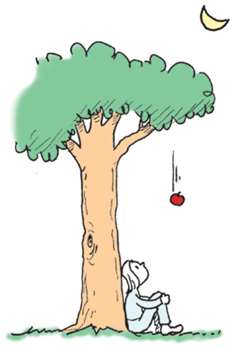
Legend of the Apple: The famous story of Newton observing an apple fall led him to consider that the same force pulling the apple to the ground also keeps the Moon in orbit around Earth.
Celestial and Terrestrial Unity: The force that causes an apple to fall is the same force that governs the motion of planets and stars.
The Universal Law of Gravity
Newton's Law of Universal Gravitation states that every object in the universe attracts every other object with a force that is proportional to the product of their masses and inversely proportional to the square of the distance between their centers.
Formula: where:
F = gravitational force between two objects
G = universal gravitational constant ()
m_1, m_2 = masses of the objects
d = distance between the centers of the masses
Key Points:
The greater the masses, the greater the force.
The greater the distance, the weaker the force (inverse-square law).
The Universal Gravitational Constant, G
The gravitational constant, G, quantifies the strength of gravity in the universe. Gravity is the weakest of the four fundamental forces, but it acts over infinite distances and affects all objects with mass.
Value of G:
Application: Once G was measured, it allowed scientists to calculate the mass of Earth and other celestial bodies.
Gravity and Distance: The Inverse-Square Law
The magnitude of the gravitational force follows the inverse-square law, meaning it decreases with the square of the distance from the source. This law applies to any force that spreads out evenly in all directions from a point source.
Equation:
Implication: Doubling the distance reduces the force to one-fourth; tripling reduces it to one-ninth, etc.
Force Never Reaches Zero: At great distances, the force becomes very small but never exactly zero.


Weight and Weightlessness
Weight is the force an object exerts against a supporting surface due to gravity. Weightlessness occurs when there is no support force, such as in free fall.
Weight: Changes depending on acceleration (e.g., in an elevator going up or down).
Weightlessness: Experienced in free fall or orbit, where objects are in continuous free fall around Earth (e.g., astronauts in the International Space Station).
Example: Standing on a scale in an accelerating elevator changes the reading due to changes in support force.

Ocean Tides
Tides are the periodic rise and fall of ocean levels, primarily caused by the gravitational pull of the Moon and, to a lesser extent, the Sun.
High and Low Tides: Most coastal areas experience two high tides and two low tides each day.
Cause: The Moon's gravity pulls on Earth's oceans, creating bulges (high tides) on the side closest to and farthest from the Moon.
Spring Tides: Occur when the Sun, Moon, and Earth are aligned (new or full Moon), resulting in higher high tides and lower low tides.
Neap Tides: Occur when the Sun and Moon are at right angles, partially canceling each other's effects, resulting in less pronounced tides.


Gravitational Fields
A gravitational field is a region of space around a mass where another mass experiences a force of gravitational attraction. It is an example of a force field, similar to electric or magnetic fields.
Field Lines: Represented as arrows pointing toward the center of mass (e.g., Earth), indicating the direction of the force.
Strength: The field is stronger where the lines are closer together (near the surface) and weaker farther away.
Inside a Planet: The gravitational field decreases to zero at the center due to opposing pulls from the mass above and below.
Outside a Planet: The field decreases with the square of the distance from the center.
Thought Experiment: If you fell through a tunnel passing through Earth's center, your acceleration would decrease to zero at the center and increase again as you moved toward the other side.



Einstein's Theory of Gravitation
Einstein's General Theory of Relativity describes gravity not as a force, but as a curvature of space-time caused by mass. Massive objects warp the fabric of space-time, and this curvature guides the motion of other objects.
Analogy: A heavy ball placed on a stretched rubber sheet creates a dent; a marble rolling nearby will spiral toward the ball due to the curvature.
Effect: The presence of mass tells space-time how to curve, and curved space-time tells objects how to move.

Black Holes
A black hole forms when a massive star exhausts its nuclear fuel and collapses under its own gravity, concentrating its mass into a very small volume. The gravitational field becomes so strong that not even light can escape.
Formation: As the radius of the star decreases, the gravitational force at its surface increases dramatically ().
Event Horizon: The boundary beyond which nothing can escape the black hole's gravity.
Trapped by Spacetime: All matter and radiation are trapped inside by the extreme curvature of space-time.


Wormholes
A wormhole is a hypothetical feature of space-time that acts as a shortcut connecting distant regions of the universe or different universes. Wormholes are predicted by some solutions to Einstein's equations, but none have been observed.
Structure: A tunnel-like connection through space-time.
Speculation: Wormholes could, in theory, allow for faster-than-light travel or connections between different universes.
Current Status: No experimental evidence for wormholes exists.

Universal Gravitation and Unsolved Mysteries
Gravity is responsible for the shape and structure of astronomical objects and the universe itself. However, there are still unresolved mysteries, such as the nature of dark matter and dark energy.
Earth's Shape: Gravity pulls all parts of Earth toward the center, making it nearly spherical.
Dark Matter: Galaxies rotate faster than can be explained by visible matter alone, suggesting the presence of unseen mass.
Dark Energy: The universe's expansion is accelerating, driven by a mysterious form of energy.
