 Back
BackChapter 9: Momentum and Angular Momentum – Study Notes
Study Guide - Smart Notes
 Tailored notes based on your materials, expanded with key definitions, examples, and context.
Momentum and Angular Momentum
Introduction to Momentum
Momentum is a fundamental concept in physics that quantifies the motion of an object. It is a vector quantity, meaning it has both magnitude and direction, and is defined for any object with mass moving at a velocity.
Definition: The momentum p of an object is given by the product of its mass m and velocity \vec{v}:
Units: kg·m/s
Direction: Momentum points in the same direction as the velocity vector.
If an object moves in the negative direction, both velocity and momentum are negative.
Example: A 4,000 kg truck moving right at 10 m/s and an 800 kg racecar moving left at 50 m/s have momenta of 40,000 kg·m/s (right) and -40,000 kg·m/s (left), respectively.
Impulse and Change in Momentum
Impulse is the effect of a force acting over a time interval, resulting in a change in momentum. It is closely related to Newton's Second Law.
Definition: Impulse J is the product of force F and the time interval \Delta t:
Impulse is also equal to the change in momentum:
Units: N·s or kg·m/s
Example: Pushing a 50 kg crate with 100 N for 8 s delivers an impulse of 800 N·s, changing the crate's speed.
Impulse from Force vs. Time Graphs
Impulse can be determined graphically as the area under a force vs. time graph.
Area above the time axis gives positive impulse; below gives negative impulse.
For constant force: area = F × Δt (rectangle).
For varying force: area under the curve (may require splitting into geometric shapes).
Total Momentum of a System
The total momentum of a system is the vector sum of the momenta of all objects in the system.
For two objects:
Momentum is conserved in isolated systems (no external forces).
Conservation of Momentum
When objects interact (collide or push apart), the total momentum of the system before the interaction equals the total momentum after, provided no external forces act.
Conservation Equation:
Applies to both collisions and "push-away" (explosion/recoil) problems.
For objects initially at rest:
Types of Collisions
Collisions are classified based on whether kinetic energy is conserved and whether objects stick together.
Elastic Collision: Both momentum and kinetic energy are conserved.
Inelastic Collision: Momentum is conserved, but kinetic energy is not.
Completely Inelastic Collision: Objects stick together after collision and move with the same final velocity.
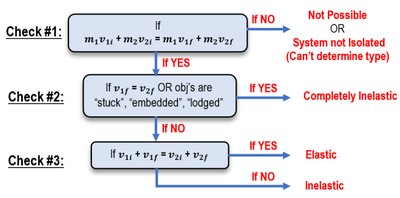
Example: Two blocks collide and stick together; use conservation of momentum to find final velocity.
Collisions in Two Dimensions
For collisions involving motion in two dimensions, momentum conservation must be applied separately to each axis (x and y).
Write conservation equations for both axes:
Ballistic Pendulums and Combined Conservation
Some problems, such as ballistic pendulums, require using both conservation of momentum (during collision) and conservation of energy (after collision, during motion).
Momentum is conserved during the collision phase.
Mechanical energy is conserved during the subsequent swing or motion.
Angular Momentum
Angular momentum is the rotational analog of linear momentum. It is defined for rotating objects and is conserved in the absence of external torques.
Definition: For a rotating object:
Where I is the moment of inertia and \omega is the angular velocity.
Units: kg·m2/s
For a point mass moving in a circle:
Conservation: Angular momentum is conserved if the net external torque is zero.
Example: An ice skater pulling in her arms decreases her moment of inertia, increasing her angular speed to conserve angular momentum.
Angular Collisions
When a rotating object interacts with another object (e.g., a mass is added to a spinning disc), angular momentum is conserved for the system.
For two objects:
For a point mass added at a distance r from the axis:
Summary Table: Types of Collisions
Type | Momentum Conserved? | Kinetic Energy Conserved? | Objects Stick Together? |
|---|---|---|---|
Elastic | Yes | Yes | No |
Inelastic | Yes | No | No |
Completely Inelastic | Yes | No | Yes |
Key Equations
Momentum:
Impulse:
Conservation of Momentum:
Angular Momentum:
Angular Momentum (point mass):
Practice and Application
Apply conservation laws to solve collision, explosion, and rotational problems.
Use diagrams to visualize before and after states.
Check for isolated systems before applying conservation principles.
Additional info: These notes expand on the provided slides and problems, filling in definitions, equations, and academic context for clarity and completeness.
