Back
BackChapter 9: Momentum and Angular Momentum – Study Notes
Study Guide - Smart Notes
 Tailored notes based on your materials, expanded with key definitions, examples, and context.
Momentum
Conservation of Momentum
The law of conservation of momentum states that the total momentum of a system remains constant if no external forces act on it. This principle is fundamental in analyzing interactions such as collisions and explosions.
Isolated System: A system where the net external force is zero, so momentum is conserved.
Impulse Approximation: For very short, intense interactions, external forces can be ignored, and momentum is conserved during the interaction.
Mathematical Formulation: For a system of objects, the total momentum before an interaction equals the total momentum after:
Problem-Solving Steps:
Strategize: Define the system and check for isolation.
Prepare: Draw before-and-after diagrams, define symbols, and list knowns/unknowns.
Solve: Apply conservation of momentum equations.
Assess: Check units and reasonableness of the answer.
Explosions
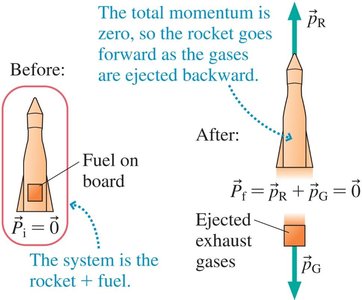
An explosion is an event where the particles of a system move apart after a brief, intense interaction. Explosions are the opposite of collisions, and if the system is isolated, the total momentum is conserved.
Internal Forces: The forces causing the explosion are internal, so the total system momentum remains unchanged.
Example: A rocket expelling exhaust gases demonstrates conservation of momentum: the rocket moves forward as gases are ejected backward.
Inelastic Collisions
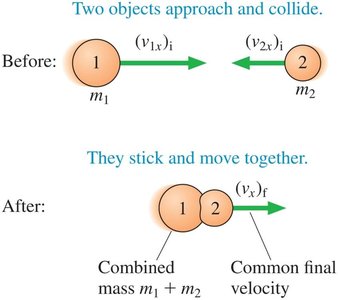
In a perfectly inelastic collision, two objects stick together and move with a common final velocity. Momentum is conserved, but kinetic energy is not.
Examples: Clay hitting the floor, a bullet embedding in wood.
Equation:
Momentum and Collisions in Two Dimensions
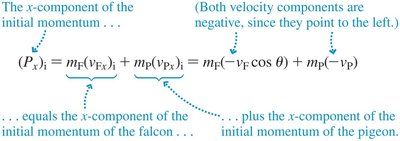
When collisions occur in two dimensions, momentum must be conserved in each component (x and y directions) separately.
Component Equations:
Application: The total vector momentum is conserved, even though individual momenta may change.

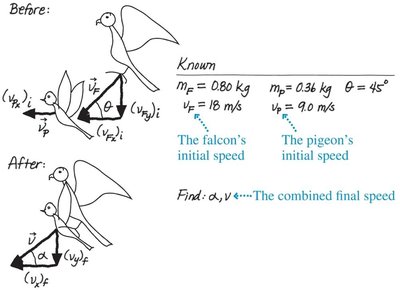
Example: Peregrine Falcon Strike (Two-Dimensional Collision)
This example analyzes a perfectly inelastic collision between a falcon and a pigeon, using conservation of momentum in two dimensions.
Given: Falcon mass = 0.80 kg, speed = 18 m/s at 45°; Pigeon mass = 0.36 kg, speed = 9.0 m/s (horizontal).
Find: Speed and direction of the combined mass after collision.
Solution Steps:
Break initial velocities into x and y components.
Apply conservation of momentum in both directions.
Find final velocity magnitude and direction using Pythagorean theorem and trigonometry.
Key Equations:
Angular Momentum
Definition and Properties
Angular momentum is the rotational analog of linear momentum. It is conserved in the absence of external torques and is crucial for understanding rotational motion.
Angular Momentum (L): where is the moment of inertia and is the angular velocity.
Comparison to Linear Momentum:
Rotational Dynamics
Linear Dynamics
Torque ()
Force ()
Moment of inertia ()
Mass ()
Angular velocity ()
Velocity ()
Angular momentum ()
Linear momentum ()

Conservation of Angular Momentum
If the net external torque on a system is zero, the total angular momentum remains constant. This principle is analogous to the conservation of linear momentum.
Mathematical Statement:
Law of Conservation: If , then
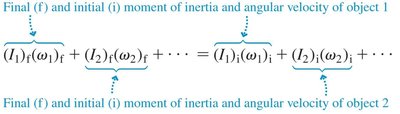
System Application: The total angular momentum is the sum over all objects in the system.
Equation for Multiple Objects: $
Varying Moment of Inertia
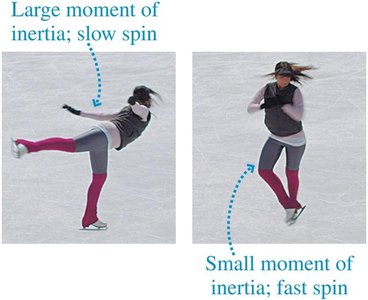
The moment of inertia of a system can change if the distribution of mass changes, even if the system is isolated. This leads to changes in angular velocity to conserve angular momentum.
Example: Figure skaters spin faster by pulling their arms in, reducing their moment of inertia.
Equation:
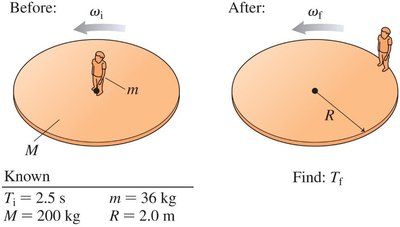
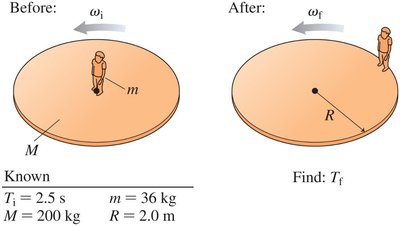
Example: Period of a Merry-Go-Round
This example demonstrates conservation of angular momentum when a person moves from the center to the edge of a rotating merry-go-round.
Given: Joey (36 kg) stands on a 200 kg merry-go-round (radius 2.0 m), initially rotating once every 2.5 s.
Find: The new period after Joey walks to the edge.
Solution Steps:
Model the merry-go-round as a uniform disk:
Joey's moment of inertia is $0mR^2$ at the edge.
Apply conservation:
Relate angular velocity to period:
Result: The period increases as Joey moves outward, since the moment of inertia increases and angular velocity decreases to conserve angular momentum.