 Back
BackChapter 9: Momentum – Impulse, Collisions, and Conservation Laws
Study Guide - Smart Notes
 Tailored notes based on your materials, expanded with key definitions, examples, and context.
Momentum and Impulse
Impulse
Impulse is a vector quantity that measures the effect of a force acting over a time interval. It is defined as the product of the average force and the time interval during which the force acts:
Definition:
SI Units: kg·m/s
Impulse in Multiple Dimensions:
One dimension:
Two dimensions:
Three dimensions:
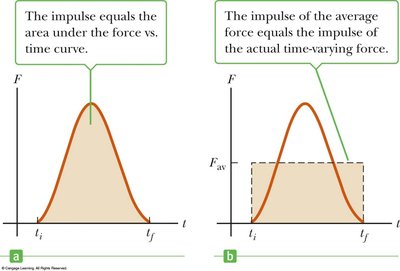
Impulse as Area: The impulse delivered by a force is equal to the area under the force vs. time curve.
Average Force in Impulse
The average force, , is the constant force that would produce the same impulse as the actual time-varying force over the same interval:
Momentum
Momentum is a vector quantity defined as the product of an object's mass and velocity:
Definition:
SI Units: kg·m/s
Relation to Kinetic Energy:
Impulse-Momentum Theorem
The impulse-momentum theorem states that the impulse delivered to an object equals the change in its momentum:
Solving Impulse and Momentum Problems
Example: Car Collision
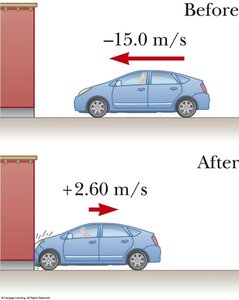
Consider a car of mass kg colliding with a wall and rebounding. The initial and final velocities are m/s and m/s, respectively. If the collision lasts for 0.150 s, the impulse and average force can be calculated as follows:
Impulse:
Average Force:
Force-Time Graphs in Collisions
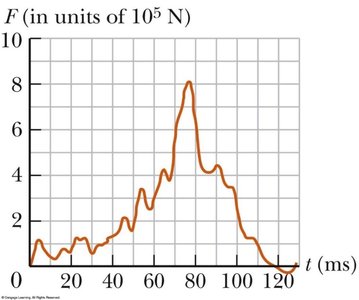
In real collisions, the force varies with time. The area under the force-time graph gives the impulse delivered to the object.
Conservation of Momentum
Principle of Conservation
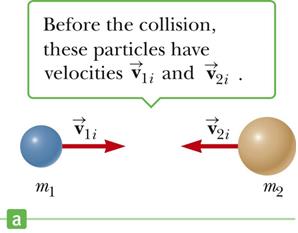
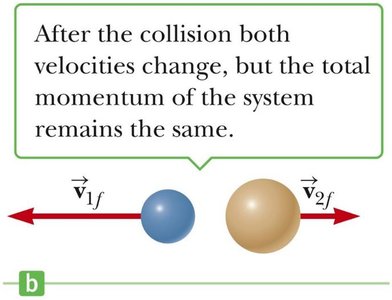
When no net external force acts on a system, the total momentum of the system remains constant:
Newton's Third Law and Collisions
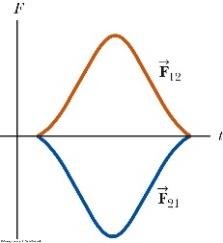
During a collision, the forces that two objects exert on each other are equal in magnitude and opposite in direction, as per Newton's third law:
Elastic and Inelastic Collisions
Elastic Collisions
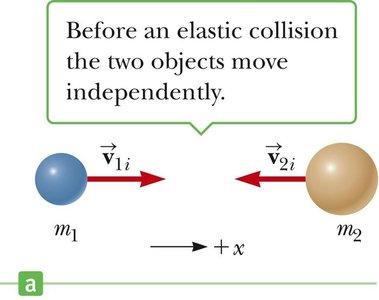
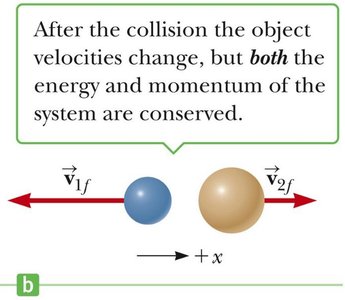
In an elastic collision, both momentum and kinetic energy are conserved. Before the collision, the objects move independently; after the collision, their velocities change, but the total energy and momentum remain constant.
Momentum Conservation:
Kinetic Energy Conservation:
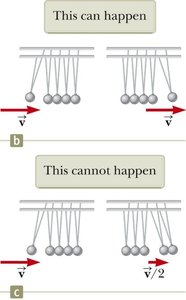
Demonstration: Newton's Cradle
Newton's cradle demonstrates conservation of momentum and energy in elastic collisions. When one ball strikes the group, one ball exits on the opposite side with nearly the same velocity.

Inelastic Collisions
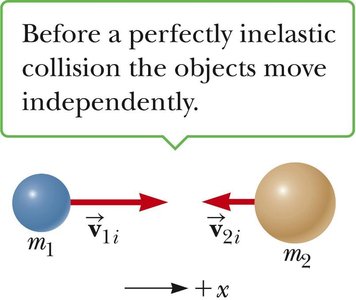
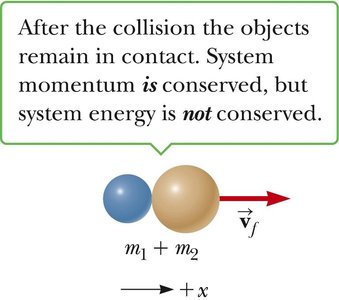
In an inelastic collision, momentum is conserved but kinetic energy is not. In a perfectly inelastic collision, the objects stick together after the collision and move with a common velocity.
Momentum Conservation:
Kinetic Energy: Not conserved; some is transformed into other forms (e.g., heat, deformation).
Momentum and Collisions in Two Dimensions
Two-Dimensional Collisions
In two-dimensional collisions, the conservation of momentum applies separately to each component (x and y):
x-component:
y-component:
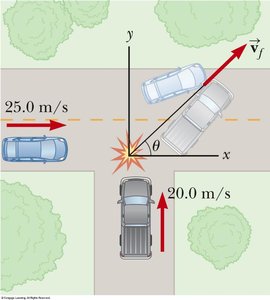
Example: Collision at an Intersection
A car and a pickup truck collide at an intersection. The conservation of momentum in both x and y directions allows calculation of the velocity and direction of the combined wreckage after a perfectly inelastic collision.
Key Terms Table
Term | Definition |
|---|---|
Impulse | Change in momentum due to a force acting over a time interval |
Momentum | Product of mass and velocity of an object |
Elastic Collision | Collision where both momentum and kinetic energy are conserved |
Inelastic Collision | Collision where momentum is conserved but kinetic energy is not |
Perfectly Inelastic Collision | Collision where objects stick together after impact |
Angular Momentum | Rotational analog of linear momentum (not detailed in this chapter) |
Additional info: Angular momentum is mentioned but not elaborated in these notes; it is typically covered in detail in a separate chapter.
