 Back
BackChapter 9: Momentum – Impulse, Conservation, and Collisions
Study Guide - Smart Notes
 Tailored notes based on your materials, expanded with key definitions, examples, and context.
Momentum and Impulse
Impulse
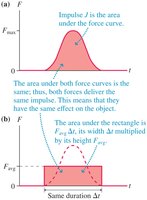
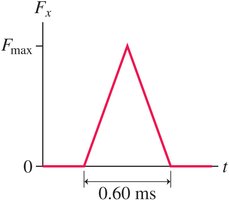
Impulse is a fundamental concept in physics describing the effect of a force acting over a short time interval, typically during collisions or sudden interactions. The impulse delivered to an object is equal to the area under the force versus time curve, and it results in a change in the object's momentum.
Definition: Impulse (J) is the product of force and the time interval over which it acts: .
Units: Newton-seconds (N·s) or kg·m/s.
Impulse is a vector: It points in the direction of the average force.
Force curve: The area under the force-time graph represents the impulse.
Average force: , where is the impulse and is the duration.
Application: Increasing the duration of a collision (e.g., catching a water balloon with soft arms) reduces the force experienced.


Impulse-Momentum Theorem
The impulse-momentum theorem states that the impulse delivered to an object causes a change in its momentum. This relationship is a direct consequence of Newton's second law.
Equation:
Momentum (p): (product of mass and velocity)
Vector nature: Momentum and impulse are both vectors; direction matters.
Example: A soccer player's head delivers an impulse to a ball, changing its momentum.

Momentum
Definition and Properties
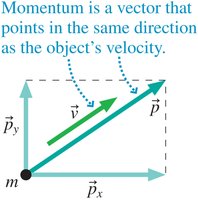
Momentum is a measure of the motion of an object and is defined as the product of its mass and velocity. It is a conserved quantity in isolated systems.
Equation:
Units: kg·m/s
Vector: Points in the direction of velocity.
Magnitude:
Total Momentum of a System
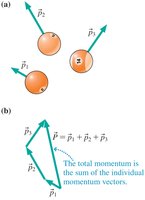
For a system of particles, the total momentum is the vector sum of the individual momenta.
Equation:
Conservation of Momentum
Law of Conservation of Momentum
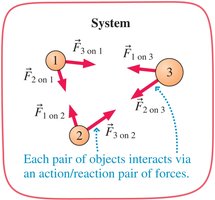
The law of conservation of momentum states that the total momentum of an isolated system remains constant if no external forces act on it. This principle is fundamental in analyzing collisions and explosions.
Equation:
Isolated system: No net external force.
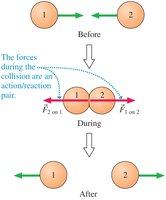
Internal forces: Forces between objects within the system do not change total momentum.
Application: Collisions
Collisions are events where two or more objects interact, often exchanging momentum. In perfectly inelastic collisions, objects stick together and move with a common velocity.
Perfectly inelastic collision: Objects stick together after collision.
Equation:
Application: Explosions
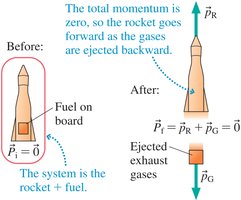
In an explosion, particles move apart after a brief, intense interaction. If the system is isolated, the total momentum is conserved.
Equation:
Impulse Approximation
The impulse approximation allows us to ignore small forces acting during the brief time of an impulsive force, focusing only on the momenta and velocities immediately before and after collisions.
Useful for: Short, intense interactions (e.g., collisions, explosions).
Momentum and Collisions in Two Dimensions
Two-Dimensional Collisions
When collisions occur in two dimensions, both the x- and y-components of momentum must be conserved. This requires solving simultaneous equations for each component.
Equation: and
Angular Momentum
Definition and Conservation
Angular momentum is the rotational analog of linear momentum. It is conserved in systems with no net external torque.
Equation:
Conservation: if
Moment of inertia (I): Depends on mass distribution.
Angular velocity (): Rate of rotation.
Varying Moment of Inertia
Moment of inertia can change if the mass distribution changes, affecting angular velocity to keep angular momentum constant.
Example: Skaters increase angular speed by reducing moment of inertia.
Problem-Solving Strategies
Before-and-After Visual Overview
To solve momentum problems, draw diagrams showing the system before and after the interaction, define symbols, list known values, and identify unknowns.
Steps:
Draw before-and-after pictures.
Establish a coordinate system.
Define symbols for masses and velocities.
List known information.
Identify desired unknowns.
Summary Tables
Comparison of Linear and Angular Momentum
Linear Momentum | Angular Momentum |
|---|---|
Conserved if no net external force | Conserved if no net external torque |
Units: kg·m/s | Units: kg·m2/s |
Key Equations
Impulse:
Impulse-Momentum Theorem:
Momentum:
Conservation of Momentum:
Angular Momentum:
Conservation of Angular Momentum:
Applications
Collisions: Analyze using conservation of momentum; perfectly inelastic collisions result in common final velocity.
Explosions: Particles move apart; total momentum is conserved.
Two-Dimensional Collisions: Both x- and y-components must be conserved.
Rotational Dynamics: Angular momentum conservation explains changes in rotational speed due to changing moment of inertia.
