 Back
BackChapter 9: Momentum – Impulse, Momentum, and Conservation
Study Guide - Smart Notes
 Tailored notes based on your materials, expanded with key definitions, examples, and context.
Momentum
Definition and Properties of Momentum
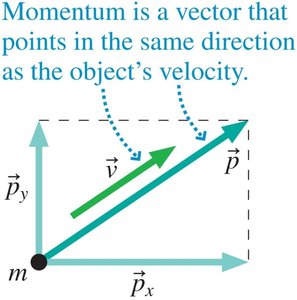
Momentum is a fundamental concept in physics that describes the quantity of motion an object possesses. It is defined as the product of an object's mass and its velocity, and is a vector quantity, meaning it has both magnitude and direction.
Momentum (\( \vec{p} \)): The product of mass (\( m \)) and velocity (\( \vec{v} \)).
Formula:
Units: Kilogram meter per second (kg·m/s)
Direction: Same as the velocity vector.
Example: A 2 kg ball moving at 3 m/s has a momentum of 6 kg·m/s in the direction of motion.
Impulse
Impulse and Its Physical Meaning
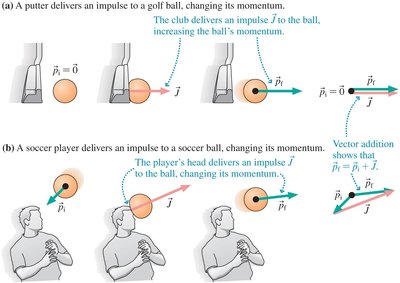
Impulse is the effect of a force acting over a short period of time, commonly encountered in collisions. It quantifies the change in momentum resulting from a force applied over a time interval.
Impulse (\( \vec{J} \)): The product of the average force (\( \vec{F}_{avg} \)) and the time interval (\( \Delta t \)) during which the force acts.
Formula:
Units: Newton-second (N·s), equivalent to kg·m/s
Impulse is a vector: It points in the direction of the average force.

Example: Kicking a soccer ball applies a large force over a short time, resulting in a significant change in the ball's momentum.
Impulse and Force-Time Graphs
The impulse delivered by a force is equal to the area under the force-versus-time curve. For variable forces, this area can be calculated using integration, but for simple shapes (like triangles or rectangles), geometric formulas suffice.
Area under the curve: Represents the impulse delivered to the object.
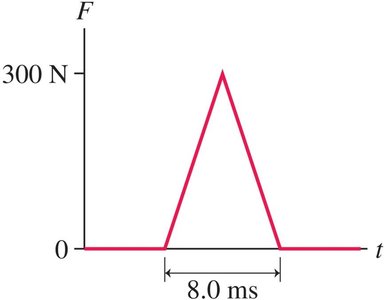
For a triangular force curve:
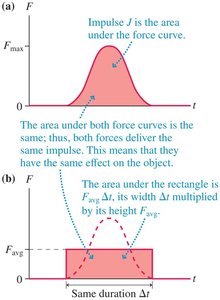
Example: If a force rises to 300 N over 8 ms in a triangular shape, the impulse is .
Average Force and Impulse
It is often useful to replace a varying force with an equivalent constant (average) force that delivers the same impulse over the same time interval.
Average force:
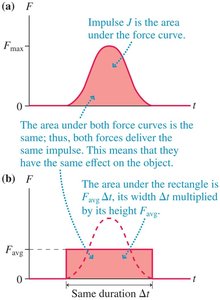
Example: If the impulse is 1.2 N·s over 0.008 s, the average force is N.
Impulse-Momentum Theorem
Statement and Application
The impulse-momentum theorem states that the impulse delivered to an object is equal to the change in its momentum. This theorem is fundamental in analyzing collisions and other interactions involving forces over time.
Theorem:
Component form: ,
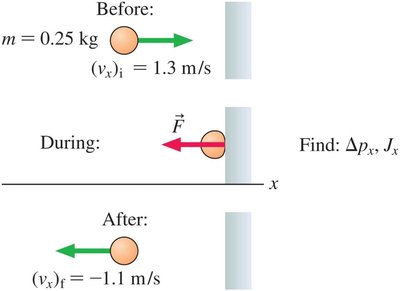
Example: If a 0.25 kg ball rebounds from 1.3 m/s to -1.1 m/s, the change in momentum is kg·m/s. The impulse delivered is also -0.6 kg·m/s.
Practical Implications: Reducing Force in Collisions
Increasing the duration of a collision reduces the average force experienced. This principle is used in safety devices (e.g., airbags, padding) and in nature (e.g., hedgehog spines).
Formula:
Longer collision time → smaller force for same impulse.

Solving Impulse and Momentum Problems
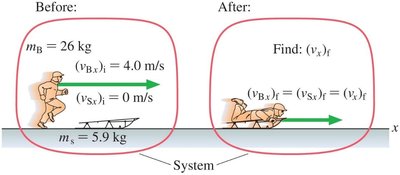
Before-and-After Visual Overviews
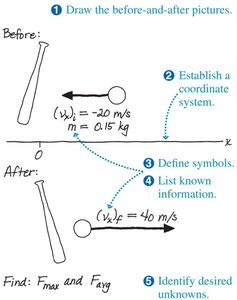
When solving momentum problems, it is helpful to draw diagrams showing the situation immediately before and after the interaction. This clarifies the changes in velocity and momentum.
Draw the objects before and after the event.
Establish a coordinate system.
Define symbols for masses and velocities.
List known quantities and identify unknowns.
Conservation of Momentum
Newton’s Third Law and Momentum Exchange
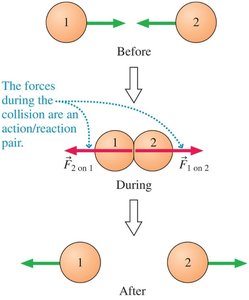
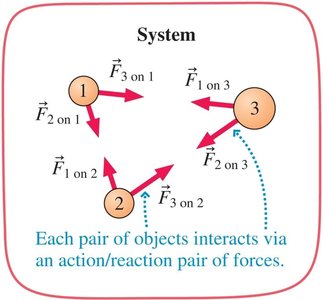
During a collision, the forces two objects exert on each other are equal in magnitude and opposite in direction. The impulses are also equal and opposite, leading to the principle of momentum conservation in isolated systems.
Action-reaction pair:
If one object gains momentum, the other loses the same amount.
System Boundaries and Internal vs. External Forces
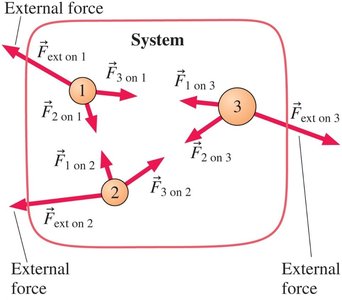
Momentum is conserved in a system if no external forces act on it. Internal forces (between objects within the system) do not change the total momentum.
System: All objects considered together for analysis.
Internal forces: Forces between objects inside the system.
External forces: Forces from outside agents; these can change the system's total momentum.
Law of Conservation of Momentum
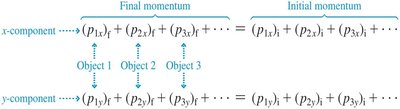
The total momentum of an isolated system (no net external force) remains constant, regardless of the interactions between objects within the system.
Mathematical statement:
For multiple objects:
Choosing the System
To apply conservation of momentum, choose a system such that the net external force is zero. For example, considering both a person and a sled together as the system ensures momentum is conserved if no external forces act.
Summary Table: Impulse and Momentum Relationships
Quantity | Symbol | Formula | Units |
|---|---|---|---|
Momentum | \( \vec{p} \) | kg·m/s | |
Impulse | \( \vec{J} \) | N·s (kg·m/s) | |
Impulse-Momentum Theorem | |||
Conservation of Momentum |
