 Back
BackCharges, Fields, and Capacitors: Conductors, Dielectrics, and Energy Storage
Study Guide - Smart Notes
 Tailored notes based on your materials, expanded with key definitions, examples, and context.
Charges and Fields in Conductors
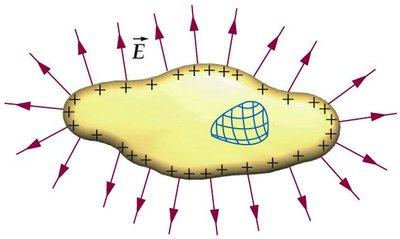
Electrostatic Equilibrium in Conductors
When a conductor is in electrostatic equilibrium, free charges inside the conductor do not move, resulting in a zero electric field (E) everywhere within the interior. This means that any net charge resides only on the surface of the conductor.
Key Point 1: E = 0 inside a conductor at equilibrium.
Key Point 2: Net charges are found only on the surface, not in the interior.
Example: A hollow metal sphere with excess charge will have all charge distributed on its outer surface.
Electric Field at the Surface of a Conductor
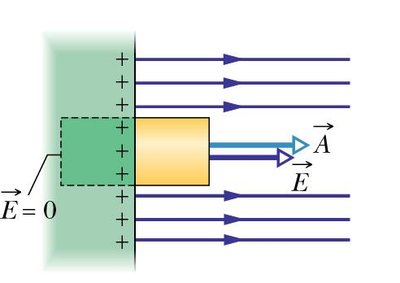
The electric field just outside a conductor must be perpendicular to the surface. If it were not, free charges would move along the surface, violating electrostatic equilibrium.
Key Point: E is perpendicular to the surface just outside a conductor.
Example: The surface of a charged metal sphere exhibits perpendicular field lines.
Shielding and Faraday Cage
When an uncharged conductor is placed in an external electric field, free electrons redistribute themselves until the internal field is reduced to zero. This principle is used in Faraday cages to shield sensitive equipment from external electric fields.
Key Point: Conductors shield their interiors from external electric fields.
Example: A car acts as a Faraday cage during a lightning storm.
High Electric Field at Sharp Tips
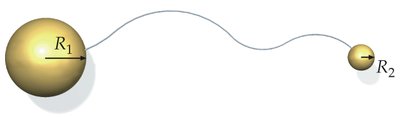
When two conducting spheres are connected by a wire, the potential is equalized. The sphere with a smaller radius of curvature has a larger electric field at its surface, which can lead to ionization and phenomena such as lightning.
Key Point: Smaller radius of curvature → larger electric field.
Formula:
Example: Lightning rods have sharp tips to create high electric fields and safely discharge lightning.
Lightning and Grounding
Lightning occurs when the electric field between a cloud and the ground becomes strong enough to ionize air, creating a conductive path. Grounding discharges objects by connecting them to the Earth, allowing electrons to move and equalize potential.
Key Point: Grounding neutralizes excess charge by providing a path to Earth.
Example: Lightning rods protect buildings by providing a safe path for charge to reach the ground.

Dielectric Materials and Polarization
Polarization of Dielectrics
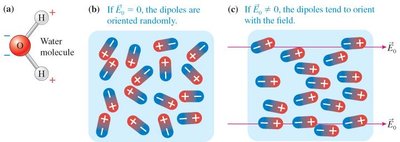
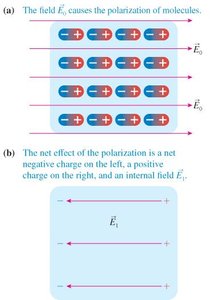
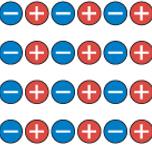
Dielectric materials become polarized when an electric field displaces atomic charges, inducing a dipole moment. Induced or natural electric dipoles align with external fields, reducing the net field inside the material.
Key Point: Dielectrics reduce the external electric field inside them.
Example: Water molecules align with an electric field due to their dipole nature.
Induced Electric Field and Dielectric Constant
The induced dipole fields oppose the external field inside a dielectric, leading to a decreased net field. The dielectric constant (κ) quantifies a material's ability to reduce the external field.
Key Point:
Example: Glass has a dielectric constant between 4 and 7, reducing the field more than air.
Dielectric Constants of Materials
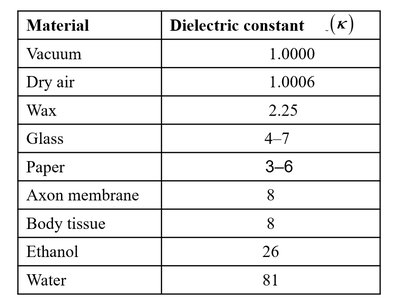
Different materials have different dielectric constants, affecting their ability to reduce electric fields.
Material | Dielectric constant (κ) |
|---|---|
Vacuum | 1.0000 |
Dry air | 1.0006 |
Wax | 2.25 |
Glass | 4–7 |
Paper | 3–6 |
Axon membrane | 8 |
Body tissue | 8 |
Ethanol | 26 |
Water | 81 |
Electric Force in Dielectrics
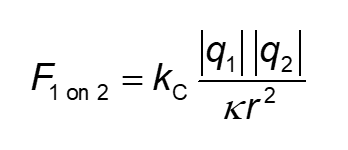
The force between two charges in a dielectric is reduced by the dielectric constant compared to the force in a vacuum.
Formula:
Key Point: Higher κ → lower force between charges.
Capacitors and Energy Storage
Capacitor Structure and Function
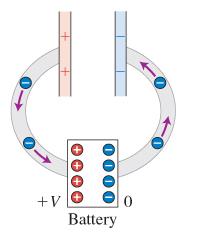
A capacitor consists of two conducting surfaces separated by a nonconducting material or vacuum. Its primary role is to store electric potential energy.
Key Point: Capacitors store energy by separating charge.
Example: Parallel plate capacitors are common in electronic circuits.
Parallel Plate Capacitors
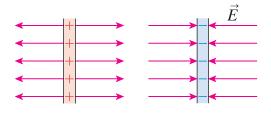
For a parallel plate capacitor, the electric field between the plates is given by:
Formula:
Key Point: The field is uniform between the plates.
Capacitance and Its Calculation
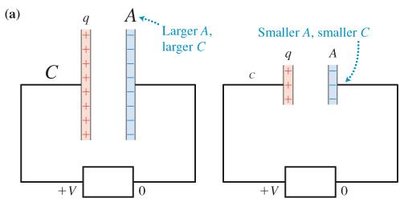
Capacitance (C) is defined as the ratio of charge stored to the potential difference across the plates. For a parallel plate capacitor:
Formula:
Key Point: Larger plate area (A) increases capacitance; larger separation (s) decreases capacitance.
SI Unit: Farad (F)
Capacitor Breakdown and Dielectrics
When the electric field between capacitor plates exceeds a critical value, the dielectric material breaks down and becomes conductive, causing a spark. Inserting a dielectric increases the breakdown voltage and enhances the capacitor's performance.
Key Point: Dielectrics allow capacitors to store more energy before breakdown.
Capacitance with Dielectrics
When a dielectric is inserted between the plates, the capacitance increases by a factor of the dielectric constant (κ):
Formula:
Key Point: Higher κ → higher capacitance.
Capacitors in Series and Parallel
The effective capacitance of a set of capacitors depends on their configuration:
Series:
Parallel:
Energy Storage in Capacitors
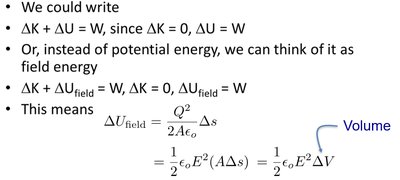
The energy stored in a capacitor is related to the work required to move charge between the plates:
Formula:
Energy Density:
Key Point: Energy is stored in the electric field between the plates.
Additional info: The notes cover topics from Ch. 17 (Electric Charge, Force, and Energy), Ch. 18 (The Electric Field), and Ch. 19 (DC Circuits), as well as Ch. 12 (Gases) and Ch. 15 (First Law of Thermodynamics) in the context of dielectric breakdown and energy storage.
