 Back
BackCircuits and DC Instruments: Series & Parallel Resistors, EMF, Kirchhoff’s Rules, Measuring Devices, Wheatstone Bridge, and RC Circuits
Study Guide - Smart Notes
 Tailored notes based on your materials, expanded with key definitions, examples, and context.
Resistors in Series and Parallel
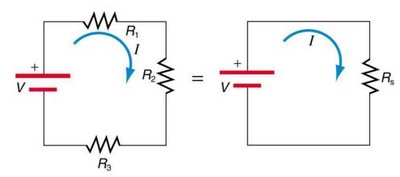
Resistors in Series
When resistors are connected in series, the same current flows sequentially through each resistor. The total or equivalent resistance is the sum of the individual resistances.
Equivalent Resistance (Series):
Current: The same current flows through all resistors due to conservation of charge.
Voltage: The total voltage across the series combination is the sum of the voltage drops across each resistor.
Resistors in Parallel
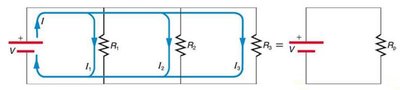
Resistors are in parallel when each is connected directly across the same voltage source. The reciprocal of the equivalent resistance is the sum of the reciprocals of the individual resistances.
Equivalent Resistance (Parallel):
Voltage: The voltage across each resistor is the same.
Current: The total current is the sum of the currents through each resistor.
Combination Circuits
Complex circuits may involve combinations of series and parallel resistors. These can be simplified stepwise by reducing series and parallel groups to their equivalents.
Example Calculation
Series:
Parallel:
Electromotive Force (emf) and Terminal Voltage
Definition and Concept
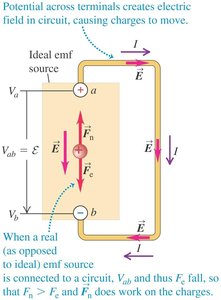
An electromotive force (emf) is the energy provided per unit charge by a source such as a battery. It is not a force, but a potential difference, measured in volts (V).
Ideal emf Source:
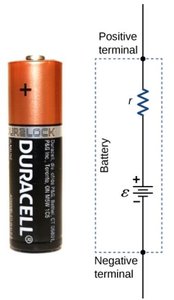
Real emf Source: , where is the internal resistance.
Current in Circuit:
Example Calculation
Terminal Voltage:
Internal Resistance:
Kirchhoff’s Rules
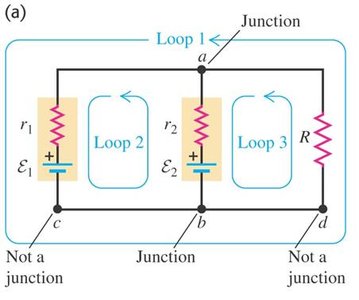
Junction and Loop Rules
Kirchhoff’s rules are used to analyze complex circuits with multiple loops and junctions.
Junction Rule: The sum of currents entering a junction equals the sum leaving (conservation of charge).
Loop Rule: The sum of potential changes around any closed loop is zero (conservation of energy).
Sign Conventions for Loop Rule
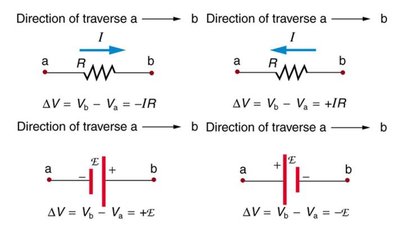
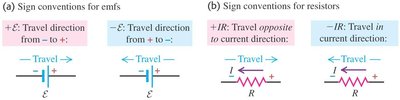
When traversing a resistor in the direction of current, the potential drops by .
When traversing an emf source from negative to positive, the potential increases by .
Reverse the sign if traversing in the opposite direction.
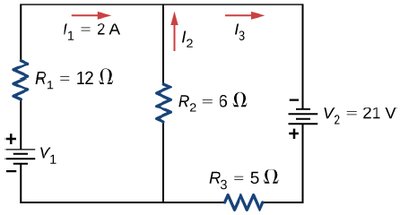
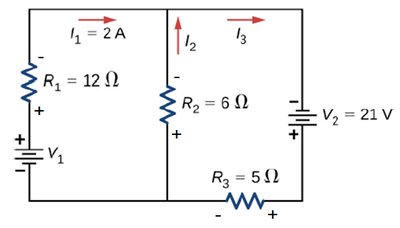
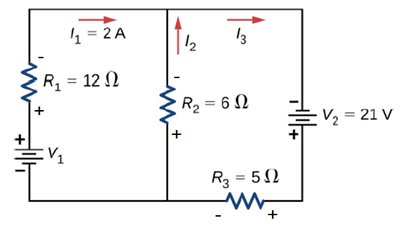
Example: Multi-Loop Circuit Analysis
Apply the junction and loop rules to solve for unknown currents and voltages in a circuit.
Electrical Measuring Instruments
Galvanometer
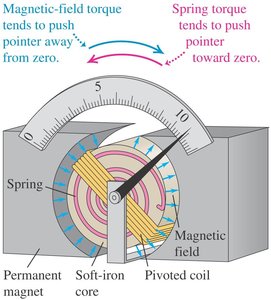
A galvanometer is a sensitive instrument for detecting and measuring small electric currents. It operates based on the torque exerted by a magnetic field on a current-carrying coil.
Ammeters and Voltmeters
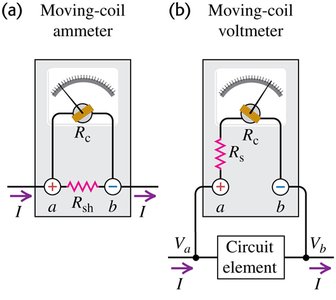
Ammeter: Measures current; ideal ammeter has zero resistance and is connected in series.
Voltmeter: Measures potential difference; ideal voltmeter has infinite resistance and is connected in parallel.
Ohmmeter
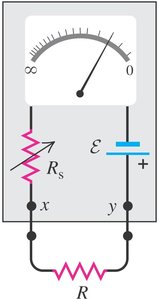
An ohmmeter measures resistance by applying a known voltage and measuring the resulting current. It contains an internal voltage source.
The Wheatstone Bridge
Principle and Operation
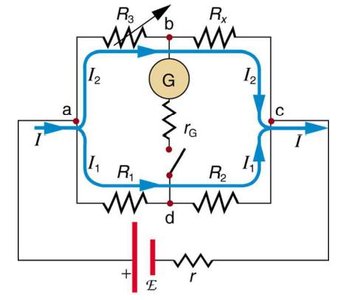
The Wheatstone bridge is a null measurement device used to determine an unknown resistance by balancing two legs of a bridge circuit. When the bridge is balanced, no current flows through the galvanometer, and the ratio of resistances can be used to solve for the unknown.
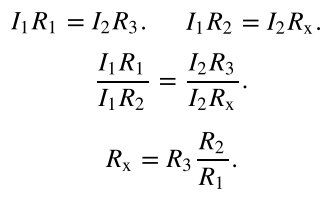
Balance Condition:
RC Circuits: Charging and Discharging Capacitors
Charging a Capacitor
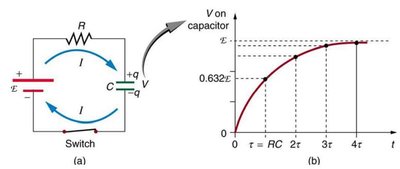
When a capacitor is charged through a resistor, the voltage across the capacitor increases exponentially with time. The time constant characterizes the rate of charging.
Voltage during Charging:
After one time constant, the voltage reaches about 63.2% of its final value.
Discharging a Capacitor
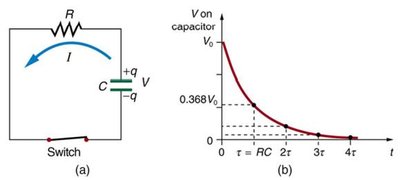
When a charged capacitor discharges through a resistor, the voltage decreases exponentially. The time constant again determines the rate of discharge.
Voltage during Discharging:
After one time constant, the voltage drops to about 36.8% of its initial value.
Example: Pacemaker Circuit
Given a capacitor charged to 0.632 of its final voltage 72 times per minute, the time constant is .
For , .
