 Back
BackCircular Dynamics and Non-Uniform Circular Motion: Study Notes
Study Guide - Smart Notes
 Tailored notes based on your materials, expanded with key definitions, examples, and context.
Circular Dynamics
Dynamics of Non-Uniform Circular Motion
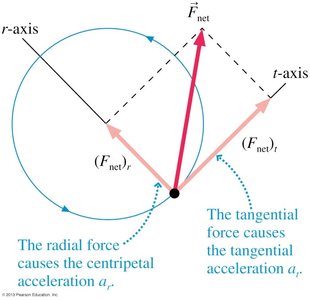
Non-uniform circular motion occurs when the speed of an object moving in a circle changes, requiring both radial (centripetal) and tangential components of force and acceleration. The net force acting on the object can be decomposed into these two components, which are essential for understanding the motion.
Radial Force: Causes centripetal acceleration, keeping the object moving in a circle.
Tangential Force: Causes tangential acceleration, changing the speed of the object along the circular path.
Newton's Second Law: In the rzt coordinate system, the law applies separately to radial and tangential directions.
Equation: The net force can be written as , with having both radial and tangential components.
Application: This decomposition is crucial for analyzing problems involving changing speeds in circular motion, such as roller coasters or rockets on pivots.
Vertical Circular Motion
Forces at Different Points in a Vertical Circle
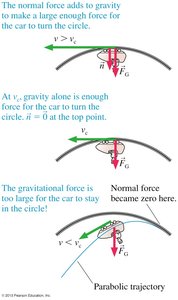
When an object moves in a vertical circle, such as a ball on a string or a roller coaster loop, the forces acting on it vary depending on its position. The tension or normal force and gravity combine to provide the necessary centripetal force.
At the Bottom: The tension in the string (or normal force) must be greater than the weight to provide the required centripetal acceleration.
At the Top: Both tension and gravity act downward; the minimum speed is required to keep the string taut.
Critical Speed: The minimum speed at the top of the circle to maintain circular motion is .
Equation for Centripetal Acceleration:
Discussion: If the speed is less than the critical speed, the object will not stay in the circle and will follow a parabolic trajectory.
Example: Tension in a Vertical Circle
To calculate the tension in the string at the bottom of the circle, use the following:
Net Radial Force:
Centripetal Requirement:
Solving for Tension:
Application: This formula is used for objects at the bottom of a vertical circle, such as a swinging bucket or roller coaster.
Minimum Speed for Circular Motion
At the top of the circle, the minimum speed is determined by setting the tension to zero (the string just goes slack):
Condition:
Equation:
Critical Speed:
Application: This is the minimum speed for a roller coaster or bucket to stay in circular motion at the top of the loop.
Discussion Questions and Example Problems
Instantaneous Angular Acceleration in Circular Motion
For a ball rolling inside a horizontal pipe, the angular acceleration depends on the forces acting tangentially to the circle. If only gravity acts, and the pipe is horizontal, the angular acceleration is zero unless there is a tangential component.
Key Point: Angular acceleration is produced by a net torque.
Equation: , where is torque and is moment of inertia.
Rocket on a Pivot: Radial and Tangential Forces
A rocket attached to a pivot provides thrust at an angle. The force can be decomposed into radial and tangential components, which determine the rocket's acceleration and angular velocity.
Radial Component:
Tangential Component:
Linear Acceleration:
Angular Velocity after Time: (assuming constant tangential acceleration)
Tension in the Rod: Calculated using the radial component and the mass of the rocket.
Summary Table: Forces in Vertical Circular Motion
Position | Forces Acting | Required Condition |
|---|---|---|
Bottom | Tension upward, gravity downward | |
Top | Tension and gravity downward | |
Critical Speed | Gravity only |
Key Formulas
Centripetal Acceleration:
Critical Speed (Vertical Circle):
Radial Force:
Tangential Force:
Linear Acceleration:
Angular Acceleration:
Applications
Roller Coasters: Understanding minimum speeds and forces at different points in the loop.
Rockets on Pivots: Decomposing thrust into radial and tangential components for motion analysis.
Buckets and Balls in Vertical Circles: Calculating tension and critical speeds to maintain circular motion.
