 Back
BackCircular Motion and Newton’s Law of Gravity – Step-by-Step Physics Guidance
Study Guide - Smart Notes
 Tailored notes based on your materials, expanded with key definitions, examples, and context.
Q1. A tether ball is attached to a swivel in the ceiling by a light cord of length L. When the ball is hit by a paddle, it swings in a horizontal circle with constant speed v, and the cord makes a constant angle β with the vertical direction. The ball goes through one revolution in time T. Assume that T, the mass m, and the length L of rope are known, derive algebraic expressions for the tension FT in the cord and the angle β.
Background
Topic: Circular Motion and Forces
This question tests your understanding of uniform circular motion, centripetal force, and how forces act on an object moving in a circle. You are asked to derive expressions for the tension in the cord and the angle it makes with the vertical.
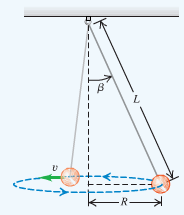
Key Terms and Formulas
Centripetal force: The net force required to keep an object moving in a circle.
Tension (): The force in the cord.
Period (): Time for one revolution.
Radius ():
Speed ():
Newton's second law:
Step-by-Step Guidance
Draw a free-body diagram for the ball, identifying the forces: tension in the cord and gravity.
Resolve the tension into vertical and horizontal components: (vertical) and (horizontal).
Set up the vertical force balance: (since there is no vertical acceleration).
Set up the horizontal force balance: , where is the centripetal acceleration.
Express in terms of and : , and .
Try solving on your own before revealing the answer!
Final Answer:
These expressions are derived by substituting the relationships for period, radius, and speed into the force balance equations.
Q2. A passenger on a Ferris wheel moves in a vertical circle of radius R with constant speed v. (a) Assuming that the seat remains upright during the motion, derive expressions for the magnitude of the upward force the seat exerts on the passenger at the top and bottom of the circle if the passenger’s mass is m.
Background
Topic: Circular Motion in a Vertical Plane
This question tests your understanding of how forces change for an object moving in a vertical circle, specifically at the top and bottom positions.
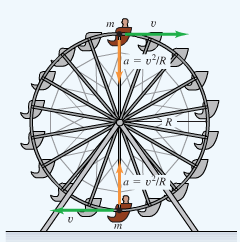
Key Terms and Formulas
Centripetal force:
Force at the top:
Force at the bottom:
Gravity:
Step-by-Step Guidance
At the top of the circle, both gravity and the seat force act downward. The centripetal force must be provided by the sum of these forces.
Write the equation for the top:
At the bottom of the circle, gravity acts downward and the seat force acts upward. The net upward force must provide the centripetal force.
Write the equation for the bottom:
Rearrange both equations to solve for the seat forces at the top and bottom.
Try solving on your own before revealing the answer!
Final Answer:
At the top:
At the bottom:
These forces show how the seat must exert more force at the bottom and less at the top due to gravity's direction.
