Back
BackCircular Motion, Gravitation, and Work-Energy in Physics
Study Guide - Smart Notes
 Tailored notes based on your materials, expanded with key definitions, examples, and context.
Circular Motion & Gravitation
Forces in Circular Motion
Circular motion occurs when an object moves along a circular path, requiring a net force directed toward the center of the circle, known as the centripetal force. This force is responsible for maintaining the object's curved trajectory.
Centripetal Acceleration: The acceleration directed toward the center of the circle, given by , where is the speed and is the radius of the circle.
Source of Centripetal Force: In planetary or satellite motion, gravity provides the necessary centripetal force.
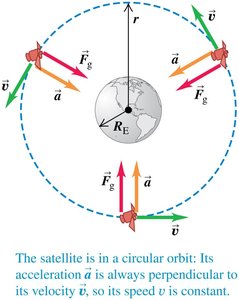
Additional info: The velocity vector is always tangent to the path, while the acceleration and gravitational force vectors point toward the center.
Motion in a Vertical Circle
When an object moves in a vertical circle, the forces acting on it (such as gravity and tension) vary in magnitude and direction throughout the motion. The analysis involves considering the changing net force at different points along the path.
Newton’s Law of Gravitation
Newton's Law of Universal Gravitation states that every two masses attract each other with a force proportional to the product of their masses and inversely proportional to the square of the distance between their centers:
G: Universal gravitational constant ()
Applications: Explains planetary orbits, satellite motion, and the behavior of objects near Earth's surface.
Weight and Its Variation with Altitude
The weight of an object is the gravitational force exerted on it by the Earth. Weight decreases with altitude because the gravitational force weakens as distance from Earth's center increases.
Weight Formula: , where is Earth's mass, is the object's mass, and is the distance from Earth's center.
At Earth's surface, (Earth's radius).
As increases, decreases.
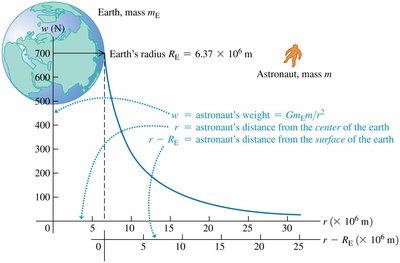
Additional info: The graph illustrates how an astronaut's weight decreases as their distance from Earth's center increases, with a sharp drop beyond Earth's surface.
Earth’s Density Profile
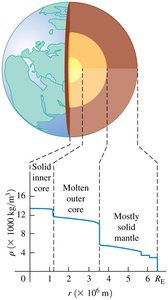
Earth is not uniform in density; it consists of a solid inner core, a molten outer core, and a mostly solid mantle. The density decreases with increasing distance from the center.
Solid Inner Core: Highest density, composed mainly of iron and nickel.
Molten Outer Core: Lower density than the inner core, still primarily iron and nickel.
Solid Mantle: Density decreases further outward.
Projectile and Satellite Motion
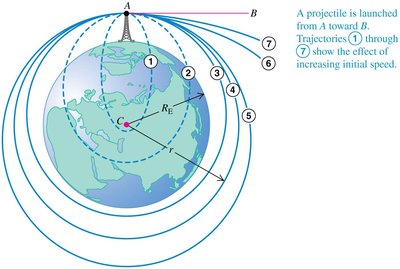
The trajectory of a projectile launched from a great height depends on its initial speed. With increasing speed, the path transitions from a curved trajectory that falls back to Earth to a circular or elliptical orbit, and eventually to escape from Earth's gravity.
Low Speed: Projectile falls back to Earth.
Orbital Speed: Projectile enters a stable circular or elliptical orbit.
Escape Speed: Projectile escapes Earth's gravitational pull.
Circular Satellite Orbits
Satellites in circular orbits maintain a constant distance from Earth's center. The gravitational force provides the necessary centripetal acceleration to keep the satellite in orbit.
Orbital Speed:
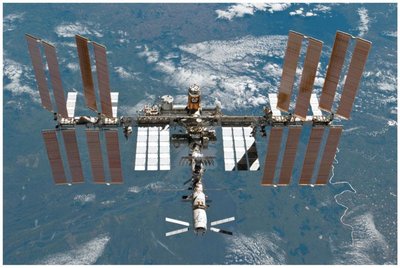
International Space Station (ISS): The largest artificial satellite, with a mass of approximately kg and a width over 100 m.
Black Holes
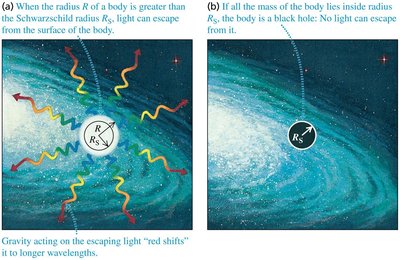
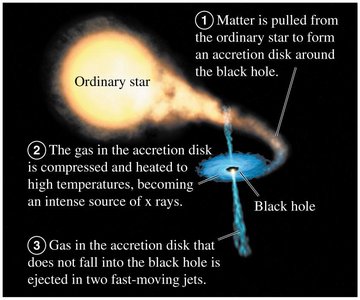
A black hole is a region in space where gravity is so strong that not even light can escape. Black holes are detected by observing x-rays emitted from the accretion disks of matter spiraling into them.
Schwarzschild Radius (): The critical radius at which the escape velocity equals the speed of light.
Detection: X-rays from accretion disks, gravitational effects on nearby objects.

Work and Energy
Overview of Energy
Energy is the ability to do work. It exists in various forms, including kinetic, potential, thermal, chemical, electrical, nuclear, and gravitational energy. Energy is a conserved quantity in physics, meaning it cannot be created or destroyed, only transformed from one form to another.
Kinetic Energy: Energy of motion,
Potential Energy: Stored energy due to position or configuration
Conservation of Energy: Total energy in a closed system remains constant.

Work
Work is done when a force causes a displacement. The amount of work depends on the magnitude of the force, the displacement, and the angle between them.
Work by a Constant Force:
Dot Product Form:
Units: Joules (J), where


Work Done by a Force at an Angle
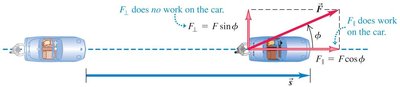
When a force is applied at an angle to the direction of displacement, only the component of the force in the direction of displacement does work.
Example: Steve pushes a car 19 m with a force of 210 N at 30° to the direction of motion. The work done is .

Positive, Negative, and Zero Work
The sign of work depends on the direction of the force relative to the displacement:
Positive Work: Force and displacement are in the same direction.
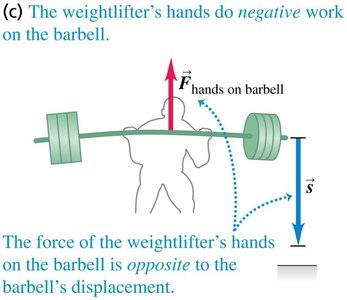
Negative Work: Force is opposite to displacement.
Zero Work: Force is perpendicular to displacement or displacement is zero.


Work Done on an Inclined Plane
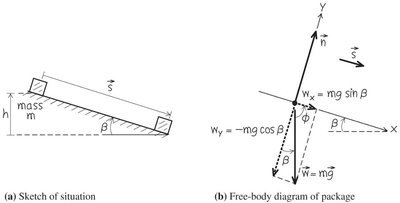
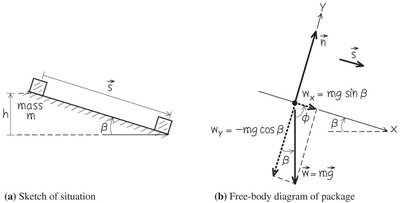
When an object moves down a frictionless inclined plane, the work done by gravity can be calculated using the component of weight parallel to the incline.
Parallel Component:
Displacement: , so
Work Done by Several Forces
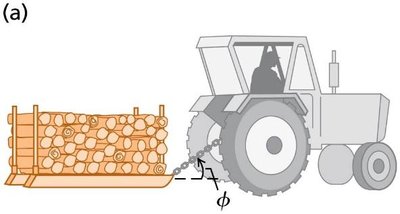
When multiple forces act on an object, the total work is the algebraic sum of the work done by each force. Forces can do positive, negative, or zero work depending on their direction relative to displacement.
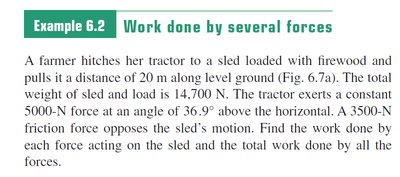
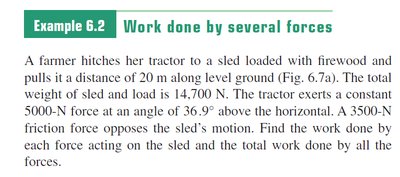
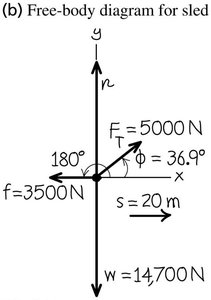
Example: A tractor pulls a sled with firewood, opposed by friction and gravity. The total work is the sum of the work done by the tractor, friction, and weight.
Force | Work Done |
|---|---|
Tractor | Positive (in direction of motion) |
Friction | Negative (opposes motion) |
Weight | Zero (perpendicular to motion on level ground) |
Work and Weightlifting Examples
Work in weightlifting depends on the direction of force and displacement:
Positive Work: Barbell does positive work on hands when lifted.
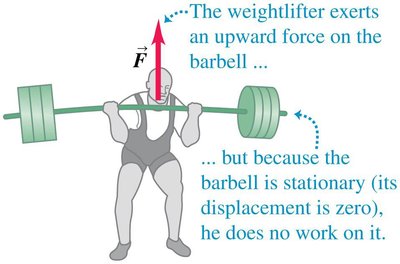
Zero Work: Holding the barbell stationary does no work (no displacement).
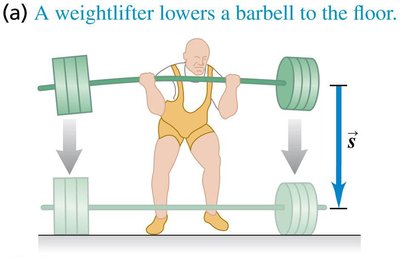
Negative Work: Lowering the barbell, hands do negative work on the barbell.