 Back
BackCircular Motion, Orbits, and Gravity – Study Notes
Study Guide - Smart Notes
 Tailored notes based on your materials, expanded with key definitions, examples, and context.
Ch 06: Circular Motion, Orbits & Gravity
Rotational Position & Displacement
Rotational motion describes the movement of objects around a fixed point in a circular path. The rotational equivalents of linear position and displacement are angular position (θ) and angular displacement (Δθ).
Rotational Position (θ): Measures how far an object is from the origin (center of rotation), in radians. The origin is always at the center, and direction is positive for counterclockwise (CCW) and negative for clockwise (CW) motion.
Rotational Displacement (Δθ): The change in angular position, analogous to linear displacement (Δx).
Linking Linear and Rotational Quantities: The relationship is given by: where r is the radius.
Radians and Degrees: 1 radian ≈ 57°. To convert:
Example: An object moves along a circle of radius 10 m from 30° to 120°. Find (a) angular displacement, (b) linear displacement.
Displacement in Multiple Revolutions
When an object completes full revolutions around a circle, angular displacement and linear displacement can be calculated as follows:
One full revolution: radians,
N full revolutions: ,
To find the number of revolutions:
Example: Starting from 0°, you make 2.2 revolutions around a circle of radius 20 m. Find (a) rotational displacement in degrees, (b) degrees away from 0°, (c) linear displacement.
Rotational Velocity & Acceleration
Rotational velocity and acceleration are the angular counterparts to linear velocity and acceleration.
Average Angular Velocity: [rad/s]
Angular Acceleration: [rad/s2]
Frequency (f): Number of revolutions per second [Hz]. 1 Hz = 1 rev/s. 1 RPM = rad/s.
Rotational equations apply to both point masses and rigid bodies.
Example: A 30-kg disc of radius 2 m rotates at 120 RPM. Calculate (a) period, (b) angular speed.
Motion Equations for Rotation
Rotational kinematics uses equations analogous to linear motion, substituting angular variables:
Linear | Rotational |
|---|---|
Example: A wheel accelerates from rest at 4 rad/s2 to 80 rad/s. Find (a) degrees rotated, (b) time taken.
Converting Between Linear and Rotational Quantities
Linear (tangential) and rotational (angular) variables are linked by the radius:
For a rotating rigid body, all points share the same angular quantities, but linear speed depends on distance from the axis.
Example: A wheel of radius 8 m spins at 10 rad/s. Find angular and linear speeds at (i) center, (ii) 4 m from center, (iii) edge.
Types of Acceleration in Rotation
There are four types of acceleration in rotational motion:
Tangential Acceleration (aT): Due to change in speed along the tangent.
Radial (Centripetal) Acceleration (aC): Due to change in direction, always points toward the center:
Total Linear Acceleration:
Angular Acceleration (α): Rate of change of angular velocity.
Example: A carousel of radius 10 m completes one cycle every 45 s. Find (a) tangential velocity, (b) angular acceleration, (c) radial acceleration, (d) tangential acceleration, (e) total linear acceleration.
Rolling Motion (Free Wheels)
When a rigid body both rotates and translates (e.g., a rolling wheel), the velocity at different points varies:
Fixed Axis: ,
Free Axis (Rolling): ,
At the top of the wheel:
At the bottom:
Example: A wheel of radius 0.30 m rolls at 10 m/s. Find (a) angular speed, (b) speed at the bottom relative to the floor.
Connected Wheels and Gears
When two wheels or gears are connected by a chain or belt, their angular velocities are related by their radii:
For static (fixed axis) systems, only rotation occurs; for moving systems, both rotation and translation occur.
Example: Two gears (R1 = 2 m, R2 = 3 m) connected by a chain. If the smaller spins at 40 rad/s, what is the angular speed of the larger?
Uniform Circular Motion (UCM)
In UCM, an object moves at constant speed in a circle. The velocity vector changes direction, resulting in centripetal acceleration toward the center:
Centripetal Acceleration:
Units: [m/s2]
Example: Moving at 5 m/s in a circle of radius 10 m, m/s2.
Centripetal Forces
Circular motion requires a net force directed toward the center (centripetal force):
Can be provided by tension, gravity, friction, etc.
Example: A 3 kg block on a 2 m string completes a rotation every 4 s. Find the tension in the string.
Satellite Motion and Orbits
Satellites orbit planets due to gravity. For a circular orbit:
Orbital Speed:
Orbital Period: or (Kepler's Third Law)
As orbital radius increases, speed decreases, period increases.
Example: The International Space Station orbits at 7,670 m/s. Calculate its orbital height.
Geosynchronous Orbits
A geosynchronous orbit has a period equal to the planet's rotation period, so the satellite stays above the same point on the surface.
For Earth: hours
Only one orbital radius allows this:
Example: Find the height of Earth's geosynchronous orbit.

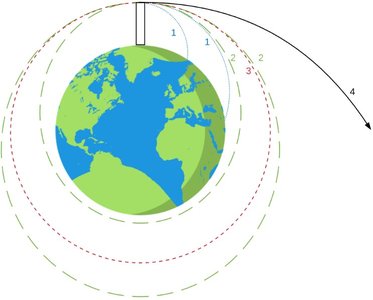
Universal Law of Gravitation
Newton's Universal Law of Gravitation states that every mass attracts every other mass with a force:
G = m3/kg·s2
r is the center-to-center distance between objects.
Example: Two 30-kg spheres separated by 5 m:
Gravitational Forces in 2D and Symmetry
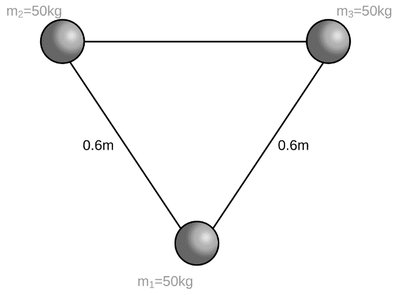
When multiple masses are arranged in two dimensions, use vector addition and symmetry to find net gravitational force.
Decompose forces into x and y components.
Use symmetry to simplify calculations when possible.
Example: Three 50-kg masses in an equilateral triangle (side 0.6 m). Find the net force on one mass.
Acceleration Due to Gravity
The acceleration due to gravity at a distance r from a planet's center is:
On the surface:
Weight at any distance:
Example: Compare gravity at the top of Mount Everest (8.85 km above sea level) to Earth's surface gravity.
Summary Table: Key Equations
Concept | Equation |
|---|---|
Linear/Angular Displacement | |
Angular Velocity | |
Angular Acceleration | |
Tangential Velocity | |
Centripetal Acceleration | |
Centripetal Force | |
Universal Gravitation | |
Orbital Speed | |
Orbital Period | |
Surface Gravity |
