 Back
Circular Motion, Orbits, and Gravity: Study Notes for Physics with Calculus
Study Guide - Smart Notes
 Tailored notes based on your materials, expanded with key definitions, examples, and context.
Chapter 6: Circular Motion, Orbits, and Gravity
Section 6.1: Uniform Circular Motion
Velocity and Acceleration in Uniform Circular Motion
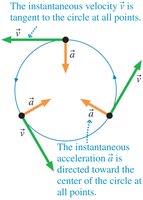
Uniform circular motion describes the movement of an object at constant speed along a circular path. Although the speed remains constant, the velocity changes because its direction is always changing. The acceleration in this motion, called centripetal acceleration, is always directed toward the center of the circle.
Instantaneous velocity (\vec{v}) is tangent to the circle at every point.
Instantaneous acceleration (\vec{a}) points toward the center of the circle.
Formula for centripetal acceleration:
Period, Frequency, and Speed
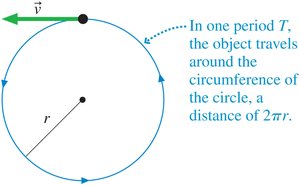
The period (T) is the time it takes for an object to complete one revolution around the circle. The frequency (f) is the number of revolutions per second, measured in inverse seconds (Hz). The speed of an object in uniform circular motion is related to the circumference and period:
Combining with centripetal acceleration:
Example: A Spinning Table Saw Blade
Consider a table saw blade with a diameter of 25 cm spinning at 3600 rpm. To analyze the motion of a tooth at the edge:
Convert diameter to radius: m
Convert rpm to Hz: Hz
Period:
Speed:
Acceleration:
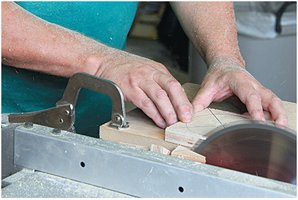
Example: The speed and acceleration of the tooth are extremely high, demonstrating the significant forces involved in high-speed circular motion.
Section 6.2: Dynamics of Uniform Circular Motion
Forces in Circular Motion
Objects in circular motion experience a net force directed toward the center of the circle, called the centripetal force. This force is not a new type of force, but rather results from familiar forces such as tension, friction, or the normal force.
Formula:
Examples: Tension in a string, friction between tires and road, normal force from the surface.
QuickCheck: Centripetal Force Source
For a puck tied to a string and swung in a circle, the tension in the string provides the centripetal force.
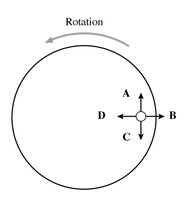
QuickCheck: Direction of Velocity and Frictional Force
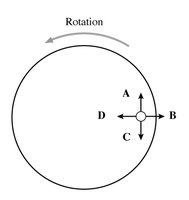
For a coin rotating on a turntable:
The velocity vector is tangent to the circle at the coin's position.
The frictional force points toward the center of the circle.
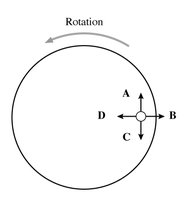
QuickCheck: Motion Without Friction
If friction disappears, the coin moves in a straight line tangent to the circle at its position, illustrating Newton's first law.
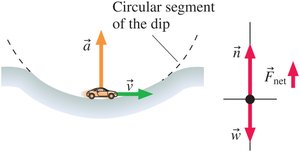
Conceptual Example: Forces on a Car in a Dip
At the bottom of a dip, a car experiences a normal force greater than its weight due to the upward centripetal acceleration required for circular motion.
Normal force () > weight () at the bottom of the dip.
Apparent weight increases due to the net upward force.
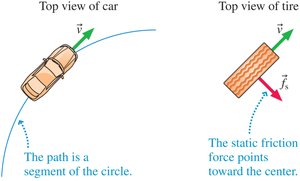
Conceptual Example: Forces on a Car Turning a Corner
When a car turns a corner, static friction between the tires and the road provides the necessary centripetal force. If the road is icy and friction is reduced, the car cannot turn and will continue in a straight line.
Static friction is responsible for turning.
Kinetic friction occurs only if the tires skid.
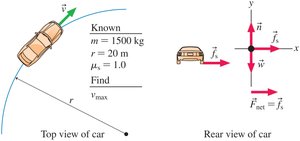
Example: Maximum Speed for a Car to Turn a Corner
The maximum speed at which a car can turn without sliding depends on the coefficient of static friction and the radius of the turn:
Mass cancels out; maximum speed does not depend on vehicle mass.
Example: Speed on a Banked Turn
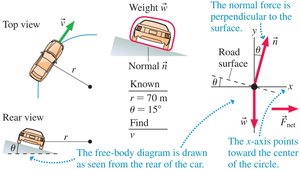
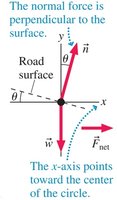
On a banked curve, the horizontal component of the normal force provides the centripetal acceleration. The speed at which a car can take the curve without friction is:
Only at this speed can the turn be negotiated without friction.
Section 6.3: Apparent Forces in Circular Motion
Centrifugal Force
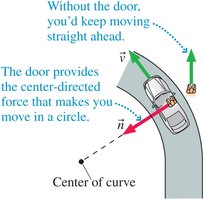
The sensation of being pushed outward in a turning car is due to inertia; the actual force acting on you is the car door pushing inward. Centrifugal force is not a real force and does not appear in free-body diagrams.
Apparent Weight in Circular Motion
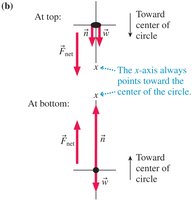
Apparent weight changes in circular motion, such as on a roller coaster. At the bottom of a loop, the normal force is greater than the true weight; at the top, it can be less.
At bottom:
At top: can be less than
Critical speed: (minimum speed to complete the loop)
Section 6.4: Circular Orbits and Apparent Weightlessness
Orbital Motion
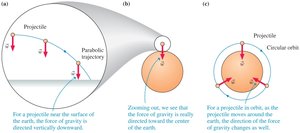
When a projectile's trajectory matches the curvature of the Earth, it enters orbit and is in free fall. The force of gravity provides the centripetal acceleration for orbital motion.
Orbital speed:
Period:
Apparent Weightlessness in Orbit
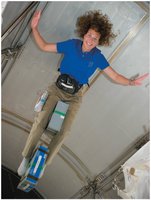
Astronauts in orbit experience apparent weightlessness because they are in free fall, with gravity as the only force acting on them.
Section 6.5: Newton’s Law of Gravity
Newton's Law of Gravitation
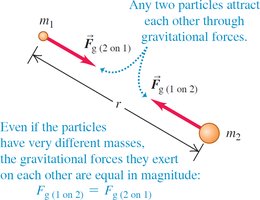
Newton's law states that every two masses attract each other with a force proportional to the product of their masses and inversely proportional to the square of the distance between them:
G is the gravitational constant: N m/kg
Inverse-square law: Doubling distance reduces force by factor of 4.
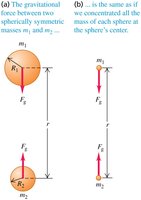
Gravitation and Spherically Symmetric Objects
The gravitational effect outside a spherically symmetric mass is as if all mass were concentrated at its center.
Weight and Acceleration Due to Gravity
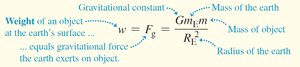
The weight of an object at Earth's surface is the gravitational force exerted by Earth:
Acceleration due to gravity:

Section 6.6: Gravity and Orbits
Gravity and Orbits
For a satellite in circular orbit, the gravitational force provides the centripetal acceleration. The orbital speed and period are given by:
Example: Locating a Geostationary Satellite
A geostationary satellite must have a period of 24 hours to remain stationary relative to Earth's surface. The radius of its orbit can be found using the orbital period formula.
Radius is about 7 times Earth's radius.
Summary Table: Key Formulas in Circular Motion and Gravity
Concept | Formula | Description |
|---|---|---|
Centripetal Acceleration | Acceleration toward center in circular motion | |
Orbital Speed | Speed for stable orbit | |
Newton's Law of Gravity | Gravitational force between two masses | |
Weight at Earth's Surface | Gravitational force on object at Earth's surface | |
Orbital Period | Period for satellite in circular orbit |
Additional info: These notes expand on the original content by providing full academic explanations, formulas, and relevant examples for each topic. Images included are directly relevant to the explanations and reinforce key concepts in circular motion and gravity.
