 Back
BackCircular Motion, Orbits, and Gravity: Study Notes
Study Guide - Smart Notes
 Tailored notes based on your materials, expanded with key definitions, examples, and context.
Chapter 6: Circular Motion, Orbits, and Gravity
Introduction
This chapter explores the physics of circular motion, the forces involved, and the laws governing planetary orbits and gravity. It covers the foundational work of scientists such as Newton, Kepler, and Cavendish, and provides mathematical tools for analyzing motion in circular paths and gravitational interactions.
Circular Motion
Uniform Circular Motion
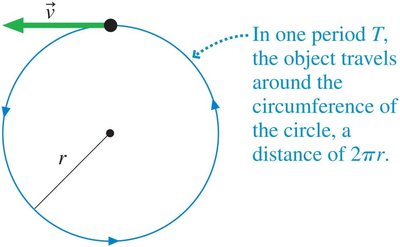
Uniform circular motion refers to the movement of an object along a circular path at a constant speed. The period (T) is the time taken for one complete revolution, and the frequency (f) is the number of revolutions per second.
Period (T): Time for one revolution (measured in seconds).
Frequency (f): Number of revolutions per second.
Speed (v):
Centripetal Acceleration
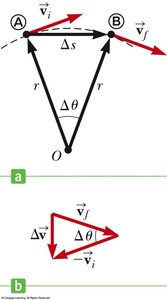
Even with constant speed, an object in circular motion experiences acceleration due to the continuous change in direction. This acceleration is called centripetal acceleration and always points toward the center of the circle.
Definition: Centripetal acceleration is the rate of change of tangential velocity.
Formula:
Direction: Always toward the center of the circle.
Centripetal Force
Definition and Equation
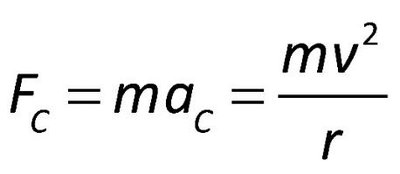
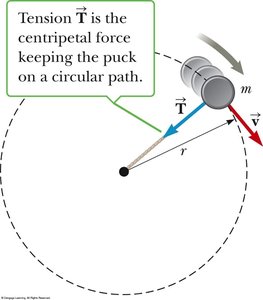
Centripetal force is not a new type of force, but a classification for any force (or combination of forces) that causes centripetal acceleration. It must be supplied by a physical force such as tension, gravity, or friction.
General Equation:
If the force vanishes, the object moves in a straight line tangent to the circle.
Example: Tension in a String
When a puck is attached to a string and moves in a circle on a frictionless table, the tension in the string provides the necessary centripetal force.
Physical Sources of Centripetal Force
Tension (e.g., string in a conical pendulum)
Gravity (e.g., planets orbiting the Sun)
Friction (e.g., car tires on a curve)
Dynamics of Uniform Circular Motion
Radial Forces and Newton's Second Law
Newton's second law for circular motion considers the sum of radial forces. Forces toward the center are negative (centripetal), while forces away are positive (centrifugal, but these are apparent forces in non-inertial frames).
Equation: (for centripetal direction)
Applications: Curves and Banking
Level Curves: Friction provides the centripetal force for cars turning to avoid sliding.
Banked Curves: The normal force has a component toward the center, allowing higher speeds without relying solely on friction.
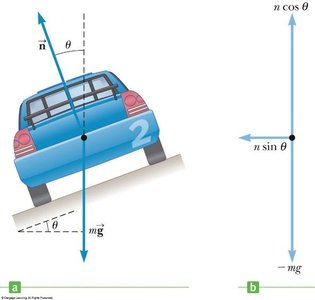
Apparent Forces in Circular Motion
Centrifugal Force
The centrifugal force is an apparent (fictitious) force that appears in rotating reference frames. It is not a real force and does not appear in free-body diagrams.
Example: In a centrifuge, centripetal acceleration separates substances by density.
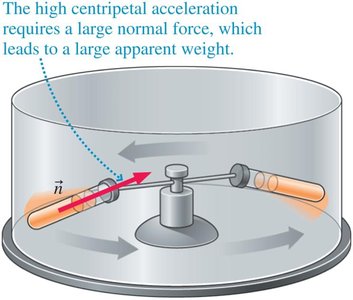
Circular Orbits and Weightlessness
Orbital Motion
When a projectile's trajectory matches the curvature of the Earth, it enters orbit. The force of gravity provides the necessary centripetal acceleration for orbital motion.
Orbital Speed:
Period of Orbit:
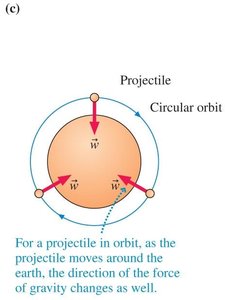
Weightlessness
Weightlessness is experienced when an object is in continuous free fall, such as astronauts in orbit. They are not free from gravity, but are falling around the Earth.
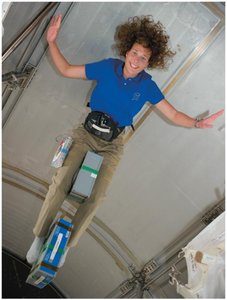
Newton’s Law of Universal Gravitation
Law Statement and Equation
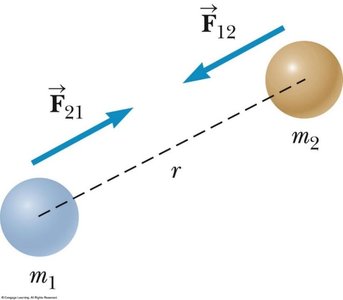
Newton’s law states that every particle attracts every other particle with a force proportional to the product of their masses and inversely proportional to the square of the distance between them.
Equation:
Universal gravitational constant:
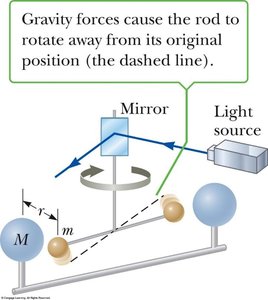
Measurement of G: Cavendish Experiment
Henry Cavendish first measured the gravitational constant using a torsion balance, allowing calculation of Earth's mass.
Applications of Universal Gravitation
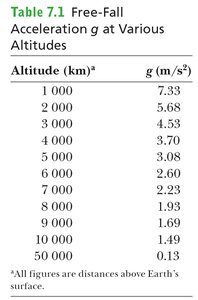
Acceleration Due to Gravity
On Earth:
Varies with altitude and planetary mass/radius.
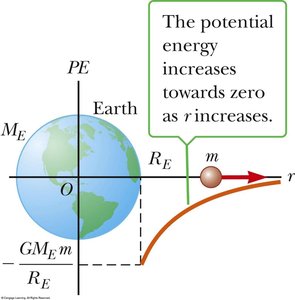
Gravitational Potential Energy
Near Earth:
General:
Escape Speed
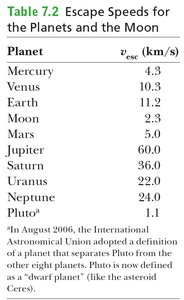
The escape speed is the minimum speed needed for an object to escape Earth's gravity without further propulsion.
Equation:
For Earth: km/s
Gravity and Orbits
Elliptical Orbits and Kepler’s Laws
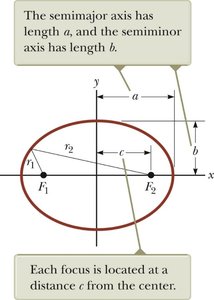
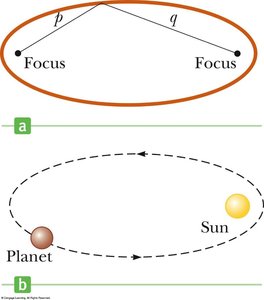
Ellipse: A closed curve with two foci; the sum of distances from any point on the ellipse to the foci is constant.
Eccentricity (e): Measures deviation from a circle ( for ellipses).
Kepler’s First Law (Law of Ellipses)
All planets move in elliptical orbits with the Sun at one focus.
Kepler’s Second Law (Law of Equal Areas)
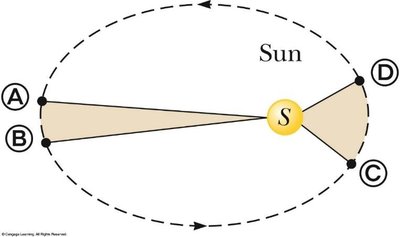
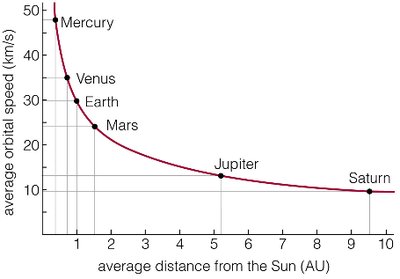
A line joining a planet and the Sun sweeps out equal areas during equal intervals of time. Planets move faster when closer to the Sun and slower when farther away.
Kepler’s Third Law (Law of Periods)
The square of a planet’s orbital period is proportional to the cube of the semimajor axis of its orbit.
Equation:
For our solar system:
Summary Table: Key Concepts in Circular Motion and Gravity
Concept | Equation | Description |
|---|---|---|
Frequency | Revolutions per second | |
Speed in Circle | Speed along circular path | |
Centripetal Acceleration | Acceleration toward center | |
Centripetal Force | Net force toward center | |
Gravitational Force | Attraction between masses | |
Orbital Speed | Speed for stable orbit | |
Escape Speed | Speed to leave planet | |
Kepler’s Third Law | Period and semimajor axis |
