 Back
BackCircular Motion: Vertical Circles and Banked Turns
Study Guide - Smart Notes
 Tailored notes based on your materials, expanded with key definitions, examples, and context.
Circular Motion
Minimum Coefficient of Friction for a Car on a Flat Curve
When a car travels around a flat, unbanked curve, friction between the tires and the road provides the necessary centripetal force to keep the car moving in a circle. The minimum coefficient of static friction required can be calculated as follows:
Centripetal Force (Fc): The force required to keep an object moving in a circle of radius R at speed v is .
Normal Force (FN): On a horizontal surface, .
Frictional Force (fs): The maximum static friction is .
Setting gives , so .
Example: For , , , .
Vertical Circles
Vertical circular motion involves objects moving in a circle in a vertical plane, such as a motorcycle inside a sphere or a pendulum. The forces acting on the object change depending on its position in the circle.
Apparent Weight: The normal force experienced by the object, which can differ from its actual weight due to acceleration.
At the Bottom: ; the normal force is greatest, and the object feels heavier.
At the Sides: ; gravity does not contribute to the normal force.
At the Top: ; if , the object loses contact and falls.
Minimum Speed at the Top: To maintain contact, , so .
Example: Minimum Speed at the Top of a Vertical Circle
For a circle of radius , at the minimum speed.
For ,
Conservation of Energy in Vertical Circles
As an object moves around a vertical circle, its kinetic and potential energies change, but the total mechanical energy is conserved (if friction is negligible).
At the Bottom: Maximum kinetic energy, minimum potential energy.
At the Top: Minimum kinetic energy, maximum potential energy.
Energy Conservation:
Banked Turns
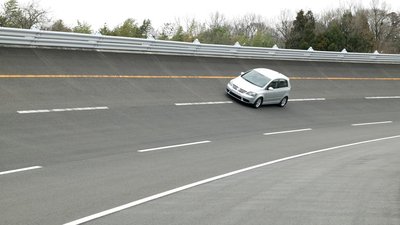
Banked turns are designed so that the normal force provides the necessary centripetal force for circular motion, reducing reliance on friction. This is common in highways and racetracks.
Normal Force Components: The normal force can be resolved into horizontal () and vertical () components.
Vertical Equilibrium:
Horizontal (Centripetal) Force:
Bank Angle Formula:
Maximum Speed (No Friction):
Example: For , ,
Banked Turns with Friction
When friction is present, it can increase the maximum speed at which a car can safely navigate a banked turn. The frictional force adds to the normal force components, allowing for greater centripetal force.
Frictional Force: Acts parallel to the surface, increasing both the x and y components of the net force.
Designing Safe Turns: Engineers calculate the required banking angle to ensure safety even in low-friction conditions (e.g., icy roads).
Example: For , , the required bank angle is .
Summary Table: Forces in Circular Motion
Position | Normal Force () | Apparent Weight | Condition |
|---|---|---|---|
Bottom of Vertical Circle | Heavier | Maximum | |
Side of Vertical Circle | Normal | Gravity perpendicular to motion | |
Top of Vertical Circle | Lighter or zero | Minimum |
Key Equations
Additional info: The image included shows a car navigating a banked turn, which visually reinforces the explanation of how banked turns use the normal force to provide centripetal force, reducing reliance on friction.
