 Back
BackCollege Physics I – Midterm 1 Review: Step-by-Step Guidance
Study Guide - Smart Notes
 Tailored notes based on your materials, expanded with key definitions, examples, and context.
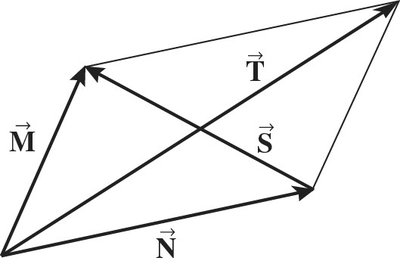
Q3(A). Given the vector diagram, which of the following vector equations is correct?
Background
Topic: Vector Addition and Subtraction
This question tests your understanding of vector operations, specifically how to interpret vector diagrams and write vector equations based on the head-to-tail method and parallelogram law.
Key Terms and Concepts:
Vector Addition: The process of combining two or more vectors to find a resultant vector.
Vector Subtraction: Subtracting one vector from another is equivalent to adding its negative.
Resultant Vector: The vector sum of two or more vectors.
Step-by-Step Guidance
Examine the diagram and identify the vectors \( \vec{M} \), \( \vec{N} \), \( \vec{S} \), and \( \vec{T} \). Notice how the vectors are arranged head-to-tail and across the parallelogram.
Recall that in a parallelogram, the diagonals can be expressed as sums or differences of the sides. For example, if two vectors form adjacent sides, their sum is the diagonal from the common tail to the opposite corner.
Write out possible vector equations using the diagram. For example, check if \( \vec{S} = \vec{M} + \vec{N} \) or \( \vec{T} = \vec{M} - \vec{N} \) matches the diagram.
Compare each option given in the question to the diagram. For each, visualize or sketch the vector addition/subtraction to see if it matches the direction and magnitude shown.
Try solving on your own before revealing the answer!
