 Back
BackCollege Physics I: Models, Measurements, and Vectors – Study Notes
Study Guide - Smart Notes
 Tailored notes based on your materials, expanded with key definitions, examples, and context.
Course Overview
This course, College Physics I (PHYS 1301), introduces students to the fundamental principles of physics, focusing on algebra-based methods. Topics include space and time, kinematics, forces, energy, momentum, conservation laws, periodic motion, waves, and thermodynamics. The course emphasizes problem-solving, conceptual understanding, and the application of physical laws.
Models, Measurements, and Vectors
The Nature of Physics
Physics is the foundational science that seeks to understand the patterns and laws governing the natural world. It is an experimental science, relying on observation, experimentation, and the formulation of theories and laws.
Physical Law: A well-established theory widely used to describe natural phenomena.
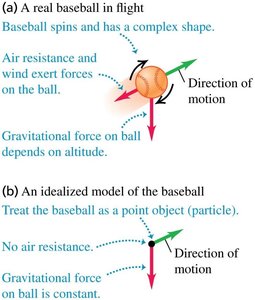
Model: An idealized representation of a physical system used to simplify analysis.
Example: Modeling a baseball in flight as a point object to ignore air resistance and focus on gravitational force.
Historical Foundations
Early physicists such as Aristotle, Galileo, and Newton contributed to our understanding of motion and forces.
Aristotle: Proposed that falling speed is proportional to weight.
Galileo: Demonstrated that objects fall at the same rate regardless of mass in the absence of resistance.
Newton: Formulated the laws of motion and universal gravitation.
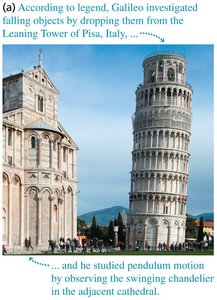
Example: Galileo's experiments from the Leaning Tower of Pisa and his study of pendulum motion.
Solving Physics Problems
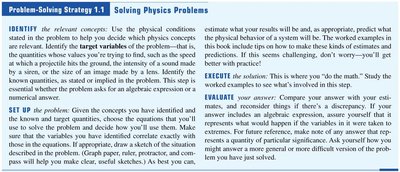
Effective problem-solving in physics involves a systematic approach:
Identify: Relevant concepts, target variables, and known quantities.
Set Up: Choose appropriate equations and draw diagrams.
Execute: Perform calculations and show reasoning.
Evaluate: Compare results with estimates and check for consistency.
Standards and Units
Fundamental Quantities
Physics relies on three fundamental quantities: length, time, and mass. The International System of Units (SI) is the standard system used worldwide.
Length: Measured in meters (m)
Time: Measured in seconds (s)
Mass: Measured in kilograms (kg)
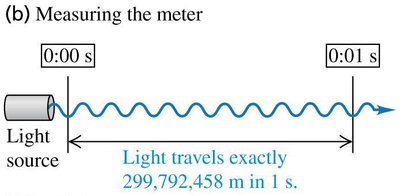
Example: The meter is defined by the distance light travels in a vacuum in 1 second.
Measurement Standards
Precise standards are used to define units:
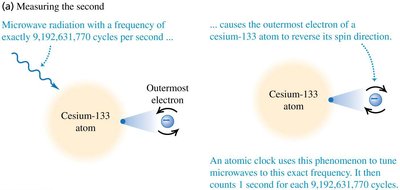
Second: Defined by the frequency of microwave radiation absorbed by cesium-133 atoms.
Meter: Defined by the distance light travels in a vacuum in 1/299,792,458 seconds.
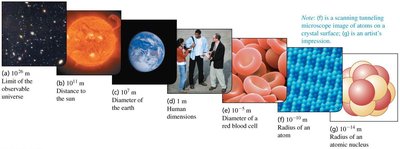
Prefixes and Unit Conversions
Prefixes are used to express multiples and submultiples of units. Unit conversions are essential for dimensional consistency in calculations.
Common Prefixes: µ (micro, ), k (kilo, ), m (milli, ), n (nano, )
Unit Consistency: Equations must be dimensionally consistent; only quantities with the same units can be added or equated.
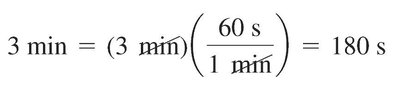
Example: Converting 3 minutes to seconds:
Course Structure and Assessment
Exams and Quizzes
The course includes three major exams, pop quizzes, homework assignments, and pre/post-tests. Exams cover material discussed in class and are graded numerically. Homework is submitted via Mastering Physics, and quizzes are scheduled online.
Instructor | Course Information | Exam Name | Exam Start Date | Exam End Date | Exam Start/End Time | Exam Type | Exam Duration |
|---|---|---|---|---|---|---|---|
Paul MacAlevy | PHYS 1301/PHYS 2325. All Sections - MECHANICS | Pretest | 1/20/2026 | 2/2/2026 | During Center hours | Online | 60 mins |
Paul MacAlevy | PHYS 1301/PHYS 2325. All Sections - MECHANICS | Posttest | 4/15/2026 | 4/25/2026 | During Center hours | Online | 60 mins |
Grading Policy
Exams: 70% of final grade (Exam 1: 20%, Exam 2: 20%, Final Exam: 30%)
Homework: 18% via Mastering Physics
Quizzes: 10%
Learning Evaluation: Pre-test and Post-test (2% each)
Extra Credit: Up to 3% for class participation
Key Learning Objectives
Compute vector operations (sum, scalar multiplication, vector multiplication)
Analyze linear and rotational motion (displacement, velocity, acceleration)
Apply force concepts, including gravity and Newton’s laws
Classify energy forms and use conservation of energy
Define momentum and analyze collisions
Relate linear and rotational variables
Explain simple harmonic motion and waves
Describe fluid mechanics and interpret thermodynamic laws
Additional info:
These notes cover the introductory chapter and course structure, focusing on models, measurements, and vectors. Further chapters will expand on motion, forces, energy, and other core physics topics as outlined in the syllabus.
