 Back
BackCollege Physics I: Newton’s Laws, Circular Motion, Work & Energy, and Momentum – Study Notes
Study Guide - Smart Notes
 Tailored notes based on your materials, expanded with key definitions, examples, and context.
Ch5 Application of Newton’s Law
Newton’s Laws of Motion
Newton’s laws describe the relationship between the motion of an object and the forces acting on it. These laws are foundational to classical mechanics.
Newton’s First Law (Law of Inertia): An object remains at rest or in uniform motion unless acted upon by a net external force.
Newton’s Second Law: The net force on an object is equal to the mass of the object multiplied by its acceleration.
Newton’s Third Law: For every action, there is an equal and opposite reaction.
Friction Forces
Maximum static friction: The maximum force before sliding begins.
Kinetic friction: The force opposing motion once sliding has started.
Ch6 Circular Motion and Gravitation
Uniform Circular Motion
Objects moving in a circle at constant speed experience a net force directed toward the center of the circle (centripetal force).
Centripetal force:
Newton’s Law of Gravitation
Every mass attracts every other mass with a force proportional to the product of their masses and inversely proportional to the square of the distance between them.
Gravitational force:
Gravitational acceleration at Earth’s surface: where is Earth’s mass and is Earth’s radius.
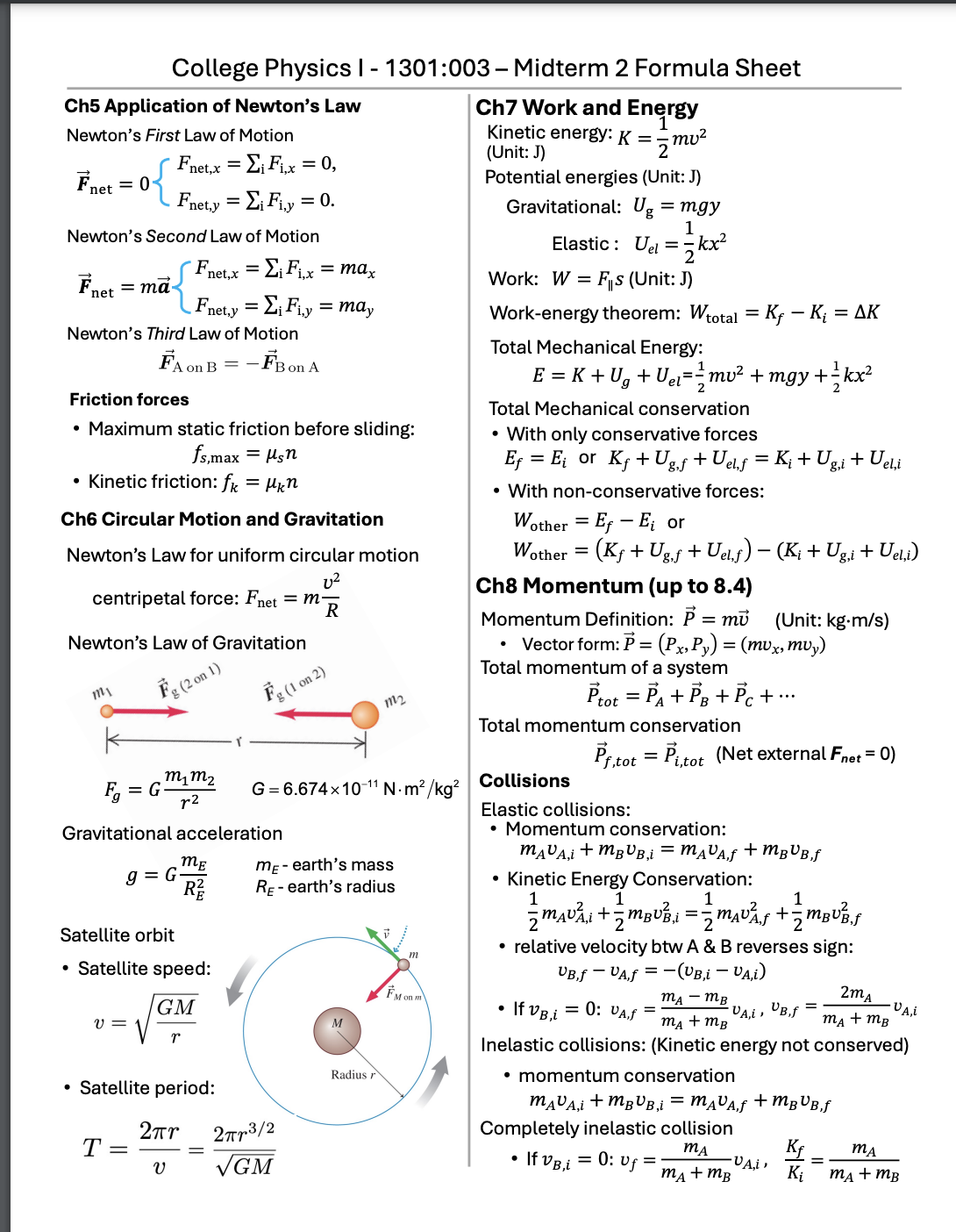
Satellite Orbits
Satellite speed:
Satellite period:
Ch7 Work and Energy
Kinetic and Potential Energy
Energy is the capacity to do work. Mechanical energy includes kinetic and potential forms.
Kinetic energy:
Potential energy:
Gravitational:
Elastic (spring):
Work and the Work-Energy Theorem
Work:
Work-energy theorem:
Total Mechanical Energy and Conservation
Total mechanical energy:
Conservation (only conservative forces): or
With non-conservative forces: or
Ch8 Momentum (up to 8.4)
Momentum and Its Conservation
Momentum is a vector quantity defined as the product of mass and velocity. In the absence of external forces, the total momentum of a system remains constant.
Momentum: (Unit: kg·m/s)
Vector form:
Total momentum of a system:
Conservation of momentum: (if net external )
Collisions
Elastic collisions:
Momentum conservation:
Kinetic energy conservation:
Relative velocity reverses sign:
Special cases:
If : ,
Inelastic collisions: Only momentum is conserved, not kinetic energy.
Completely inelastic collision: Objects stick together after collision.
If :
Fraction of kinetic energy remaining:
