 Back
BackComprehensive Study Guide for General Physics with Calculus (Ph212) – Final Exam Preparation
Study Guide - Smart Notes
 Tailored notes based on your materials, expanded with key definitions, examples, and context.
Final Exam Overview
Purpose and Structure
The final exam in General Physics with Calculus (Ph212) is designed to assess mastery of core physics concepts and problem-solving skills. It covers material from the entire term, with equal emphasis on topics from the first two midterms and those introduced after midterm II.
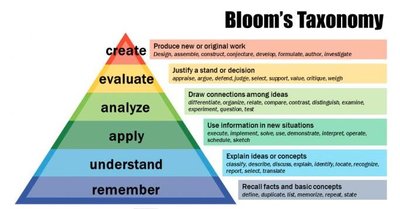
Assessment Focus: Application, analysis, and evaluation of physics principles (see Bloom's Taxonomy below).
Exam Format: Combination of conceptual questions and quantitative problems.
Allowed Materials: Scientific calculator, blank paper, writing utensil, and instructor-provided equation sheet.
Course Learning Objectives
Core Competencies
Multiple Representations: Use diagrams, graphs, words, and equations to describe and solve physical problems.
Critical Thinking: Analyze new systems, make assumptions, break down problems, apply concepts, and evaluate solutions.
Exam Topics and Key Concepts
Wave Optics and Light
Wave optics explores the behavior of light as a wave, including interference and diffraction phenomena.
Interference: Superposition of waves leading to constructive (bright) and destructive (dark) patterns.
Phase Difference & Path-Length Difference: Determines the type of interference; constructive occurs when the phase difference is a multiple of , destructive when it is an odd multiple of .
Thin Films & Optical Coatings: Used to enhance or reduce reflection via interference.
Double-Slit & Single-Slit Interference: Patterns depend on slit separation and wavelength.
Diffraction Grating & Spectroscopy: Gratings produce sharp interference patterns, useful in analyzing light spectra.
Ray Model of Light: Treats light as straight lines; useful for reflection and refraction.
Law of Reflection: Angle of incidence equals angle of reflection ().
Law of Refraction (Snell's Law): .
Total Internal Reflection: Occurs when light cannot exit a medium and is reflected internally.
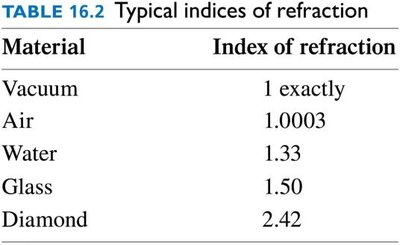
Indices of Refraction
The index of refraction quantifies how much light slows down in a medium.
Material | Index of Refraction |
|---|---|
Vacuum | 1 exactly |
Air | 1.0003 |
Water | 1.33 |
Glass | 1.50 |
Diamond | 2.42 |
Sign Convention for Thin Lenses
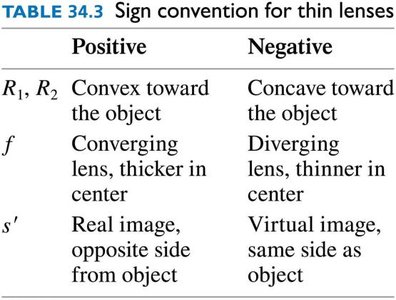
Understanding sign conventions is crucial for lens calculations.
Positive | Negative | |
|---|---|---|
R1, R2 | Convex toward the object | Concave toward the object |
f | Converging lens, thicker in center | Diverging lens, thinner in center |
s' | Real image, opposite side from object | Virtual image, same side as object |
Newton’s Universal Law of Gravity & Kepler’s Laws
Gravitational interactions govern planetary motion and orbits.
Newton’s Law of Gravity:
Gravitational Potential Energy:
Kepler’s Third Law:
Rotational Motion and Moments of Inertia
Rotational dynamics describe how objects spin and how mass distribution affects rotation.
Angular Position, Velocity, Acceleration: ,
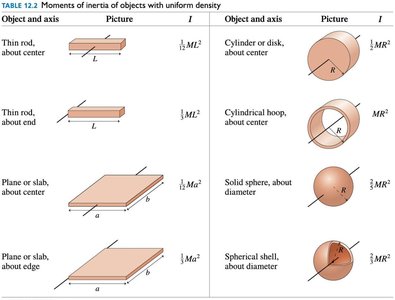
Moment of Inertia: Quantifies resistance to rotational acceleration; depends on mass distribution.
Object and Axis | Picture | I |
|---|---|---|
Thin rod, about center | — | |
Thin rod, about end | — | |
Plane/slab, about center | — | |
Plane/slab, about edge | — | |
Cylinder/disk, about center | — | |
Cylindrical hoop, about center | — | |
Solid sphere, about diameter | — | |
Spherical shell, about diameter | — |
Oscillatory Motion
Oscillatory systems include springs, pendulums, and damped oscillators.
Simple Harmonic Motion: ,
Pendulum Motion:
Damped Oscillations:
Traveling Waves and Superposition
Wave phenomena are central to understanding sound, light, and other physical systems.
Wave Equation:
Wave Speed:
Superposition Principle:
Beat Frequency:
Fluids and Elasticity
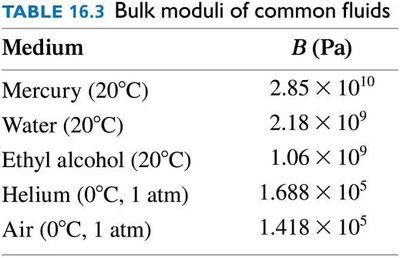
Fluid properties are characterized by their resistance to compression, described by the bulk modulus.
Medium | B (Pa) |
|---|---|
Mercury (20°C) | |
Water (20°C) | |
Ethyl alcohol (20°C) | |
Helium (0°C, 1 atm) | |
Air (0°C, 1 atm) |
General Exam Preparation Guidelines
Review all class materials, homework, and textbook examples.
Practice conceptual and quantitative problems from relevant chapters.
Understand every symbol and equation on the provided equation sheet.
Engage in active recall and spaced repetition for effective learning.
Focus on understanding, not memorization; exams test higher-level thinking.
Additional Info
Chapters emphasized: 4 (Kinematics in Two Dimensions), 8 (Dynamics II: Motion in a Plane), 12 (Rotation of a Rigid Body), 15 (Oscillations), 16 (Traveling Waves), 17 (Superposition), 33 (Wave Optics), 34 (Ray Optics), 13 (Newton's Theory of Gravity).
Practice problems and conceptual questions are listed for targeted review.
