 Back
BackComprehensive Study Guide for General Physics with Calculus (Ph212) – Final Exam Preparation
Study Guide - Smart Notes
 Tailored notes based on your materials, expanded with key definitions, examples, and context.
Course Overview and Exam Preparation
General Learning Objectives
The final exam in General Physics with Calculus assesses mastery of core physics concepts and problem-solving skills. Students are expected to represent information in multiple forms, apply critical thinking, and analyze physical systems using diagrams, graphs, equations, and words.
Multiple Representations: Ability to translate between diagrams, graphs, equations, and verbal descriptions.
Critical Thinking: Analyze new systems, make assumptions, break down problems, apply concepts, and evaluate solutions.
Bloom's Taxonomy in Physics Exams
Physics exams emphasize higher-level thinking skills, including application, analysis, and evaluation, as outlined in Bloom's Taxonomy.
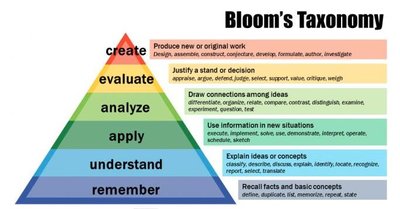
Apply: Use information in new situations.
Analyze: Draw connections among ideas.
Evaluate: Justify a stand or decision.
Create: Produce new or original work.
Exam Topics and Chapter Coverage
Key Chapters and Concepts
The exam covers material from the following chapters, focusing on both foundational and advanced topics:
Ch 4: Kinematics in Two Dimensions
Ch 8: Dynamics II: Motion in a Plane
Ch 12: Rotation of a Rigid Body
Ch 15: Oscillations
Ch 16: Traveling Waves
Ch 17: Superposition
Ch 33: Wave Optics
Ch 34: Ray Optics
Ch 13: Newton's Theory of Gravity
New Topics Since Midterm II
Recent topics include interference, phase and path-length differences, thin films, optical coatings, wave and ray models of light, double-slit and single-slit interference, diffraction gratings, spectroscopy, laws of reflection and refraction, total internal reflection, Newton’s law of gravity, gravitational potential energy, and Kepler’s laws.
Mathematical and Physical Relationships
Vector Relationships
Vectors are fundamental in physics for representing quantities with both magnitude and direction.
Vector Decomposition:
Magnitude:
Direction:
Kinematics and Dynamics
Kinematics describes motion using position, velocity, and acceleration, while dynamics relates motion to forces.
Position Vector:
Velocity:
Acceleration:
Constant Acceleration Equations:
Rotational Motion and Moments of Inertia
Rotational motion involves angular position, velocity, and acceleration. The moment of inertia quantifies an object's resistance to rotational acceleration.
Angular Velocity:
Angular Acceleration:
Moment of Inertia: or
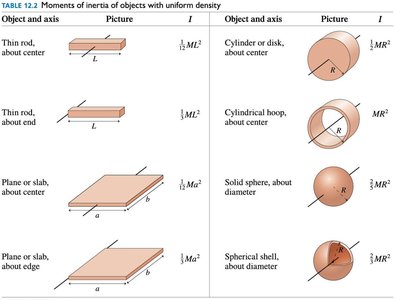
Common moments of inertia for various objects:
Object and Axis | Picture | I |
|---|---|---|
Thin rod, about center | — | |
Thin rod, about end | — | |
Plane or slab, about center | — | |
Plane or slab, about edge | — | |
Cylinder or disk, about center | — | |
Cylindrical hoop, about center | — | |
Solid sphere, about diameter | — | |
Spherical shell, about diameter | — |
Oscillatory Motion
Simple Harmonic Motion (SHM)
SHM describes systems where the restoring force is proportional to displacement, such as springs and pendulums.
Equation of Motion:
Angular Frequency:
Energy:
Wave Motion and Superposition
Sinusoidal Waves
Waves transport energy and information. The wave equation describes displacement as a function of position and time.
Wave Equation:
Wave Speed:
Wave Number:
Indices of Refraction
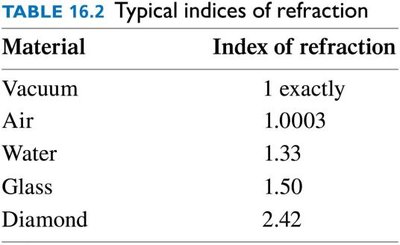
The index of refraction quantifies how much light slows down in a medium compared to vacuum.
Material | Index of Refraction |
|---|---|
Vacuum | 1 exactly |
Air | 1.0003 |
Water | 1.33 |
Glass | 1.50 |
Diamond | 2.42 |
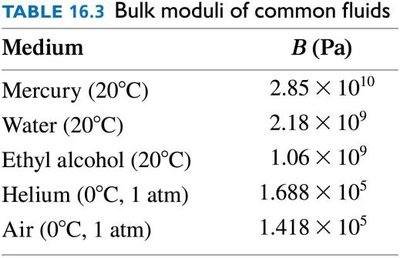
Bulk Modulus of Common Fluids
The bulk modulus measures a fluid's resistance to compression, important in sound propagation.
Medium | B (Pa) |
|---|---|
Mercury (20°C) | |
Water (20°C) | |
Ethyl alcohol (20°C) | |
Helium (0°C, 1 atm) | |
Air (0°C, 1 atm) |
Optics: Wave and Ray Models
Wave Optics: Interference and Diffraction
Wave optics explains phenomena such as interference and diffraction, which arise from the superposition of light waves.
Double-Slit Interference:
Single-Slit Diffraction:
Path Difference: (constructive), (destructive)
Ray Optics: Reflection and Refraction
Ray optics uses geometric principles to describe how light interacts with surfaces.
Law of Reflection:
Law of Refraction (Snell's Law):
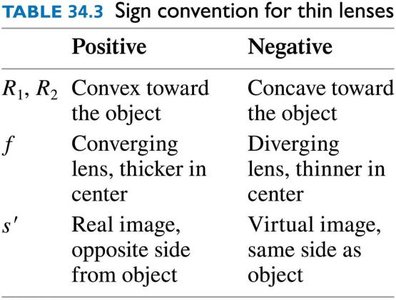
Sign Conventions for Thin Lenses
Understanding sign conventions is essential for solving lens problems.
Positive | Negative | |
|---|---|---|
R1, R2 | Convex toward the object | Concave toward the object |
f | Converging lens, thicker in center | Diverging lens, thinner in center |
s' | Real image, opposite side from object | Virtual image, same side as object |
Gravity and Kepler’s Laws
Newton’s Universal Law of Gravity
Newton’s law describes the gravitational force between two masses.
Gravitational Force:
Gravitational Potential Energy:
Kepler’s Laws
Kepler’s laws govern planetary motion:
Third Law:
Study Strategies and Exam Preparation
Effective Study Techniques
Success in physics requires active engagement and problem-solving. Recommended strategies include:
Practice conceptual and quantitative problems from the textbook.
Review lecture notes, homework, and in-class activities.
Study in groups and teach concepts to others.
Use active recall and spaced repetition for retention.
Focus on understanding, not memorization.
Review chapter summaries, terms, and notation.
Exam Materials and Guidelines
Allowed: Scientific calculator, blank paper, writing utensil, instructor-provided equation sheet.
Review all symbols and equations, and relate them to diagrams and graphs.
Answers to odd-numbered textbook problems are available for self-check.
Summary
This study guide provides a structured overview of the key physics concepts, equations, and strategies necessary for success in the final exam. Mastery of these topics, combined with effective study habits, will ensure comprehensive understanding and application of physics principles.
