 Back
BackConcepts of Motion and Kinematics: Structured Study Notes
Study Guide - Smart Notes
 Tailored notes based on your materials, expanded with key definitions, examples, and context.
Concepts of Motion
Trajectory and Motion
The trajectory is the path along which an object moves, which may be straight or curved. Motion is defined as the change of an object's position with time, always measured relative to a reference point. An object's position is its directed distance from this reference point, and movement is said to occur when the position changes.
Motion Diagrams
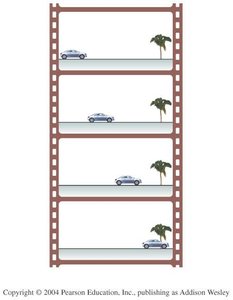
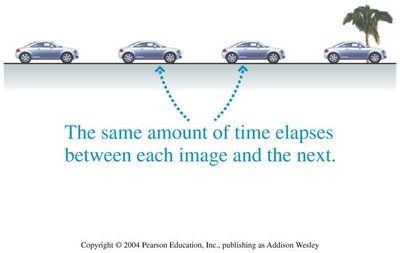
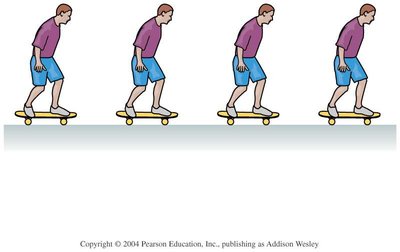
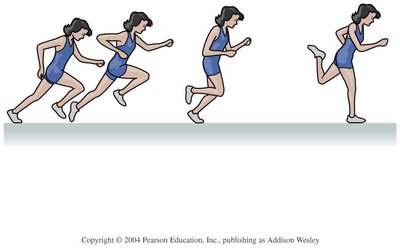
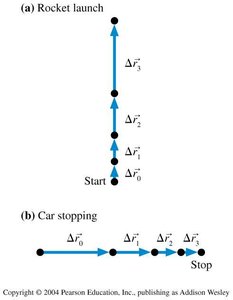
Motion diagrams are composite photos or sketches showing an object's position at several equally spaced instants of time. They are essential tools for visualizing motion and understanding how an object's position changes over time.
Uniform motion: The object moves with constant speed, and the spacing between positions is equal.
Non-uniform motion: The spacing between positions changes, indicating acceleration or deceleration.
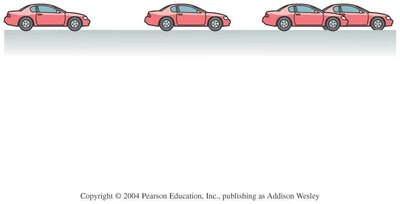
The Particle Model
Point Particle Approximation
Objects undergoing purely translational motion (no rotation) can be modeled as point particles. This simplifies analysis by concentrating all mass at a single point and ignoring effects such as shape change and rotation.
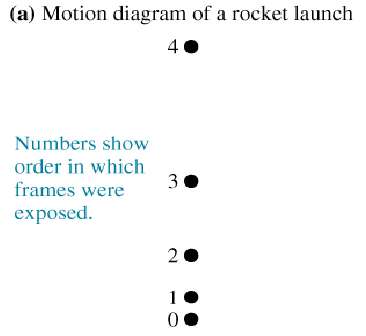
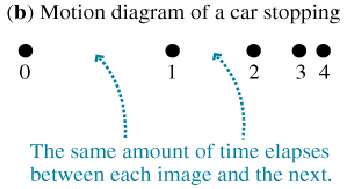
Coordinate Systems and Position
Establishing a Coordinate System
To describe motion quantitatively, a coordinate system is established:
Origin: The reference point for position measurements.
Axes: Typically, the x-axis points right and the y-axis points upward.
Scale: Units for measurement (meters, seconds, etc.).
Each point in space is specified by its x and y coordinates. The orientation and placement of axes can be chosen to simplify problem-solving.
Time Measurement
Clock reading: The actual time shown on a clock.
Time interval: The difference between two clock readings.
Vectors and Displacement
Position Vector
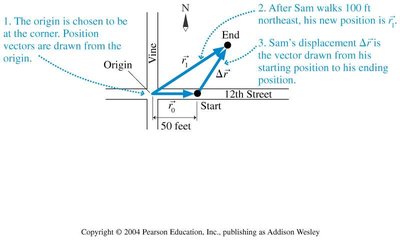
The position vector is an arrow drawn from the origin to the object's position. It is a vector quantity, described by both magnitude and direction.
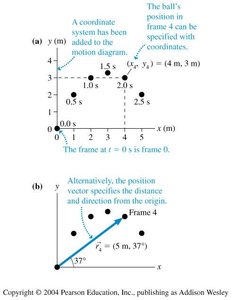
Displacement
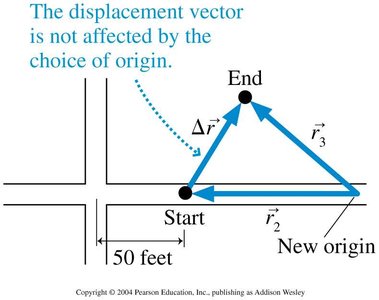
Displacement is the change in position of an object and is a vector quantity. It depends only on the initial and final positions, not on the path taken or the coordinate system.
Vector Representation
Vectors are denoted by an arrow above the letter (e.g., ) or boldface.
The magnitude of a vector is its length and is always non-negative.
Graphically, vectors are represented as arrows; the length corresponds to magnitude, and the direction indicates the vector's direction.
Vector Addition and Subtraction
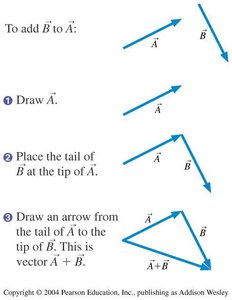
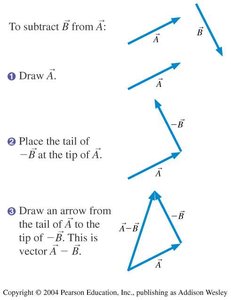
Vectors can be added or subtracted graphically using the tip-to-tail method:
Addition: Place the tail of the second vector at the tip of the first, then draw the resultant from the tail of the first to the tip of the second.
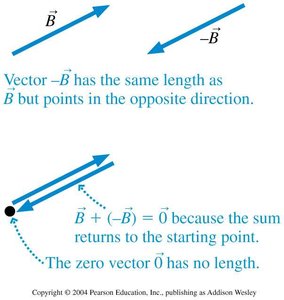
Subtraction: Add the negative of the vector to be subtracted.
Speed, Velocity, and Acceleration
Speed and Velocity
Average speed:
Average velocity:
Relating Position to Velocity
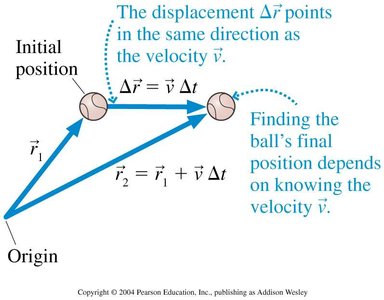
The displacement vector points in the same direction as the velocity vector .
Final position can be found using .
Motion Diagrams: Velocity and Acceleration
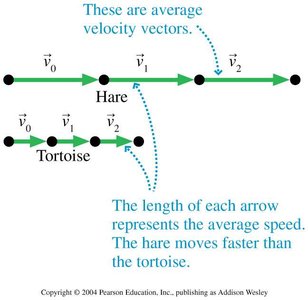
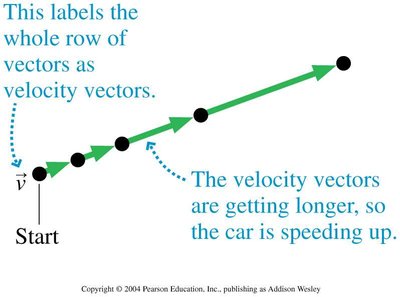
Velocity vectors are drawn between position dots; their length represents speed.
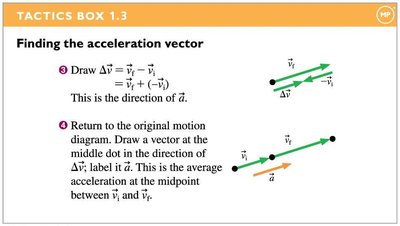
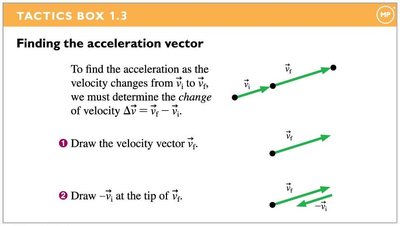
Acceleration vectors are drawn between velocity vectors; they indicate changes in velocity.
Acceleration
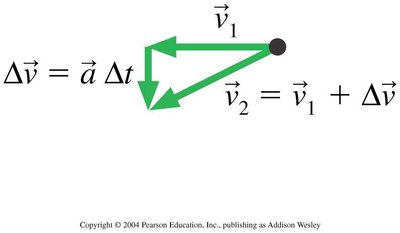
Average acceleration is defined as the ratio of the change in velocity to the time taken:
Acceleration arises whenever velocity changes, either in magnitude, direction, or both.
Sign of Position, Velocity, and Acceleration
Determining Signs in One-Dimensional Motion
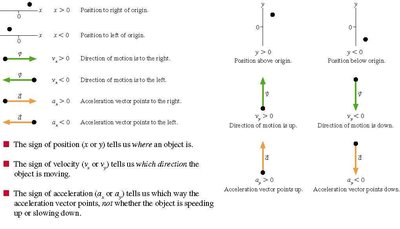
The sign of position (x or y) tells us where an object is relative to the origin.
The sign of velocity (vx or vy) tells us which direction the object is moving.
The sign of acceleration (ax or ay) tells us which way the acceleration vector points, not whether the object is speeding up or slowing down.
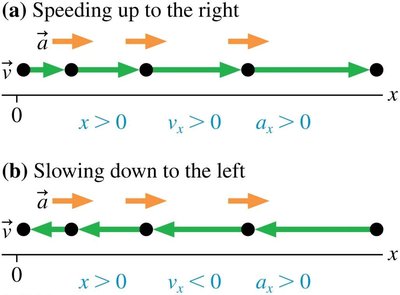
Speeding Up and Slowing Down
An object is speeding up if the velocity and acceleration vectors point in the same direction.
An object is slowing down if the velocity and acceleration vectors point in opposite directions.
Velocity is constant if the acceleration vector is zero.
Position-versus-Time Graphs
Graphical Representation of Motion
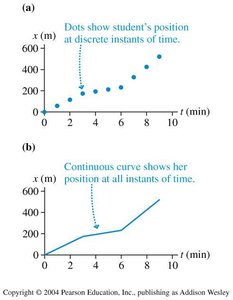
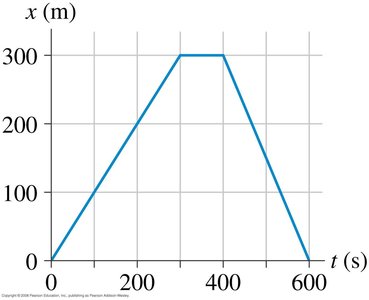
Position-versus-time graphs plot position on the vertical axis and time on the horizontal axis. These graphs are useful for visualizing how an object's position changes over time.
Interpreting Position-versus-Time Graphs
Discrete points show position at specific instants.
Continuous curves show position at all instants.
The slope of the graph at any point gives the object's velocity.
Summary Table: Key Concepts in Motion
Concept | Definition | Vector/Scalar |
|---|---|---|
Position | Location relative to reference point | Vector |
Displacement | Change in position | Vector |
Distance | Total path length traveled | Scalar |
Speed | Rate of distance traveled | Scalar |
Velocity | Rate of displacement | Vector |
Acceleration | Rate of change of velocity | Vector |
Additional info: Academic context and explanations have been expanded to ensure completeness and clarity for exam preparation.
