 Back
BackConductors in Electrostatic Equilibrium and Applications of Gauss's Law
Study Guide - Smart Notes
 Tailored notes based on your materials, expanded with key definitions, examples, and context.
Conductors in Electrostatic Equilibrium
Introduction to Conductors and Electrostatic Equilibrium
Conductors are materials, typically metals, in which electrons are free to move due to metallic bonding. When a conductor reaches electrostatic equilibrium, the charges within it are no longer in motion. This state is crucial for understanding the behavior of electric fields and charge distribution in conductors.
Electrostatic equilibrium: The condition where the net force on every charge within the conductor is zero, resulting in no further movement of charges.
Key properties of conductors in this state are foundational for applications in shielding and charge manipulation.
Property #1: Zero Electric Field Inside a Conductor
At electrostatic equilibrium, the electric field E is zero everywhere inside a conductor, whether it is solid or hollow. This is because any nonzero field would cause free charges to move, contradicting the equilibrium condition.
Mathematical condition: inside the conductor.
Any external electric field is canceled by the induced internal field, ensuring no net field inside.
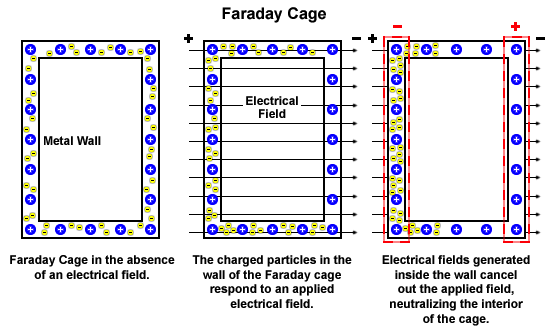
Example: The Faraday Cage is a practical application where the interior is shielded from external electric fields due to this property.
Application: Faraday Cage
A Faraday Cage is an enclosure made of conducting material that blocks external static and non-static electric fields. It is named after Michael Faraday, who demonstrated that the charge on a conductor resides only on its exterior and has no influence on anything enclosed within it.
Used for protecting sensitive electronic equipment, shielding cables, and safety suits for technicians working near high voltages.
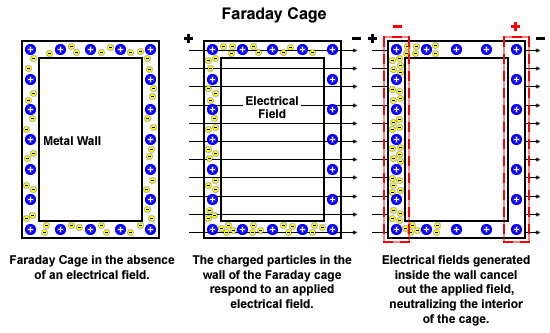
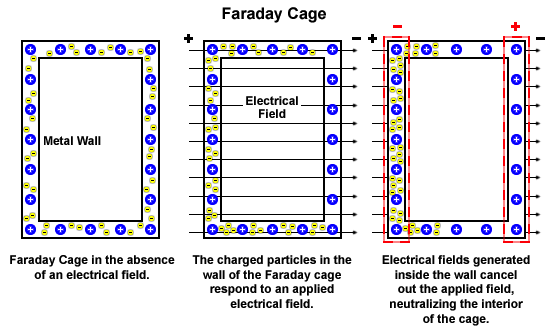
Electric fields generated inside the wall of the cage cancel out the applied field, neutralizing the interior.

Property #2: Net Charge Resides on the Surface
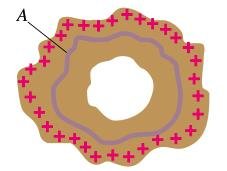
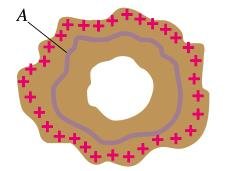
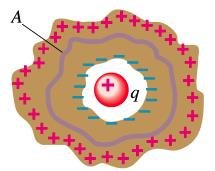
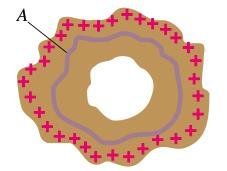
Any net charge placed on a conductor at electrostatic equilibrium will reside entirely on its surface. This is a direct consequence of the zero electric field inside the conductor.
For any Gaussian surface entirely within the conductor, the electric flux must be zero, so excess charges move to the surface.
Even in hollow conductors, free electrons rearrange to maintain zero field inside the material.
Property #3: Electric Field Just Outside the Surface
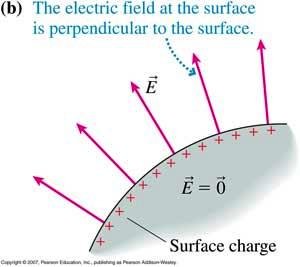
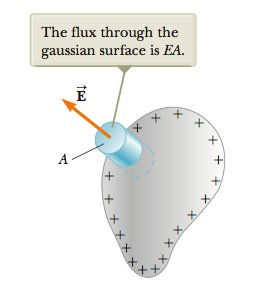
The electric field just outside a conductor in electrostatic equilibrium is always perpendicular to the surface and has a magnitude given by , where is the surface charge density.
No parallel component of the electric field exists at the surface, as this would cause surface charges to move.
This property is derived using Gauss's Law:
For a small Gaussian pillbox at the surface:
Property #4: Charge Density and Surface Curvature
On irregularly shaped conductors, the surface charge density is greatest where the radius of curvature is smallest (i.e., at sharp points or edges). This leads to stronger local electric fields at these locations.
This explains phenomena such as corona discharge and why lightning rods are pointed.
Example: Electric Field of a Charged Spherical Conductor
Electric Field Inside and Outside a Spherical Conductor
Consider a conducting sphere with excess electrons (net negative charge ) placed on it. After reaching electrostatic equilibrium:
Inside the sphere (): The electric field is zero, $E_{r
Outside the sphere (): The electric field behaves as if all the charge were concentrated at the center:
This is identical to the field of a point charge at the center of the sphere.
Application: This result is used in electrostatics to model the field around charged conductors and is foundational for understanding capacitors and shielding.
