 Back
BackConservation of Angular Momentum and Rotational Dynamics
Study Guide - Smart Notes
 Tailored notes based on your materials, expanded with key definitions, examples, and context.
Conservation of Angular Momentum and Rotational Dynamics
Introduction to Rotational Motion
Rotational motion is a fundamental aspect of physics, describing how objects spin around an axis. This section introduces the key concepts and equations governing rotational dynamics, drawing parallels to linear motion.
Translation vs. Rotation: Translational motion involves movement along a straight line, while rotational motion involves spinning around an axis.
Force (F): The cause of linear acceleration, defined by Newton's second law:
Torque (\tau): The rotational equivalent of force, causing angular acceleration:
Moment of Inertia (I): The rotational equivalent of mass, quantifying an object's resistance to angular acceleration: for a point mass.
Angular Acceleration (\alpha): The rate of change of angular velocity.
Symmetries and Conservation Laws
Symmetries in physics lead to conservation laws, which are foundational principles in mechanics.
Time Symmetry: Leads to conservation of energy.
Translational Symmetry: Leads to conservation of linear momentum.
Rotational Symmetry: Leads to conservation of angular momentum.
Linear and Angular Momentum
Momentum is a measure of motion, with linear and angular forms for translational and rotational motion, respectively.
Linear Momentum (P): (units: kg·m/s)
Angular Momentum (L): or (units: kg·m2/s)
Work (W): (units: Nm or Joule)
Calculating Angular Momentum
Angular momentum depends on the mass, distance from the axis, and angular velocity of a rotating object.
For a point mass:
Alternate forms:
Example: A puck of mass 3.0 kg, radius 1.0 m, and angular velocity 5.0 rad/s has kg·m2/s.
Comparison: Linear vs. Angular Momentum
Both linear and angular momentum are conserved in the absence of external forces or torques.
Linear Momentum | Angular Momentum |
|---|---|
If , is constant | If , is constant |
Conservation of Angular Momentum
Angular momentum is conserved when the net external torque on a system is zero. This principle explains many phenomena in physics and engineering.
Mathematical Statement: ; if , then is constant.
Physical Interpretation: Objects will continue spinning at a constant angular momentum unless acted upon by an external torque.
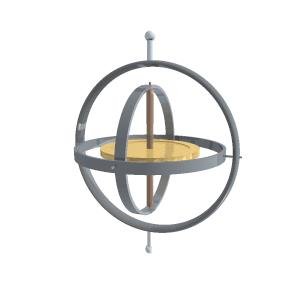
Example: A spinning gyroscope maintains its angular momentum due to minimal friction.
Applications: Figure Skating and Rotational Inertia
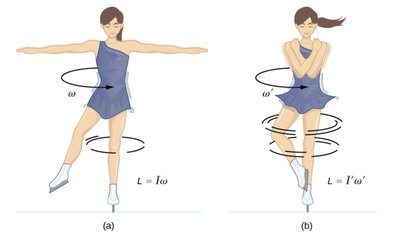
Figure skaters use the conservation of angular momentum to control their spin speed by changing their moment of inertia.
Equation:
Decreasing I: Pulling arms in reduces , increasing (spin rate).
Increasing I: Extending arms increases , decreasing .
Example: Performing a triple axel involves creating a large angular momentum, minimizing in the air, and extending the body upon landing.
Example Problem: Colliding Rotating Disks
When two rotating disks stick together, their combined angular momentum is conserved.
Given: Disk 1: , (clockwise); Disk 2: , (counterclockwise)
Total Angular Momentum:
Total Inertia:
Final Angular Velocity: (counterclockwise)
Precession and Gyroscopic Motion
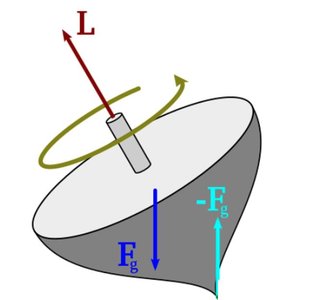
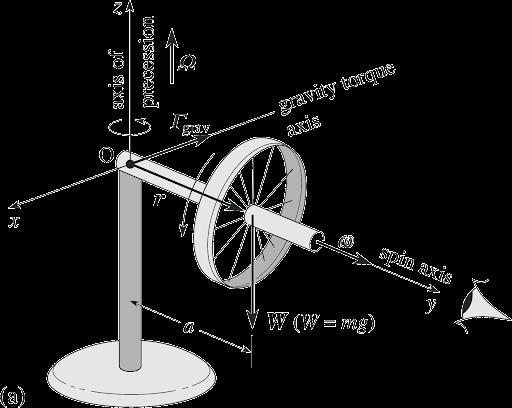
Precession is the slow change in the orientation of the rotational axis of a spinning object, caused by an external torque.
Precession: The axis of a spinning object (like a top or gyroscope) traces out a cone due to torque, often from gravity.
Gyroscopic Motion: The direction of angular momentum changes in response to applied torque:
Physical Example: A spinning top precesses due to the torque from gravity acting at a distance from the pivot point.
Applications in Modern Technology: NMR and MRI
Angular momentum and precession are fundamental to technologies like Nuclear Magnetic Resonance (NMR) and Magnetic Resonance Imaging (MRI).
NMR: Exploits the precession of nuclear spins in a magnetic field to analyze molecular structure.
MRI: Uses the same principles to image soft tissues in the human body.
Key Principle: The angular momentum of protons or nuclei precesses in an external magnetic field, and transitions between energy states can be detected.


Summary Table: Key Rotational Quantities
Quantity | Symbol | Equation | Units |
|---|---|---|---|
Torque | Nm | ||
Moment of Inertia | kg·m2 | ||
Angular Momentum | kg·m2/s | ||
Angular Velocity | rad/s |
Additional info: The notes above expand on the provided lecture content with definitions, equations, and examples for clarity and completeness, following the structure of a modern physics textbook.
