 Back
BackConservation of Energy and Work: Physics Study Guide
Study Guide - Smart Notes
 Tailored notes based on your materials, expanded with key definitions, examples, and context.
Conservation Laws in Physics
Noether's Theorem and Fundamental Conservation Laws
At the foundation of physics are conservation laws, which state that certain quantities remain constant in isolated systems. Noether's Theorem connects symmetries in nature to conservation laws:
Time symmetry → Conservation of Energy
Translational symmetry → Conservation of Momentum
Rotational symmetry → Conservation of Angular Momentum
These principles are essential for understanding physical systems and their behavior.
Energy: Forms and Conservation
Law of Conservation of Energy
The law of conservation of energy states that in a closed system, energy can change forms but cannot be created or destroyed. This is one of the most fundamental laws in physics.
Energy may transform between kinetic, potential, thermal, chemical, electromagnetic, and other forms.
All forms of energy have the same physical dimension: .
The SI unit for energy is the joule (J), equivalent to or .
Main Forms of Energy
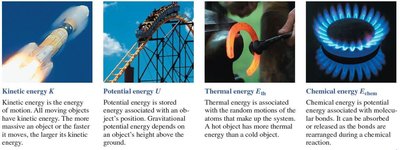
Kinetic Energy (K): Energy of motion, given by .
Potential Energy (U): Energy stored due to position, such as gravitational () or elastic ().
Thermal Energy (E_{th}): Associated with random motion of atoms and molecules.
Chemical Energy (E_{chem}): Stored in chemical bonds, released or absorbed during reactions.
Electromagnetic Energy: Related to electric and magnetic fields.
Rest Energy: (from relativity).
Heat (Q): Energy transferred due to temperature difference.
Energy Transfers and Transformations
Energy can be transferred or transformed between different forms. Examples include:
Chemical energy (ATP hydrolysis) to kinetic energy in biological systems.
Work done on a sling transforms to elastic potential energy, then to kinetic energy when released.
Gravitational potential energy converts to kinetic energy as an object falls.

Work: Definition and Calculation
Work Done by a Constant Force
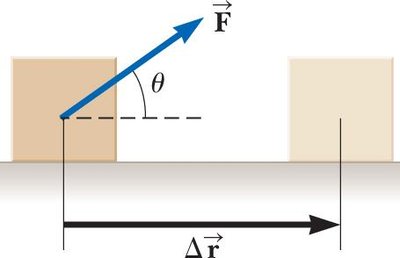
Work is the process of energy transfer by a force acting over a distance. For a constant force:
Work is defined as .
Work is a scalar quantity (has magnitude, not direction).
Unit of work is the joule (J), same as energy.
Work Done by a Varying Force
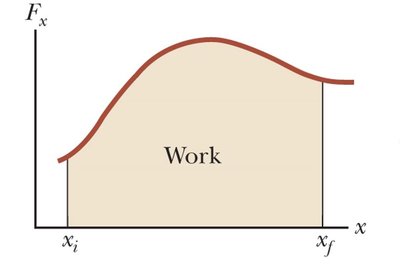
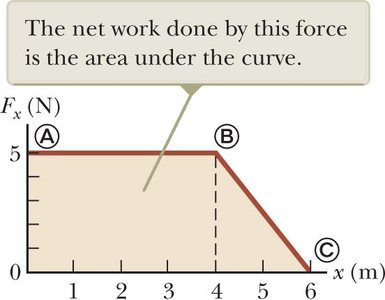
If the force varies with position, work is calculated using integration:
The total work is the area under the force vs. displacement curve.
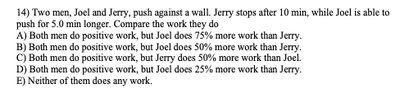
Work Examples and Conceptual Questions
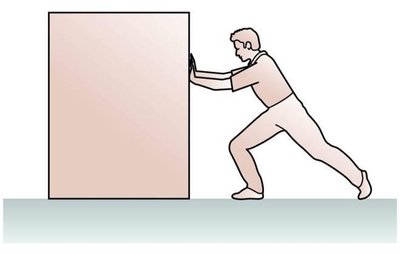
When a force is applied in the direction of displacement, work is positive.
When a force opposes displacement (e.g., friction), work is negative.
If there is no displacement, no work is done.
Work and Force Direction
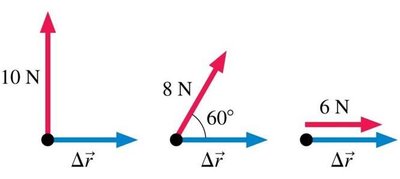
The amount of work depends on the angle between force and displacement:
Maximum work occurs when force is parallel to displacement ().
No work is done if force is perpendicular to displacement ().
Kinetic and Potential Energy
Kinetic Energy
Kinetic energy is the energy of motion:
Depends on mass and velocity.
Example: A 1 kg object moving at 4.4 m/s has J.
Potential Energy
Potential energy is stored energy due to position:
Gravitational potential energy:
Elastic potential energy:
Example: A 1 kg object at 1 m height has J.
Energy Transformations in Motion
Energy can transform between kinetic and potential forms:
As an object falls, .
At the highest point of a swing, all energy is potential; at the lowest, all is kinetic.
Conceptual Questions and Applications
Energy Transformation Scenarios
Ball A has half the mass and eight times the kinetic energy of ball B. The speed ratio is 4.
A child on a swing: as the swing moves down.
A skier gliding at constant speed: (potential energy transforms to thermal energy due to friction).
Summary Table: Forms of Energy
Form of Energy | Definition | Formula |
|---|---|---|
Kinetic Energy | Energy of motion | |
Potential Energy | Energy due to position | |
Elastic Potential Energy | Energy stored in a spring | |
Thermal Energy | Random motion of particles | N/A |
Chemical Energy | Energy in chemical bonds | N/A |
Electromagnetic Energy | Energy in fields | or |
Rest Energy | Energy due to mass |
Key Equations
Work:
Work (variable force):
Kinetic Energy:
Potential Energy:
Energy Conservation:
Summary
Understanding conservation laws, energy forms, and work is fundamental to physics. These principles allow us to analyze and predict the behavior of physical systems, from simple objects in motion to complex energy transformations in nature.
