 Back
BackConservation of Energy in Simple Harmonic Motion and Introduction to Waves
Study Guide - Smart Notes
 Tailored notes based on your materials, expanded with key definitions, examples, and context.
Conservation of Energy in Simple Harmonic Motion
Elastic Potential Energy in a Spring
When a mass is attached to a spring, the system can store energy in the form of elastic potential energy. The potential energy stored in a spring compressed or stretched by a distance x from equilibrium is given by:
Formula:
k: Spring constant (N/m)
x: Displacement from equilibrium (m)
Energy Transformations in a Mass-Spring System
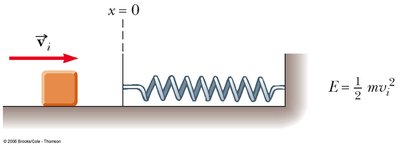
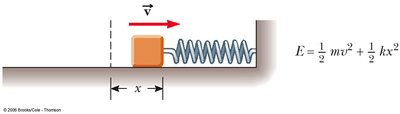
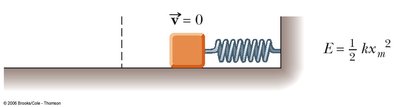
As a block moves toward a spring, its energy transforms between kinetic and potential forms, but the total mechanical energy remains constant (assuming no friction).
Initial State: All energy is kinetic as the block moves with velocity toward the spring.
Intermediate State: The block compresses the spring by distance and slows down. Energy is shared between kinetic and elastic potential energy.
Maximum Compression: The block stops momentarily at maximum compression ; all energy is stored as elastic potential energy.
Conservation of Energy Equation:
Energy Diagrams and Turning Points
The potential energy curve for a spring is a U-shaped parabola. At the turning points (), all energy is potential; at equilibrium (), all energy is kinetic.
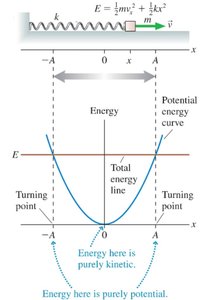
Turning Points: Maximum displacement, zero velocity, maximum potential energy.
Equilibrium: Zero displacement, maximum velocity, maximum kinetic energy.
Simple Harmonic Motion: Equations and Parameters
Equations of Motion
The position, velocity, and acceleration of a mass on a spring in simple harmonic motion (SHM) are described by sinusoidal functions:
Position:
Velocity:
Acceleration:
Angular Frequency:
Where:
A: Amplitude (maximum displacement)
T: Period (time for one complete oscillation)
\phi: Phase constant (determined by initial conditions)
Period of Oscillation
Mass-Spring System:
Pendulum:
Frequency:
Note: The period of a mass-spring system depends only on the mass and spring constant, not on gravity. The period of a pendulum depends on the length and the local gravitational acceleration.
Waves: Types and Properties
Nature of Waves
A wave is a disturbance that travels through a medium (solid, liquid, or gas), transferring energy without transferring matter. The frequency of a wave is the number of vibrations per second.
Types of Waves
Transverse Waves: The displacement of the medium is perpendicular to the direction of wave travel.
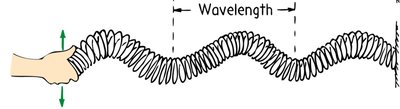
Longitudinal Waves: The displacement of the medium is parallel to the direction of wave travel.
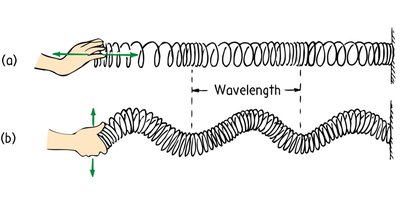
Comparison:
Type | Direction of Displacement | Example |
|---|---|---|
Transverse | Perpendicular to wave direction | Waves on a string |
Longitudinal | Parallel to wave direction | Sound waves |
Wave Properties
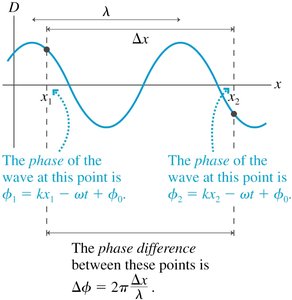
Wavelength (\(\lambda\)): The distance between two consecutive points in phase (e.g., crest to crest).
Frequency (f): Number of cycles per second (Hz).
Period (T): Time for one cycle ().
Wave Speed (v):
General Form of a Traveling Wave
The displacement of a point on a string as a function of position and time is given by:
Amplitude (A): Maximum displacement
Wave number (k):
Angular frequency (\(\omega\)):
Phase constant (\(\phi\)): Sets the initial phase at ,
Direction: The sign in the argument determines the direction of travel (− for +x, + for −x)
Wave Graphs
Snapshot Graph: Displacement as a function of position at a fixed time (shows the shape of the wave at an instant).
History Graph: Displacement as a function of time at a fixed position (shows how a point in the medium moves over time).
Phase and Phase Difference
The phase of a wave at a point describes its position within the cycle. The phase difference between two points separated by is:
Wave Speed on a String
The speed of a wave on a stretched string depends on the tension () and the mass per unit length ():
: Tension in the string (N)
: Mass per unit length (kg/m)
Summary Table: Key Equations
Quantity | Equation | Description |
|---|---|---|
Spring Force | Hooke's Law | |
Elastic Potential Energy | Energy stored in a spring | |
Kinetic Energy | Energy of motion | |
Total Mechanical Energy | Conserved in SHM | |
Period (Spring) | Oscillation period for mass-spring | |
Period (Pendulum) | Oscillation period for pendulum | |
Wave Speed | Speed of a wave | |
Wave on String | Speed on a stretched string | |
Wave Function | General wave equation |
Additional info: The notes above integrate and expand upon the provided lecture slides, including definitions, equations, and academic context for simple harmonic motion and wave phenomena, as relevant to a college-level physics course.
