 Back
BackConservation of Energy: Work, Kinetic Energy, Potential Energy, and Friction
Study Guide - Smart Notes
 Tailored notes based on your materials, expanded with key definitions, examples, and context.
Conservation of Energy
Work
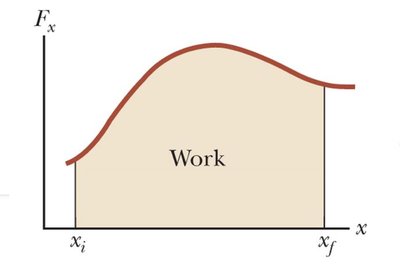
The concept of work in physics quantifies the energy transferred to or from an object via the application of force along a displacement. Work is a scalar quantity and is defined mathematically as:
Constant Force:
Variable Force:
Work as Area Under Curve: The area under a force vs. displacement graph represents the work done by the force.
Example: If a force acts in the direction of motion over a distance, the work done is the product of force and distance.
Kinetic Energy
Kinetic energy is the energy an object possesses due to its motion. It is given by:
When an object is dropped or thrown, its kinetic energy increases as it accelerates downward.
Example: Two objects of different masses dropped from the same height will have different kinetic energies when they hit the ground, but the same velocity if air resistance is neglected.
Potential Energy
Gravitational potential energy is the energy stored due to an object's position in a gravitational field. It depends only on the change in vertical height:
For an object at height h, the gravitational force can do work equal to .
Example: When an object falls, its potential energy is converted to kinetic energy.
Thermal Energy Due to Friction
Friction converts mechanical energy into thermal energy. The work done by friction is always negative, but the thermal energy generated is positive:
Friction opposes motion and reduces the mechanical energy of the system.
Conservation of Energy Principle
The conservation of energy states that the total energy in an isolated system remains constant. Energy can be transformed between kinetic, potential, and thermal forms, but the total remains unchanged:
In isolated systems, is constant.
In non-isolated systems, energy may be transferred to or from the environment.
Applications and Examples
Projectile Motion and Energy Conservation
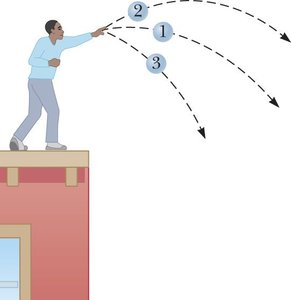
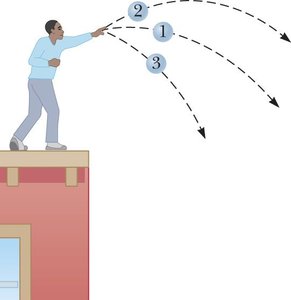
When multiple objects are thrown from the same height with the same initial speed, their speeds upon hitting the ground are equal, regardless of the direction of throw (neglecting air resistance). This is due to conservation of energy:
Initial energy:
Final energy:
Solving:
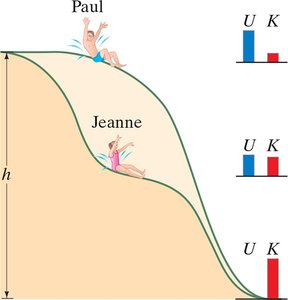
Energy in Water Slides
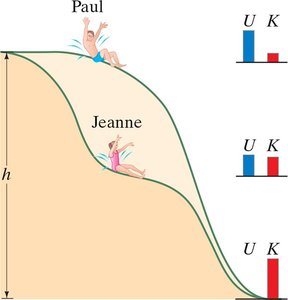
Two riders start from the same height on slides of different shapes. Ignoring friction, both have the same speed at the bottom due to conservation of energy, but the time to reach the bottom may differ:
Initial energy:
Final energy:
Speed at bottom:
Time depends on slide shape and path length.
Isolated vs. Non-Isolated Systems
Energy conservation depends on the definition of the system:
Isolated system: No energy transfer with the environment; total energy remains constant.
Non-isolated system: Energy can be transferred to/from the environment.
Example: A block sliding on a surface with friction is non-isolated if only the block is considered, but isolated if the block and surface are both included.
Friction and Energy Transfer: Penguin Example
Consider a penguin sliding on ice:
Initial kinetic energy:
Work done by friction:
Final energy: (penguin stops)
Distance to stop:
When the system is just the penguin, friction removes energy. When the system is penguin plus ice, friction converts kinetic energy to thermal energy within the system.
Table: Energy Accounting for Penguin Sliding
System | Initial Energy | Work by Friction | Final Energy | Interpretation |
|---|---|---|---|---|
Penguin | 0 | Energy lost to environment | ||
Penguin + Ice | 0 | (thermal) | Energy converted within system |
Key Points and Formulas
Work:
Kinetic Energy:
Potential Energy:
Thermal Energy:
Conservation of Energy:
Additional info:
All equations are valid for idealized cases (neglecting air resistance unless otherwise stated).
For friction, the direction of force and displacement is important; negative work means energy is removed from the system.
In problems involving energy, always define the system clearly to account for energy transfers.
