 Back
BackConservation of Linear Momentum and Introduction to Rotational Motion
Study Guide - Smart Notes
 Tailored notes based on your materials, expanded with key definitions, examples, and context.
Conservation of Linear Momentum
Principle of Conservation of Momentum
The conservation of linear momentum states that the total momentum of a closed system remains constant if no external forces act on it. This principle is fundamental in analyzing collisions and interactions between objects.
Momentum is defined as , where is mass and is velocity.
For a two-object system, conservation in both x and y directions is expressed as:
$$ \begin{align*} & p_{1i,x}+p_{2i,x}=p_{1f,x}+p_{2f,x}\\ & p_{1i,y}+p_{2i,y}=p_{1f,y}+p_{2f,y}\end{align*} $$
These equations are used to solve for unknown velocities after a collision.
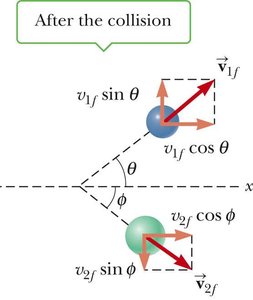
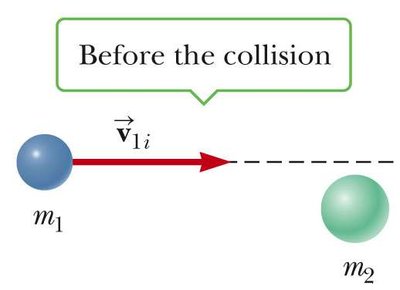
Example: Two-Ball Collision
Suppose a green ball (mass ) is initially at rest, and a blue ball () moves at . After the collision, at .
Apply conservation of momentum in both x and y directions to solve for the final velocity of the green ball.
Ballistic Pendulum
Principle and Analysis
A ballistic pendulum is a device used to measure the speed of a projectile. A bullet of mass and speed embeds in a block of mass , and the combined system swings upward.
During the collision: momentum is conserved (since the collision is very brief and external forces are negligible).
After the collision: mechanical energy is conserved as the block-bullet system rises.
Find the height the block rises using energy conservation after the collision.
Center of Mass
Definition and Properties
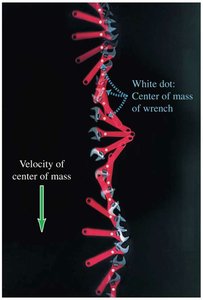
The center of mass is a hypothetical point where the entire mass of a system can be considered to be concentrated for analyzing translational motion.
If a force is applied at the center of mass, the system moves in the direction of the force without rotating.
For a system of particles:
For a continuous mass distribution:
Symmetrical Objects
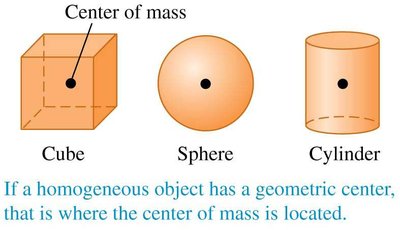
For homogeneous objects with geometric symmetry (cube, sphere, cylinder), the center of mass is located at the geometric center.
Motion of the Center of Mass
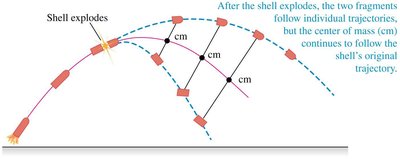
The velocity of the center of mass for a system of particles is given by:
The total momentum of the system is , which remains constant if no external forces act.
Rotational Motion
Angular Position and Displacement
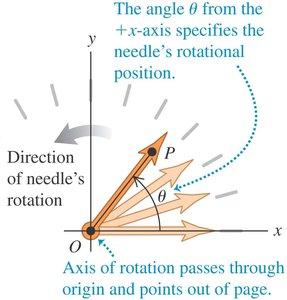
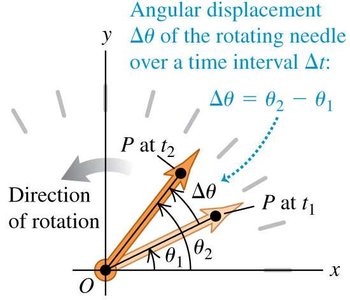
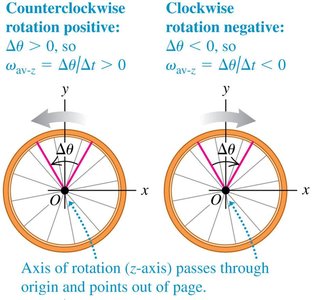
The angular position of a rotating object is the counterclockwise angle (in radians) from the positive x-axis. The angular displacement is the change in angular position over a time interval.
Angular Velocity
The average angular velocity and instantaneous angular velocity are defined as:
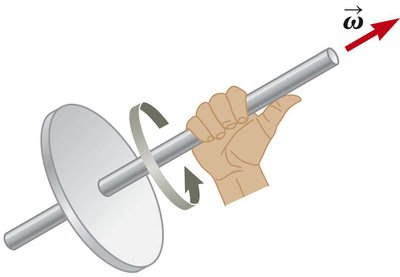
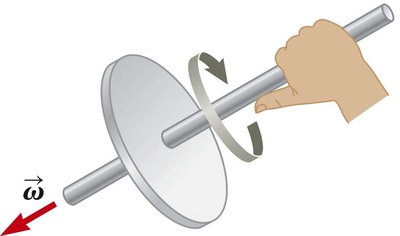
The direction of is along the axis of rotation, determined by the right-hand rule.
Units: radians per second (rad/s) or s-1 (since radians are dimensionless).
Counterclockwise rotation: ; Clockwise rotation: .
Angular Acceleration
The average angular acceleration and instantaneous angular acceleration are defined as:
The direction of is along the axis of rotation.
If and are in the same direction, the object speeds up; if opposite, it slows down.
Units: radians per second squared (rad/s2) or s-2.
